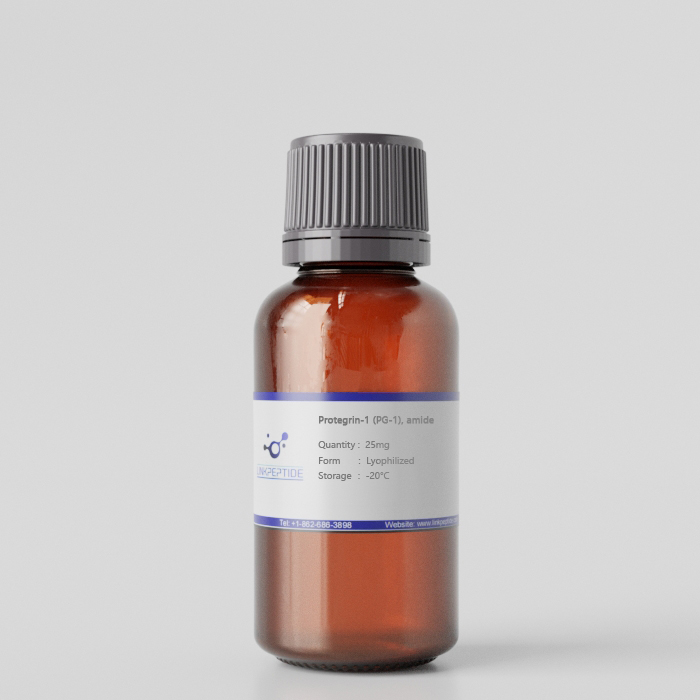
Product Name: Protegrin-1 (PG-1), amide
Sequence One Letter Code: RGGRLCYCRRRFCVCVGR-NH2 (disulfide bridge:6-15 and 8-13)
Sequence Three Letter Code: H-Arg-Gly-Gly-Arg-Leu-Cys-Tyr-Cys-Arg-Arg-Arg-Phe-Cys-Val-Cys-Val-Gly-Arg-NH2 (disulfide bridge:6-15 and 8-13)
Chemical Formula:C88H147N37O19S4
Molecular Weight: 2155.7
Purity: 95%
Form: Lyophilized
Storage Conditions: - 20 °C
Research Area: Infection Disease Research
Source / Species: porcine
Conjugation: Unconjugated
Code Nacres: NA.26
Application: Protegrin-1 is an 18-amino-acid antimicrobial peptide belonging to the cathelicidin family, originally isolated from porcine leukocytes. It adopts a β-hairpin structure stabilized by two intramolecular disulfide bonds, which are essential for its biological activity. Protegrin-1 exhibits potent broad-spectrum antimicrobial activity against Gram-positive and Gram-negative bacteria, fungi such as Candida albicans, and certain enveloped viruses. Notably, its activity is retained under physiological salt conditions, making it a robust model for host defense studies. This peptide is widely used in antimicrobial research to investigate membrane disruption mechanisms, peptide–membrane interactions, and the development of novel anti-infective therapeutics.
Current Research: Protegrin-1 is an 18-amino-acid antimicrobial peptide (AMP) belonging to the cathelicidin family, originally isolated from porcine leukocytes. It is a key component of the innate immune system and is notable for its exceptional potency and structural stability. Due to its well-defined mechanism of action and strong activity under physiological conditions, Protegrin-1 is widely used as a model in studies of antimicrobial peptides, membrane biology, and anti-infective drug development. Structural Features and β-Hairpin Conformation Protegrin-1 adopts a distinctive β-hairpin structure, which is stabilized by two intramolecular disulfide bonds. This compact and rigid conformation is critical for its biological activity. Key structural characteristics include: Cysteine-stabilized β-sheet fold Amphipathic organization, with distinct hydrophobic and cationic regions High structural stability, even under challenging conditions The disulfide bonds play a crucial role in maintaining the peptide’s conformation and resistance to degradation, directly contributing to its antimicrobial efficacy. Mechanism of Antimicrobial Action Protegrin-1 exerts its antimicrobial effects primarily through direct interaction with microbial membranes. Its mechanism involves: Electrostatic attraction to negatively charged microbial membranes Insertion into lipid bilayers Formation of pores or membrane disruptions Rapid leakage of intracellular contents leading to cell death This membrane-targeting mode of action is non-specific and rapid, allowing Protegrin-1 to kill a wide range of pathogens while reducing the likelihood of resistance development. Broad-Spectrum Antimicrobial Activity Protegrin-1 exhibits potent activity against a diverse array of microorganisms, including: Gram-positive bacteria Gram-negative bacteria Fungi, such as Candida albicans Certain enveloped viruses Importantly, unlike many antimicrobial peptides, Protegrin-1 retains its activity under physiological salt concentrations, making it especially relevant for studying antimicrobial function in biologically realistic environments. Applications in Antimicrobial and Membrane Research Protegrin-1 is extensively used in research focused on host defense peptides and membrane-active mechanisms. Its strong and reproducible activity makes it a benchmark peptide in this field. Common applications include: Studies of peptide–membrane interactions and lipid bilayer disruption Investigation of pore formation mechanisms Biophysical analysis of peptide structure and stability Evaluation of antimicrobial activity under physiological conditions Screening and design of synthetic AMP analogues These applications are critical for understanding how antimicrobial peptides function at the molecular level. Role in Anti-Infective Therapeutic Development Due to its potency and stability, Protegrin-1 has served as a template for the development of novel antimicrobial agents. Researchers use it to: Design optimized peptides with improved selectivity and reduced toxicity Explore strategies to combat antibiotic-resistant pathogens Develop peptide-based therapeutics for clinical applications Its ability to function effectively in physiological environments enhances its relevance for translational research. Advantages as a Model Antimicrobial Peptide Protegrin-1 offers several advantages for experimental use: Defined and stable β-hairpin structure High antimicrobial potency across multiple pathogen classes Retention of activity in physiological salt conditions Clear and well-characterized mechanism of action These features make it an ideal model for studying structure–function relationships in antimicrobial peptides. A Robust Tool for Studying Innate Immunity and Membrane Disruption Protegrin-1 is a foundational peptide in the field of antimicrobial research, providing valuable insights into innate immune defense mechanisms and membrane-targeting strategies. Its unique structural properties and strong biological activity make it indispensable for investigating peptide–membrane interactions, antimicrobial efficacy, and the development of next-generation anti-infective therapies. Through continued study, Protegrin-1 contributes to advancing our understanding of host–pathogen interactions and innovative approaches to combating infectious diseases.
Get a Quote
 LinkPeptide