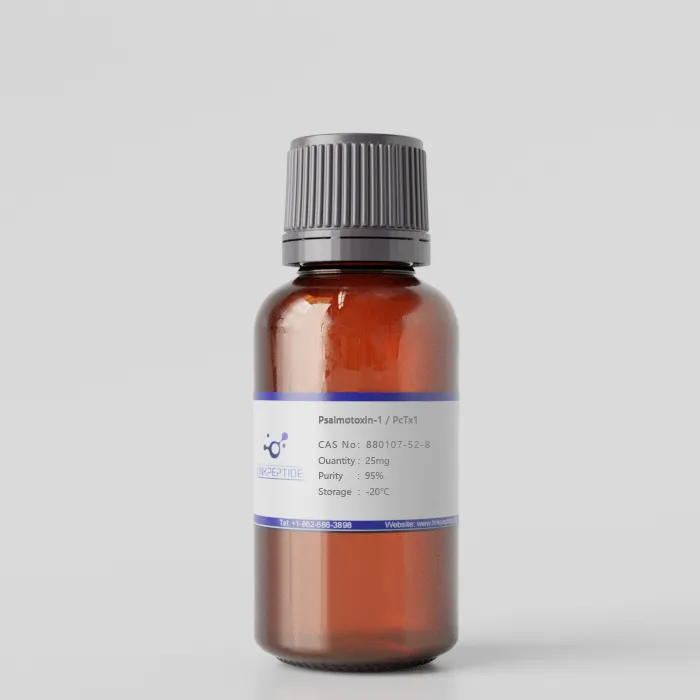
Product Name:Psalmotoxin-1 / PcTx1
Synonyms:PcTx1; Psalmopoeus cambridgei toxin-1
CAS No:880107-52-8
Purity:95%
Molar Mass:4689.39
Chemical Formula:C200H312N62O57S6
Storage:Store at -20 degrees Celsius
Sequence:EDCIPKWKGCVNRHGDCCEGLECWKRRRSFEVCVPKTPKT
Target:ASIC1a channels
Application:Psalmotoxin-1 (PcTx1), a peptide toxin derived from the tarantula Psalmopoeus cambridgei, is a selective inhibitor of the acid-sensing ion channel 1a (ASIC1a). ASIC1a plays a critical role in pain perception, neuronal damage, and conditions associated with acidic environments, such as ischemia. PcTx1 binds to ASIC1a and blocks ion flow, preventing excessive neuronal excitation and protecting against acid-induced damage. This toxin is extensively used in research to study the function of ASIC1a in neurological disorders and explore potential therapeutic applications for conditions like chronic pain, stroke, and neurodegenerative diseases. PcTx1 is a powerful tool for investigating ASIC-related pathologies.
Current Research:
Psalmotoxin-1 (PcTx1) is a peptide toxin isolated from the venom of the Trinidad chevron tarantula (Psalmopoeus cambridgei). It functions as a potent and selective inhibitor of acid-sensing ion channel 1a (ASIC1a), a proton-gated sodium channel implicated in various physiological and pathological processes. Structural Characteristics PcTx1 is a 40-amino-acid peptide that adopts an inhibitor cystine knot (ICK) motif, stabilized by three disulfide bonds. This structure is crucial for its high affinity and specificity toward ASIC1a. Mechanism of Action PcTx1 binds to the extracellular domain of ASIC1a at subunit-subunit interfaces, increasing the channel's apparent affinity for protons. This interaction stabilizes the closed state of the channel, effectively inhibiting proton-induced activation. The inhibition is highly potent, with an IC50 of approximately 0.9 nM. Pharmacological Effects By inhibiting ASIC1a, PcTx1 can modulate neuronal excitability and has been shown to induce cell apoptosis. Additionally, it inhibits cell migration, proliferation, and invasion in certain cancer cell lines, suggesting potential therapeutic applications. Research Applications Due to its specificity and potency, PcTx1 serves as a valuable tool in neuropharmacological research: Receptor Characterization: It aids in elucidating the structural and functional dynamics of ASIC1a, enhancing our understanding of its role in physiological and pathological conditions. Drug Development: Insights into its interaction with ASIC1a contribute to the design of novel therapeutics for conditions such as pain, ischemia, and cancer. Handling and Storage PcTx1 is typically supplied as a lyophilized powder. For optimal stability, it should be stored at -20 degrees Celsius, protected from light and moisture. Upon reconstitution, aliquots should be prepared to avoid repeated freeze-thaw cycles, which can degrade the peptide. Conclusion Psalmotoxin-1 is a potent and selective inhibitor of ASIC1a, offering significant insights into ion channel physiology and potential therapeutic avenues for related disorders. Its applications extend from fundamental research to the development of novel pharmacological agents.
Reference:
Get a Quote
 LinkPeptide

![[Nphe1]Nociceptin(1-13)NH2](https://www.linkpeptide.com/wp-content/uploads/2024/10/Nphe1Nociceptin1-13NH2-jpg-3.webp "[Nphe1]Nociceptin(1-13)NH2")
![SCYLLATOXIN [Tyr2]-](https://www.linkpeptide.com/wp-content/uploads/2024/10/SCYLLATOXIN-Tyr2-jpg-2.webp "SCYLLATOXIN [Tyr2]-")