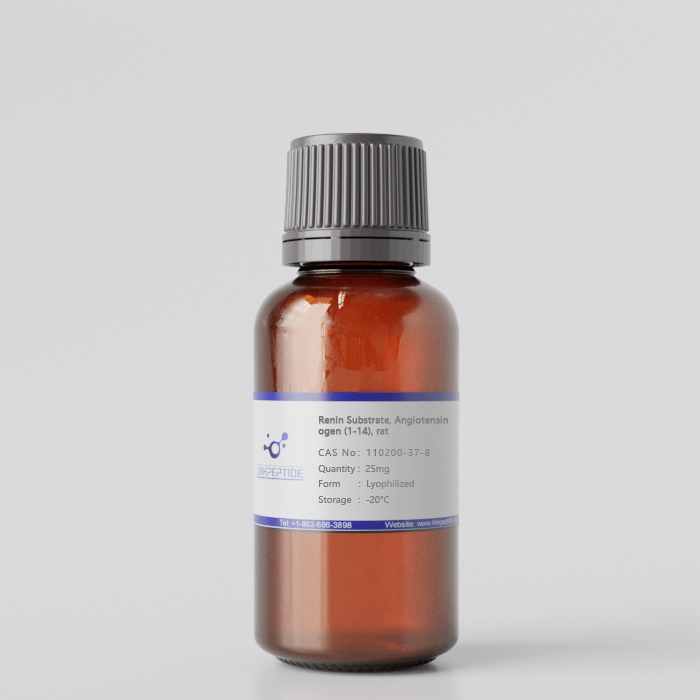
Product Name: Renin Substrate, Angiotensinogen (1-14), rat
Sequence One Letter Code: DRVYIHPFHLLYYS
Sequence Three Letter Code: H-Asp-Arg-Val-Tyr-Ile-His-Pro-Phe-His-Leu-Leu-Tyr-Tyr-Ser-OH
Cas No: 110200-37-8
Chemical Formula:C89H123N21O21
Molecular Weight: 1823.2
Purity: 95%
Form: Lyophilized
Storage Conditions: - 20 °C
Research Area: peptide substrate
SMILES: CC[C@H](C)[C@@H](C(=O)N[C@@H](CC1=CNC=N1)C(=O)N2CCC[C@H]2C(=O)N[C@@H](CC3=CC=CC=C3)C(=O)N[C@@H](CC4=CNC=N4)C(=O)N[C@@H](CC(C)C)C(=O)N[C@@H](CC(C)C)C(=O)N[C@@H](CC5=CC=C(C=C5)O)C(=O)N[C@@H](CC6=CC=C(C=C6)O)C(=O)N[C@@H](CO)C(=O)O)NC(=O)[C@H](CC7=CC=C(C=C7)O)NC(=O)[C@H](C(C)C)NC(=O)[C@H](CCCNC(=N)N)NC(=O)[C@H](CC(=O)O)N
IUPAC: (3S)-3-amino-4-[[(2S)-5-carbamimidamido-1-[[(2S)-1-[[(2S)-1-[[(2S,3S)-1-[[(2S)-1-[(2S)-2-[[(2S)-1-[[(2S)-1-[[(2S)-1-[[(2S)-1-[[(2S)-1-[[(2S)-1-[[(1S)-1-carboxy-2-hydroxyethyl]amino]-3-(4-hydroxyphenyl)-1-oxopropan-2-yl]amino]-3-(4-hydroxyphenyl)-1-oxopropan-2-yl]amino]-4-methyl-1-oxopentan-2-yl]amino]-4-methyl-1-oxopentan-2-yl]amino]-3-(1H-imidazol-4-yl)-1-oxopropan-2-yl]amino]-1-oxo-3-phenylpropan-2-yl]carbamoyl]pyrrolidin-1-yl]-3-(1H-imidazol-4-yl)-1-oxopropan-2-yl]amino]-3-methyl-1-oxopentan-2-yl]amino]-3-(4-hydroxyphenyl)-1-oxopropan-2-yl]amino]-3-methyl-1-oxobutan-2-yl]amino]-1-oxopentan-2-yl]amino]-4-oxobutanoic acid
INCHIKEY: FFCYBSGRCYFCNM-YXRWNMRVSA-N
INCHI:
InChI=1S/C89H123N21O21/c1-9-50(8)74(109-83(125)67(38-54-23-29-59(114)30-24-54)105-85(127)73(49(6)7)108-76(118)61(17-13-31-95-89(91)92)98-75(117)60(90)41-72(115)116)86(128)106-69(40-56-43-94-46-97-56)87(129)110-32-14-18-71(110)84(126)104-66(35-51-15-11-10-12-16-51)80(122)103-68(39-55-42-93-45-96-55)82(124)100-62(33-47(2)3)77(119)99-63(34-48(4)5)78(120)101-64(36-52-19-25-57(112)26-20-52)79(121)102-65(37-53-21-27-58(113)28-22-53)81(123)107-70(44-111)88(130)131/h10-12,15-16,19-30,42-43,45-50,60-71,73-74,111-114H,9,13-14,17-18,31-41,44,90H2,1-8H3,(H,93,96)(H,94,97)(H,98,117)(H,99,119)(H,100,124)(H,101,120)(H,102,121)(H,103,122)(H,104,126)(H,105,127)(H,106,128)(H,107,123)(H,108,118)(H,109,125)(H,115,116)(H,130,131)(H4,91,92,95)/t50-,60-,61-,62-,63-,64-,65-,66-,67-,68-,69-,70-,71-,73-,74-/m0/s1
Source / Species: rat
Conjugation: Unconjugated
Code Nacres: NA.26
Application: Renin Substrate, Angiotensinogen (1–14), rat is a synthetic peptide derived from the N-terminal region of rat angiotensinogen. It serves as a substrate for renin, a key enzyme in the renin–angiotensin system that regulates blood pressure and fluid balance. This peptide is widely used in enzymatic assays to measure renin activity and to characterize renin inhibitors. It supports cardiovascular, renal, and endocrine research focused on hypertension and regulation of systemic hemodynamics.
Current Research: The renin–angiotensin system (RAS) is a central regulator of blood pressure, fluid balance, and systemic vascular resistance. Renin, an aspartyl protease secreted by juxtaglomerular cells of the kidney, catalyzes the rate-limiting step in this pathway by cleaving angiotensinogen to generate angiotensin I. This decapeptide is subsequently converted by angiotensin-converting enzyme (ACE) into angiotensin II, a potent vasoconstrictor that stimulates aldosterone release and promotes sodium retention. Renin Substrate, Angiotensinogen (1–14), rat is a synthetic peptide corresponding to the N-terminal 14 residues of rat angiotensinogen and contains the renin cleavage site. It is widely used in biochemical assays to measure renin catalytic activity and evaluate inhibitor potency. The N-terminal region of angiotensinogen encompasses the specific sequence recognized and cleaved by renin between Leu10 and Val11 (rat sequence context). The synthetic 1–14 fragment preserves the essential residues required for substrate recognition, enabling controlled and reproducible enzymatic analysis in vitro. Compared with full-length angiotensinogen, the peptide substrate reduces structural complexity and eliminates potential confounding interactions from distal protein domains. In enzymatic assays, recombinant or purified renin is incubated with the angiotensinogen (1–14) substrate under defined conditions. Cleavage generates angiotensin I (1–10), which can be quantified by high-performance liquid chromatography (HPLC), mass spectrometry, ELISA-based detection, or fluorescence-coupled secondary assays. This approach allows determination of kinetic parameters such as Km and Vmax, providing insight into catalytic efficiency and substrate affinity. The peptide substrate is particularly valuable in drug discovery and pharmacological research targeting renin. Direct renin inhibitors (DRIs) are developed to block the initial step of the RAS cascade, thereby reducing downstream production of angiotensin II. Using Angiotensinogen (1–14), rat in competitive inhibition assays enables calculation of IC50 and Ki values for candidate compounds. Because the assay directly measures enzymatic cleavage, it provides mechanistic validation of inhibitor efficacy. Species specificity is an important consideration in renin research. Renin exhibits marked substrate preference differences among species, and rat renin preferentially cleaves rat angiotensinogen sequences. The use of the rat-derived (1–14) peptide ensures compatibility with experimental models involving rat renin, which is particularly relevant in preclinical cardiovascular and renal studies. Beyond inhibitor screening, the peptide supports investigations into regulatory mechanisms affecting renin activity. Factors such as pH, ionic strength, and cofactor presence can influence catalytic performance. By using a defined synthetic substrate, researchers can systematically examine how physiological or pathological conditions alter renin function. This is especially relevant in studies of hypertension, heart failure, and chronic kidney disease, where dysregulation of the RAS contributes to disease progression. In endocrine and renal physiology research, renin activity assays employing the angiotensinogen (1–14) substrate help quantify renin release or activity under experimental manipulation. Such assays are used to evaluate how pharmacological agents, dietary salt intake, or genetic modifications affect RAS dynamics. In summary, Renin Substrate, Angiotensinogen (1–14), rat is a synthetic N-terminal peptide containing the renin cleavage site and serves as a defined substrate for enzymatic assays. Its application enables quantitative analysis of renin kinetics, inhibitor characterization, and mechanistic studies of the renin–angiotensin system. As a core reagent in cardiovascular and renal research, it supports investigations into hypertension and systemic hemodynamic regulation.
Get a Quote
 LinkPeptide