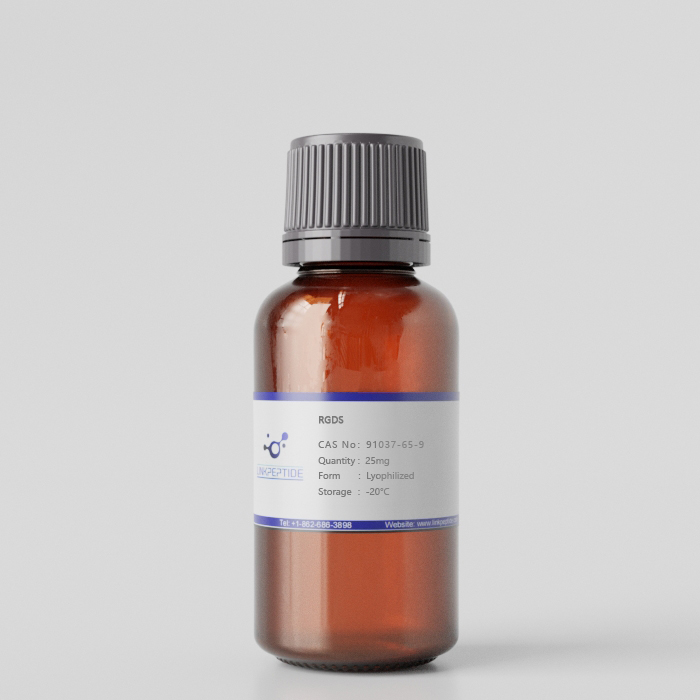
Product Name: RGDS
Sequence One Letter Code: RGDS
Sequence Three Letter Code: H-Arg-Gly-Asp-Ser-OH
Cas No: 91037-65-9
Chemical Formula:C15H27N7O8
Molecular Weight: 433.4 Purity: 95% Form: Lyophilized
Storage Conditions: - 20 °C
Research Area: cell-adhesive peptide
SMILES: C(C[C@@H](C(=O)NCC(=O)N[C@@H](CC(=O)O)C(=O)N[C@@H](CO)C(=O)O)N)CN=C(N)N
IUPAC: (3S)-3-[[2-[[(2S)-2-amino-5-(diaminomethylideneamino)pentanoyl]amino]acetyl]amino]-4-[[(1S)-1-carboxy-2-hydroxyethyl]amino]-4-oxobutanoic acid
INCHIKEY: NNRFRJQMBSBXGO-CIUDSAMLSA-N
INCHI:
InChI=1S/C15H27N7O8/c16-7(2-1-3-19-15(17)18)12(27)20-5-10(24)21-8(4-11(25)26)13(28)22-9(6-23)14(29)30/h7-9,23H,1-6,16H2,(H,20,27)(H,21,24)(H,22,28)(H,25,26)(H,29,30)(H4,17,18,19)/t7-,8-,9-/m0/s1
Source / Species: synthetic
Conjugation: Unconjugated
Code Nacres: NA.26
Application: RGDS (Arg-Gly-Asp-Ser) is a synthetic peptide that mimics the integrin-binding motif present in several extracellular matrix proteins, including fibronectin, vitronectin, and laminin. This short sequence is widely used as a cell adhesion factor to study integrin-mediated interactions between cells and the extracellular matrix. By engaging integrin receptors, RGDS can modulate cell attachment, migration, and signaling pathways involved in tissue organization and wound healing. In addition to its adhesion-related effects, RGDS has been reported to activate caspases 8 and 9, suggesting a potential role in apoptosis-related signaling. The peptide is therefore useful for investigating integrin signaling, cell survival pathways, and adhesion-dependent cellular responses. RGDS is broadly applied in cell biology, biomaterials development, apoptosis research, and studies exploring integrin-regulated cellular behavior.
Current Research: Introduction to Integrin–ECM Interactions Cell adhesion to the extracellular matrix (ECM) is a fundamental process that regulates cell survival, migration, differentiation, and tissue organization. These interactions are primarily mediated by integrins, a family of transmembrane receptors that connect extracellular matrix proteins to intracellular signaling pathways and the cytoskeleton. Through integrin binding, cells sense and respond to their surrounding microenvironment, influencing numerous physiological processes such as wound healing, immune responses, and tissue remodeling. One of the most widely studied motifs involved in integrin recognition is the RGD sequence, composed of arginine–glycine–aspartic acid. This motif appears in several extracellular matrix proteins, including fibronectin, vitronectin, and laminin. The RGDS peptide (Arg-Gly-Asp-Ser) is a synthetic version of this integrin-binding motif and has become a valuable experimental tool for studying cell adhesion and integrin-mediated signaling. Structural Characteristics of the RGDS Motif The RGDS peptide represents a short sequence that mimics the functional integrin recognition motif found in many ECM proteins. In native extracellular matrix proteins, the RGD sequence serves as a ligand-binding site for several integrin receptors, including αvβ3, αvβ5, and α5β1 integrins. By reproducing this sequence in a synthetic peptide, researchers can simulate ECM–cell interactions in controlled experimental systems. The presence of the serine residue following the RGD motif helps maintain peptide stability and contributes to its use in biochemical and cell-based assays. Because the peptide is small, soluble, and easy to incorporate into experimental systems, RGDS is commonly used as a model ligand for investigating integrin-dependent cellular responses. Role in Cell Adhesion and Migration One of the primary applications of RGDS is the study of cell adhesion mechanisms. When cells encounter surfaces containing the RGDS motif, integrin receptors on the cell membrane recognize and bind the peptide, initiating adhesion and downstream signaling events. These interactions can influence multiple cellular processes, including: Cell attachment to extracellular matrices Cell spreading and cytoskeletal organization Migration and motility Regulation of focal adhesion complexes Because integrin-mediated adhesion plays an essential role in tissue organization and repair, RGDS peptides are frequently used to analyze how cells interact with biomaterials and artificial substrates. Modulation of Integrin Signaling Pathways Beyond its role in physical cell attachment, integrin engagement by the RGDS motif also activates intracellular signaling pathways. Integrins transmit signals from the extracellular environment to the interior of the cell, affecting pathways that regulate gene expression, cytoskeletal dynamics, and cell survival. By binding to integrin receptors, RGDS peptides can modulate signaling cascades that influence cellular behavior. Researchers often use RGDS-containing substrates or soluble peptides to examine how integrin activation affects processes such as cell proliferation, differentiation, and mechanotransduction. These studies contribute to a deeper understanding of how extracellular cues regulate intracellular signaling networks. Applications in Apoptosis and Cell Survival Research In addition to its well-established role in cell adhesion, RGDS has also been associated with apoptosis-related signaling pathways. Some studies suggest that interactions involving the RGDS motif can influence the activation of caspases, including caspase-8 and caspase-9, which are key regulators of programmed cell death. These findings indicate that integrin-mediated adhesion may be linked to pathways controlling cell survival and apoptosis. Disruption or modification of integrin signaling can alter cellular responses to stress and may influence whether cells undergo apoptosis or remain viable. Because of this connection, RGDS peptides can be used to explore the relationship between cell adhesion, integrin signaling, and apoptosis mechanisms. Applications in Biomaterials and Tissue Engineering RGDS peptides are widely incorporated into biomaterials and tissue engineering systems designed to support cell attachment and growth. When immobilized on synthetic scaffolds or biomaterial surfaces, the peptide provides a recognizable ligand for integrin receptors, promoting cell adhesion and spreading. This strategy is commonly used to improve the biological compatibility of engineered materials intended for regenerative medicine applications. By introducing integrin-binding motifs such as RGDS, researchers can enhance cell–material interactions and encourage tissue integration. Broad Utility in Cell Biology Research Because integrin signaling influences many aspects of cellular behavior, RGDS peptides are used across multiple research fields. Common applications include: Cell adhesion and migration assays Integrin receptor signaling studies Biomaterials and scaffold design Apoptosis and cell survival research Studies of extracellular matrix interactions Through these applications, the RGDS peptide provides a simple yet powerful tool for dissecting the molecular mechanisms underlying integrin-regulated cellular responses. Conclusion The RGDS peptide (Arg-Gly-Asp-Ser) is a synthetic integrin-binding motif derived from extracellular matrix proteins such as fibronectin, vitronectin, and laminin. By mimicking the natural RGD sequence recognized by integrin receptors, the peptide enables controlled investigation of cell adhesion and integrin-mediated signaling pathways. Widely used in cell biology, biomaterials development, apoptosis research, and integrin signaling studies, RGDS supports experiments exploring how cells interact with their microenvironment. Its ability to modulate adhesion, migration, and intracellular signaling makes it an essential tool for studying extracellular matrix interactions and integrin-regulated cellular behavior.
Get a Quote
 LinkPeptide