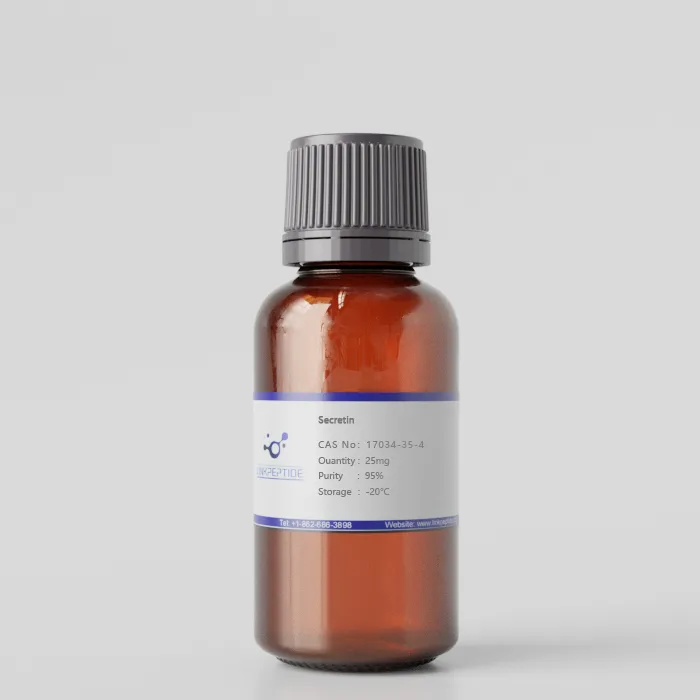
Product Name:Secretin
Form:Acetate salt
Purity:95%
Storage:-20oC
Cas No:17034-35-4
Molar Mass:3055.41
Chemical Formula:C130H220N44O41
SMILES:[H]N[C@@H](CC(O)=O)C(O)=O.[H]N[C@@H](CC(O)=O)C(O)=O.[H]N[C@@H](CC(O)=O)C(O)=O.[H]N[C@@H](CC(O)=O)C(O)=O.[H]N[C@@H](CC(O)=O)C(O)=O.[H]N[C@@H](CC(O)=O)C(O)=O.[H]N[C@@H](Cc1cnc[nH]1)C(=O)N[C@@H](CO)C(=O)N[C@@H](CC(O)=O)C(=O)NCC(=O)N[C@@H](C(C)O)C(=O)N[C@@H](Cc2ccccc2)C(=O)N[C@@H](C(C)O)C(=O)N[C@@H](CO)C(=O)N[C@@H](CCC(O)=O)C(=O)N[C@@H](CC(C)C)C(=O)N[C@@H](CO)C(=O)N[C@@H](CCCNC(N)=N)C(=O)N[C@@H](CC(C)C)C(=O)N[C@@H](CCCNC(N)=N)C(=O)N[C@@H](CC(O)=O)C(=O)N[C@@H](CO)C(=O)N[C@@H](C)C(=O)N[C@@H](CCCNC(N)=N)C(=O)N[C@@H](CC(C)C)C(=O)N[C@@H](CCC(N)=O)C(=O)N[C@@H](CCCNC(N)=N)C(=O)N[C@@H](CC(C)C)C(=O)N[C@@H](CC(C)C)C(=O)N[C@@H](CCC(N)=O)C(=O)NCC(=O)N[C@@H](CC(C)C)C(=O)N[C@@H](C(C)C)C(N)=O
InChIKey:JWQZOTGHUDZFMU-WIDFLDSMSA-N
InChI:InChI=1S/C130H220N44O41/c1-59(2)41-79(119(208)173-99(65(13)14)102(134)191)152-94(183)52-148-105(194)76(31-34-92(132)181)157-114(203)82(44-62(7)8)164-116(205)83(45-63(9)10)162-108(197)73(28-22-38-145-128(137)138)154-111(200)77(32-35-93(133)182)158-115(204)81(43-61(5)6)160-107(196)72(27-21-37-144-127(135)136)153-103(192)66(15)151-121(210)88(54-175)169-118(207)87(50-98(189)190)166-110(199)74(29-23-39-146-129(139)140)155-113(202)80(42-60(3)4)161-109(198)75(30-24-40-147-130(141)142)156-122(211)90(56-177)170-117(206)84(46-64(11)12)163-112(201)78(33-36-96(185)186)159-123(212)91(57-178)171-126(215)101(68(17)180)174-120(209)85(47-69-25-19-18-20-26-69)167-125(214)100(67(16)179)172-95(184)53-149-106(195)86(49-97(187)188)165-124(213)89(55-176)168-104(193)71(131)48-70-51-143-58-150-70/h18-20,25-26,51,58-68,71-91,99-101,175-180H,21-24,27-50,52-57,131H2,1-17H3,(H2,132,181)(H2,133,182)(H2,134,191)(H,143,150)(H,148,194)(H,149,195)(H,151,210)(H,152,183)(H,153,192)(H,154,200)(H,155,202)(H,156,211)(H,157,203)(H,158,204)(H,159,212)(H,160,196)(H,161,198)(H,162,197)(H,163,201)(H,164,205)(H,165,213)(H,166,199)(H,167,214)(H,168,193)(H,169,207)(H,170,206)(H,171,215)(H,172,184)(H,173,208)(H,174,209)(H,185,186)(H,187,188)(H,189,190)(H4,135,136,144)(H4,137,138,145)(H4,139,140,146)(H4,141,142,147)/t66-,67+,68+,71-,72-,73-,74-,75-,76-,77-,78-,79-,80-,81-,82-,83-,84-,85-,86-,87-,88-,89-,90-,91-,99-,100-,101-/m0/s1
Sequence:HSDGTFTSELSRLRDSARLQRLLQGLV-NH2
Application:Secretin is a peptide hormone primarily involved in regulating pancreatic and gastrointestinal function. It stimulates the pancreas to release bicarbonate-rich fluids, which neutralize stomach acid and aid digestion. Secretin also modulates bile secretion, gastric motility, and water homeostasis in the intestines. Clinically, it is used in pancreatic function tests, particularly for diagnosing chronic pancreatitis and exocrine pancreatic insufficiency. Additionally, secretin has been explored in neurological and metabolic disorders, including autism spectrum disorders (ASD) and obesity. Current research investigates its role in gut-brain interactions, hormone regulation, and potential therapeutic applications in gastrointestinal and neurological diseases.
Current Research:Secretin is a gastrointestinal peptide hormone that plays a key role in digestive regulation, pancreatic function, and gut-brain communication. It is primarily released by S cells in the duodenum in response to acidic chyme, stimulating the pancreas to secrete bicarbonate, which neutralizes gastric acid. While secretin??s primary medical application is in pancreatic function testing, ongoing research is exploring its neurological, metabolic, and gastrointestinal therapeutic potentials. Pancreatic Function and Gastrointestinal Disorders Secretin is widely used for diagnosing pancreatic disorders, particularly exocrine pancreatic insufficiency (EPI) and chronic pancreatitis. Pancreatic function testing: Secretin stimulation tests measure bicarbonate and enzyme secretion, helping diagnose conditions such as chronic pancreatitis, cystic fibrosis-related pancreatic dysfunction, and pancreatic tumors. Cystic fibrosis research: Studies are evaluating secretin??s role in enhancing pancreatic secretion in cystic fibrosis patients, potentially improving digestive function. Gastroesophageal reflux disease (GERD) and peptic ulcers: Research suggests secretin may play a role in modulating acid secretion and gastric motility, offering potential therapeutic benefits for acid-related disorders. Neurological and Cognitive Research: Autism and Brain-Gut Interactions Secretin has been explored for its role in neurological and neurodevelopmental disorders, particularly autism spectrum disorder (ASD). Autism research: Early studies suggested that secretin might improve language skills, social behaviors, and gastrointestinal symptoms in children with ASD. However, clinical trials have yielded mixed results, and ongoing research is investigating its potential neuropeptide interactions. Brain-gut axis modulation: Secretin receptors are found in the hypothalamus and limbic system, indicating a role in cognitive function, mood regulation, and appetite control. Studies are assessing secretin??s influence on neurotransmitter pathways that may impact anxiety, depression, and memory function. Metabolic and Endocrine Research Secretin is being investigated for its role in metabolism and energy regulation. Obesity and appetite regulation: Research suggests that secretin may influence satiety and food intake regulation by interacting with gut peptides such as glucagon-like peptide-1 (GLP-1). Diabetes research: Secretin has been studied for its potential effects on insulin sensitivity and glucose metabolism, making it a candidate for further exploration in type 2 diabetes management. Bile acid metabolism: Secretin stimulates bile secretion, and recent studies are exploring its effects on cholesterol metabolism and liver function. Emerging Research Areas Beyond its established functions, secretin is being explored for: Neuroprotective roles in neurodegenerative diseases, such as Alzheimer??s and Parkinson??s disease, due to its involvement in neuronal signaling and oxidative stress regulation. Fluid balance and kidney function research, particularly in conditions like hyponatremia and electrolyte imbalances. Cancer research, particularly in pancreatic and gastrointestinal cancers, where secretin receptor expression may influence tumor growth and treatment responses. As research progresses, secretin??s role in digestion, neurodevelopment, and metabolism continues to expand, making it a promising target for new therapeutic applications in gastroenterology, neurology, and endocrinology.
Get a Quote
 LinkPeptide