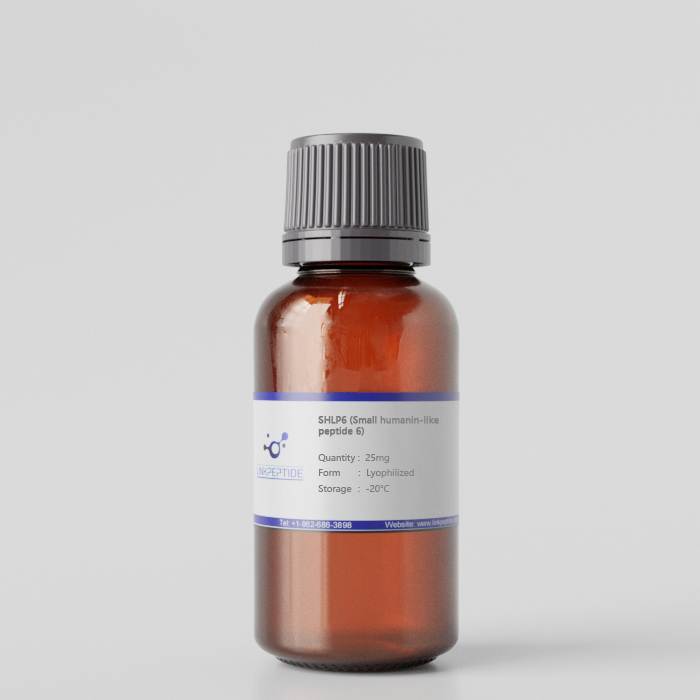
SHLP6 is a mitochondria-derived peptide encoded within the mitochondrial genome and belongs to the small humanin-like peptide family, which includes humanin and MOTS-c. These peptides function as retrograde signaling molecules that modulate cellular homeostasis and stress responses. Unlike other family members that often exhibit cytoprotective effects, SHLP6 has been reported to promote apoptosis, suggesting a distinct regulatory role in cell fate determination. Emerging evidence links SHLP6 to mitochondrial signaling pathways associated with aging, oxidative stress, and tumor biology. This peptide is suitable for research investigating mitochondrial–nuclear communication, apoptosis regulation, and the contribution of mitochondrial-encoded peptides to cancer progression and age-related cellular dysfunction.
Product Name: SHLP6 (Small humanin-like peptide 6)
Sequence One Letter Code: H - MLDQDIPMVQPLLKVRLFND - OH
Sequence Three Letter Code: NH2-Met-Leu-Asp-Gln-Asp-Ile-Pro-Met-Val-Gln-Pro-Leu-Leu-Lys-Val-Arg-Leu-Phe-Asn-Asp-COOH
Molecular Weight: 2386
Purity: 95%
Form: Lyophilized
Storage Conditions: - 20 °C
Research Area: Cancer Disease Research
Source / Species: human
Conjugation: Unconjugated
Code Nacres: NA.26
Current Research: Small Humanin-Like Peptide 6 (SHLP6) is a mitochondria-derived peptide (MDP) encoded within short open reading frames of the mitochondrial 16S rRNA region. It belongs to the small humanin-like peptide family, which includes humanin and MOTS-c—bioactive peptides increasingly recognized as mediators of mitochondrial retrograde signaling. These peptides function as communication intermediates between mitochondria and the nucleus, coordinating cellular stress responses, metabolic regulation, and survival pathways. Unlike humanin and several other SHLP family members that are typically associated with cytoprotective, anti-apoptotic, or metabolic-enhancing effects, SHLP6 has been reported to exert pro-apoptotic activity under certain experimental conditions. This functional divergence highlights the complexity of mitochondrial peptide signaling and suggests that SHLP6 may serve as a regulatory counterbalance within the MDP network. Rather than promoting cellular resilience, SHLP6 appears to influence cell fate decisions by enhancing apoptotic signaling, positioning it as a candidate modulator of mitochondrial quality control and stress-induced cell elimination. Current research into SHLP6 focuses on its role in mitochondrial–nuclear communication. Mitochondria are not only energy-producing organelles but also central hubs for apoptosis regulation, redox balance, and metabolic sensing. Retrograde signaling pathways allow mitochondria to transmit functional status information to the nucleus, thereby adjusting transcriptional programs in response to stressors such as oxidative damage, nutrient deprivation, or mitochondrial DNA perturbations. As an MDP, SHLP6 is thought to participate in these signaling networks, potentially influencing transcriptional regulators, stress-response kinases, and apoptotic mediators. In the context of apoptosis, SHLP6 has been associated with activation of mitochondrial-dependent pathways. These may involve modulation of BCL-2 family proteins, mitochondrial membrane potential dynamics, cytochrome c release, or caspase cascade activation. While the precise molecular targets remain under active investigation, emerging data suggest that SHLP6 may sensitize cells to intrinsic apoptotic stimuli, particularly under conditions of metabolic or oxidative stress. This distinguishes SHLP6 from humanin, which is known to interact with pro-apoptotic factors and block cell death pathways. Aging research represents another key area of interest. Mitochondrial dysfunction and altered inter-organelle communication are hallmarks of cellular aging. MDPs, including SHLP family members, have been proposed as systemic signaling molecules whose circulating levels change with age. SHLP6’s pro-apoptotic properties raise the possibility that it contributes to age-associated shifts in cellular turnover, tissue homeostasis, or stress adaptation. Investigations are ongoing to determine whether dysregulated SHLP6 expression correlates with age-related pathologies or altered mitochondrial quality control mechanisms. In tumor biology, SHLP6 presents a particularly intriguing profile. Because many cancers rely on evasion of apoptosis and reprogrammed mitochondrial metabolism, a mitochondria-encoded peptide that promotes apoptotic signaling could influence tumor cell survival. Preliminary studies suggest that SHLP6 may modulate proliferation and survival pathways in certain cancer cell models, potentially linking mitochondrial genomic activity to oncogenic processes. Whether SHLP6 acts as a tumor suppressive factor, a context-dependent regulator, or part of a broader mitochondrial stress response remains an active area of investigation. Methodologically, synthetic SHLP6 peptides enable controlled in vitro studies examining dose-dependent effects on cell viability, mitochondrial function, reactive oxygen species production, and signaling pathway activation. Researchers frequently employ assays assessing mitochondrial membrane potential, Annexin V staining, caspase activation, and transcriptional profiling to delineate SHLP6-mediated responses. Additionally, studies of mitochondrial peptide biology often integrate transcriptomic and proteomic approaches to understand how SHLP6 influences nuclear gene expression and cellular stress programs. Overall, SHLP6 represents an important component of the expanding field of mitochondrial-derived peptide research. Its apparent pro-apoptotic function distinguishes it within the small humanin-like peptide family and underscores the dualistic nature of mitochondrial retrograde signaling—capable of promoting either survival or programmed cell death depending on context. As interest grows in mitochondrial control of aging, oxidative stress adaptation, and cancer progression, SHLP6 provides a valuable research tool for elucidating how mitochondrial-encoded peptides shape cell fate and systemic homeostasis.
Get a Quote
 LinkPeptide