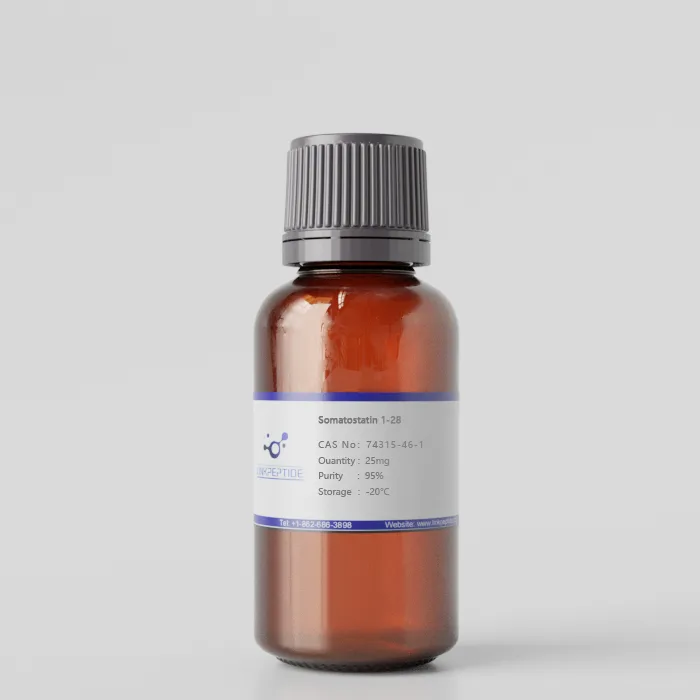
Product Name:Somatostatin 1-28
Synonyms:SST-28
CAS No:74315-46-1
Purity:95%
Molar Mass:3148.6
Chemical Formula:C137H207N41O39S3
Storage:Store at -20 degrees Celsius
Sequence:SANSNPAMAPRERKAGCKNFFWKTFTSC
Application:
Somatostatin 1-28 is the full-length, biologically active form of the somatostatin peptide hormone, consisting of 28 amino acids. This form is the primary version secreted by the hypothalamus and other tissues, playing a central role in inhibiting the secretion of several hormones, including growth hormone, thyroid-stimulating hormone (TSH), insulin, and glucagon. Somatostatin 1-28 is also involved in regulating gastrointestinal and pancreatic functions by inhibiting the release of digestive enzymes and reducing gut motility. Due to its extensive physiological effects, Somatostatin 1-28 is a key focus in research related to endocrine disorders, gastrointestinal diseases, and hormone-secreting tumors. Its synthetic analogs are used therapeutically to treat conditions such as acromegaly, neuroendocrine tumors, and certain gastrointestinal disorders.
Current Research:
Somatostatin 1-28 is a biologically active isoform of somatostatin, comprising a 28-amino acid sequence. It is the precursor form of somatostatin 1-14, which is generated by enzymatic cleavage. Found in the hypothalamus, pancreas, and gastrointestinal tract, somatostatin 1-28 plays a central role in regulating a variety of endocrine, exocrine, and neuronal functions.
Structure and Receptor Interaction
Somatostatin 1-28 binds to five somatostatin receptor subtypes (SSTR1-5), with a higher affinity for SSTR2, SSTR3, and SSTR5. Its elongated structure and extended sequence provide a broader receptor interaction profile compared to the 14-amino acid form (somatostatin 1-14). This broader interaction facilitates a wider range of physiological effects.
Physiological Functions
Hormone Inhibition:
Somatostatin 1-28 inhibits the release of growth hormone (GH), insulin, glucagon, and thyroid-stimulating hormone (TSH). This function is critical for maintaining endocrine homeostasis.
Gastrointestinal Regulation:
It suppresses gastric acid secretion, slows gastrointestinal motility, and decreases the release of digestive enzymes and bile, aiding in nutrient absorption and digestion.
Neurological Modulation:
In the central nervous system, somatostatin 1-28 acts as a neurotransmitter and neuromodulator, influencing pain perception, mood, and cognitive processes.
Antiproliferative Activity:
Somatostatin 1-28 exhibits antiproliferative effects on tumor cells, particularly in neuroendocrine and gastrointestinal cancers, by inhibiting cell growth and angiogenesis.
Research Applications
Somatostatin 1-28 is a valuable tool in research due to its broad physiological roles:
Endocrinology: It is used to study hormone regulation and to explore treatments for conditions like acromegaly and hormone-secreting tumors.
Gastrointestinal Disorders: Research on somatostatin 1-28 focuses on its role in managing peptic ulcers, pancreatitis, and other gastrointestinal conditions.
Cancer Research: Its interaction with somatostatin receptors makes it a target for developing therapies for neuroendocrine and other somatostatin receptor-expressing tumors.
Neuroscience: Studies on somatostatin 1-28 examine its role in cognitive and neurodegenerative diseases, such as Alzheimer's disease.
Conclusion
Somatostatin 1-28, as the full-length bioactive isoform of somatostatin, plays an integral role in regulating critical physiological functions. Its wide-ranging effects and receptor-specific interactions continue to make it a focus of research in endocrinology, oncology, gastroenterology, and neuroscience.
Reference:
Get a Quote
 LinkPeptide