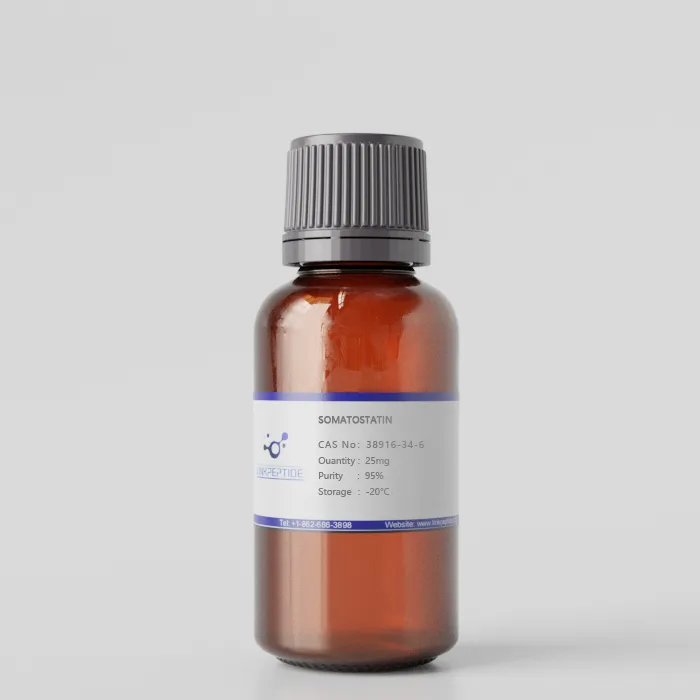
Product Name:SOMATOSTATIN
Form:Acetate salt
Purity:95%
Storage:-20oC
Cas No:38916-34-6
Molar Mass:1637.9
Chemical Formula:C76H104N18O19S2
Synonyms:Cyclic Somatostatin; Somatostatina; Somatostatine; Somatostatin-14
IUPAC Name:(4R,7S,10S,13S,16S,19S,22S,25S,28S,31S,34S,37R)-19,34-bis(4-aminobutyl)-31-(2-amino-2-oxoethyl)-37-[[2-[[(2S)-2-aminopropanoyl]amino]acetyl]amino]-13,25,28-tribenzyl-10,16-bis[(1R)-1-hydroxyethyl]-7-(hydroxymethyl)-22-(1H-indol-3-ylmethyl)-6,9,12,15,18,21,24,27,30,33,36-undecaoxo-1,2-dithia-5,8,11,14,17,20,23,26,29,32,35-undecazacyclooctatriacontane-4-carboxylic acid
SMILES:C[C@H]([C@H]1C(=O)N[C@H](C(=O)N[C@H](C(=O)N[C@H](C(=O)N[C@@H](CSSC[C@@H](C(=O)N[C@H](C(=O)N[C@H](C(=O)N[C@H](C(=O)N[C@H](C(=O)N[C@H](C(=O)N[C@H](C(=O)N1)CCCCN)CC2=CNC3=CC=CC=C32)CC4=CC=CC=C4)CC5=CC=CC=C5)CC(=O)N)CCCCN)NC(=O)CNC(=O)[C@H](C)N)C(=O)O)CO)[C@@H](C)O)CC6=CC=CC=C6)O
InChIKey:NHXLMOGPVYXJNR-ATOGVRKGSA-N
InChI:InChI=1S/C76H104N18O19S2/c1-41(79)64(100)82-37-61(99)83-58-39-114-115-40-59(76(112)113)92-72(108)57(38-95)91-75(111)63(43(3)97)94-71(107)54(33-46-23-11-6-12-24-46)90-74(110)62(42(2)96)93-66(102)51(28-16-18-30-78)84-69(105)55(34-47-36-81-49-26-14-13-25-48(47)49)88-68(104)53(32-45-21-9-5-10-22-45)86-67(103)52(31-44-19-7-4-8-20-44)87-70(106)56(35-60(80)98)89-65(101)50(85-73(58)109)27-15-17-29-77/h4-14,19-26,36,41-43,50-59,62-63,81,95-97H,15-18,27-35,37-40,77-79H2,1-3H3,(H2,80,98)(H,82,100)(H,83,99)(H,84,105)(H,85,109)(H,86,103)(H,87,106)(H,88,104)(H,89,101)(H,90,110)(H,91,111)(H,92,108)(H,93,102)(H,94,107)(H,112,113)/t41-,42+,43+,50-,51-,52-,53-,54-,55-,56-,57-,58-,59-,62-,63-/m0/s1
Sequence:AGCKNFFWKTFTSC
Application:Somatostatin is a naturally occurring peptide hormone that regulates numerous physiological processes by inhibiting the secretion of growth hormone (GH), insulin, glucagon, and various gastrointestinal hormones. It plays a critical role in endocrine and metabolic regulation and is widely studied for its therapeutic applications in neuroendocrine tumors, acromegaly, gastrointestinal disorders, and diabetes. As a potent inhibitor of gastric acid and pancreatic enzyme secretion, somatostatin is also used in managing bleeding esophageal varices and pancreatic disorders. Current research is exploring its potential in cancer therapy, neurodegenerative diseases, and metabolic syndrome, broadening its scope beyond traditional endocrinology and gastroenterology.
Current Research:Somatostatin is a peptide hormone that functions as a key inhibitor of hormonal and secretory pathways in the endocrine and gastrointestinal systems. It regulates the secretion of growth hormone (GH), insulin, glucagon, gastrin, and other neuropeptides, making it a vital component in various hormonal, metabolic, and oncological therapies. Recent research is expanding its therapeutic applications in cancer, neuroendocrine disorders, metabolic diseases, and gastrointestinal conditions. Neuroendocrine Tumors (NETs) and Cancer Research Somatostatin and its analogs (e.g., octreotide, lanreotide, and pasireotide) are well-established treatments for neuroendocrine tumors (NETs). These tumors, commonly found in the pancreas, gastrointestinal tract, and lungs, often secrete excess hormones, leading to syndromes like carcinoid syndrome and insulinomas. Antitumor effects: Research has shown that somatostatin analogs not only control hormone secretion but may also exert direct antiproliferative effects on tumors by inhibiting angiogenesis and tumor growth pathways. Combination therapies: Ongoing trials are evaluating the use of somatostatin analogs in combination with targeted therapies, immunotherapies, and radiolabeled analogs (e.g., Lutetium-177 DOTATATE) to enhance their anticancer effects. Acromegaly and Pituitary Disorders Somatostatin is critical in the management of acromegaly, a condition caused by excessive growth hormone (GH) secretion from a pituitary adenoma. First-line medical therapy: Somatostatin analogs effectively lower GH and insulin-like growth factor-1 (IGF-1) levels, reducing acromegalic symptoms. Precision medicine approaches: Research is identifying biomarkers to predict patient response to somatostatin-based therapies, optimizing individualized treatment plans. Gastrointestinal Disorders and Variceal Bleeding Somatostatin's ability to reduce gastric acid secretion, inhibit pancreatic enzyme release, and modulate gut motility has made it a valuable therapy in various gastrointestinal diseases: Esophageal variceal bleeding: Somatostatin is used in acute settings to reduce splanchnic blood flow and portal hypertension, decreasing bleeding risk in cirrhotic patients. Pancreatitis and pancreatic fistulas: Studies suggest somatostatin analogs help reduce pancreatic secretions, improving outcomes in acute pancreatitis and post-surgical complications like pancreatic fistulas. Metabolic Diseases and Diabetes Research Given its role in inhibiting insulin and glucagon secretion, somatostatin is being studied in diabetes and metabolic disorders: Type 2 diabetes and obesity: Researchers are exploring whether somatostatin-based therapies can improve glucose homeostasis and insulin sensitivity. Beta-cell function preservation: Studies suggest that somatostatin analogs may help protect pancreatic beta cells from excessive glucagon stimulation, potentially benefiting early-stage diabetes. Emerging Research Areas Beyond traditional endocrinology and gastroenterology, somatostatin is being investigated for: Neurodegenerative diseases (e.g., Alzheimer??s and Parkinson??s disease), due to its neuroprotective properties and involvement in cognitive function. Ophthalmology, particularly in diabetic retinopathy, where somatostatin regulates retinal vascular function. Anti-inflammatory applications, including autoimmune disorders and chronic inflammatory diseases, leveraging its ability to suppress cytokine secretion. With ongoing research, somatostatin continues to be a versatile therapeutic target, offering new treatment possibilities in endocrinology, oncology, and metabolic diseases.
Get a Quote
 LinkPeptide