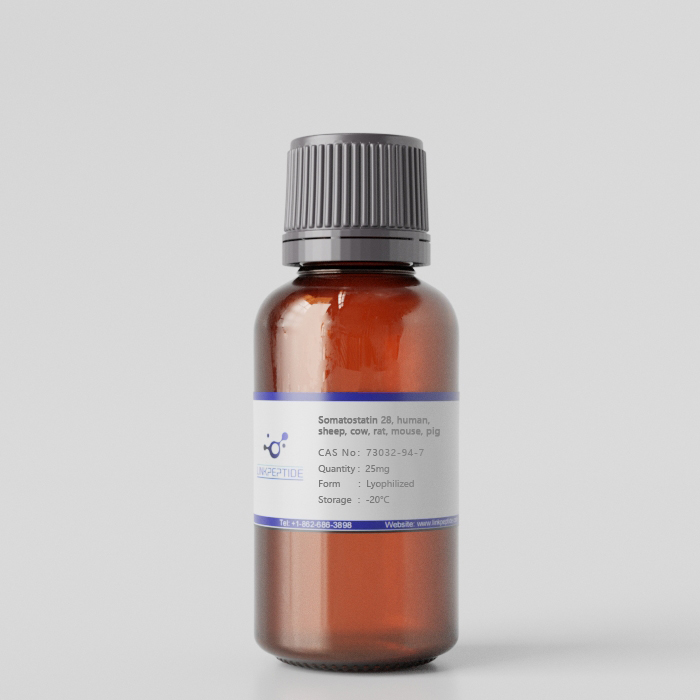
Product Name: Somatostatin 28, human, sheep, cow, rat, mouse, pig
Sequence One Letter Code: SANSNPAMAPRERKAGCKNFFWKTFTSC (Disulfide bridge: 17-28)
Sequence Three Letter Code: H-Ser-Ala-Asn-Ser-Asn-Pro-Ala-Met-Ala-Pro-Arg-Glu-Arg-Lys-Ala-Gly-Cys-Lys-Asn-Phe-Phe-Trp-Lys-Thr-Phe-Thr-Ser-Cys-OH (Disulfide bridge: 17-28)
Cas No: 73032-94-7
Chemical Formula:C137H207N41O39S3
Molecular Weight: 3148.7
Purity: 95%
Form: Lyophilized
Storage Conditions: - 20 °C
Research Area: Endocrinology Disease Research
SMILES: C[C@H]([C@H]1C(=O)N[C@H](C(=O)N[C@H](C(=O)N[C@H](C(=O)N[C@@H](CSSC[C@@H](C(=O)N[C@H](C(=O)N[C@H](C(=O)N[C@H](C(=O)N[C@H](C(=O)N[C@H](C(=O)N[C@H](C(=O)N1)CCCCN)CC2=CNC3=CC=CC=C32)CC4=CC=CC=C4)CC5=CC=CC=C5)CC(=O)N)CCCCN)NC(=O)CNC(=O)[C@H](C)NC(=O)[C@H](CCCCN)NC(=O)[C@H](CCCNC(=N)N)NC(=O)[C@H](CCC(=O)O)NC(=O)[C@H](CCCNC(=N)N)NC(=O)[C@@H]6CCCN6C(=O)[C@H](C)NC(=O)[C@H](CCSC)NC(=O)[C@H](C)NC(=O)[C@@H]7CCCN7C(=O)[C@H](CC(=O)N)NC(=O)[C@H](CO)NC(=O)[C@H](CC(=O)N)NC(=O)[C@H](C)NC(=O)[C@H](CO)N)C(=O)O)CO)[C@@H](C)O)CC8=CC=CC=C8)O
IUPAC: (4R,7S,10S,13S,16S,19S,22S,25S,28S,31S,34S,37R)-37-[[2-[[(2S)-2-[[(2S)-6-amino-2-[[(2S)-2-[[(2S)-2-[[(2S)-2-[[(2S)-1-[(2S)-2-[[(2S)-2-[[(2S)-2-[[(2S)-1-[(2S)-4-amino-2-[[(2S)-2-[[(2S)-4-amino-2-[[(2S)-2-[[(2S)-2-amino-3-hydroxypropanoyl]amino]propanoyl]amino]-4-oxobutanoyl]amino]-3-hydroxypropanoyl]amino]-4-oxobutanoyl]pyrrolidine-2-carbonyl]amino]propanoyl]amino]-4-methylsulfanylbutanoyl]amino]propanoyl]pyrrolidine-2-carbonyl]amino]-5-carbamimidamidopentanoyl]amino]-4-carboxybutanoyl]amino]-5-carbamimidamidopentanoyl]amino]hexanoyl]amino]propanoyl]amino]acetyl]amino]-19,34-bis(4-aminobutyl)-31-(2-amino-2-oxoethyl)-13,25,28-tribenzyl-10,16-bis[(1R)-1-hydroxyethyl]-7-(hydroxymethyl)-22-(1H-indol-3-ylmethyl)-6,9,12,15,18,21,24,27,30,33,36-undecaoxo-1,2-dithia-5,8,11,14,17,20,23,26,29,32,35-undecazacyclooctatriacontane-4-carboxylic acid
INCHIKEY: GGYTXJNZMFRSLX-DFTNLTQTSA-N
INCHI:
InChI=1S/C137H207N41O39S3/c1-69(154-113(194)82(37-19-22-47-138)159-115(196)85(40-25-50-149-136(145)146)160-118(199)87(44-45-106(188)189)163-116(197)86(41-26-51-150-137(147)148)164-130(211)101-43-27-52-177(101)133(214)72(4)156-114(195)88(46-54-218-7)158-110(191)71(3)155-129(210)100-42-28-53-178(100)134(215)95(61-104(144)186)171-126(207)96(65-180)172-124(205)93(59-102(142)184)165-111(192)70(2)153-112(193)80(141)64-179)109(190)152-63-105(187)157-98-67-219-220-68-99(135(216)217)174-127(208)97(66-181)173-132(213)108(74(6)183)176-125(206)91(57-77-33-15-10-16-34-77)170-131(212)107(73(5)182)175-119(200)84(39-21-24-49-140)161-122(203)92(58-78-62-151-81-36-18-17-35-79(78)81)168-121(202)90(56-76-31-13-9-14-32-76)166-120(201)89(55-75-29-11-8-12-30-75)167-123(204)94(60-103(143)185)169-117(198)83(162-128(98)209)38-20-23-48-139/h8-18,29-36,62,69-74,80,82-101,107-108,151,179-183H,19-28,37-61,63-68,138-141H2,1-7H3,(H2,142,184)(H2,143,185)(H2,144,186)(H,152,190)(H,153,193)(H,154,194)(H,155,210)(H,156,195)(H,157,187)(H,158,191)(H,159,196)(H,160,199)(H,161,203)(H,162,209)(H,163,197)(H,164,211)(H,165,192)(H,166,201)(H,167,204)(H,168,202)(H,169,198)(H,170,212)(H,171,207)(H,172,205)(H,173,213)(H,174,208)(H,175,200)(H,176,206)(H,188,189)(H,216,217)(H4,145,146,149)(H4,147,148,150)/t69-,70-,71-,72-,73+,74+,80-,82-,83-,84-,85-,86-,87-,88-,89-,90-,91-,92-,93-,94-,95-,96-,97-,98-,99-,100-,101-,107-,108-/m0/s1
Source / Species: human, sheep, cow, rat, mouse, pig
Conjugation: Unconjugated
Code Nacres: NA.26
Application: Somatostatin-28 is a 28-amino-acid cyclic peptide hormone derived from prosomatostatin and expressed in the pancreas, gastrointestinal tract, and central nervous system. It functions as a broad inhibitor of endocrine and neuroendocrine secretion, suppressing the release of growth hormone, insulin, glucagon, prolactin, and gastrointestinal hormones. Acting through somatostatin receptors, it also modulates neurotransmission, gastrointestinal motility, and cellular signaling pathways. Compared to somatostatin-14, this longer isoform exhibits distinct receptor binding profiles and altered potency in peripheral tissues. Somatostatin-28 is widely used in endocrine and neurobiology research to study hormone regulation, receptor signaling, and inhibitory pathways in physiological and disease contexts.
Current Research: Somatostatin-28 (SST-28) is a 28-amino-acid cyclic peptide hormone derived from the precursor prosomatostatin through tissue-specific proteolytic processing. It is widely expressed in the pancreas, gastrointestinal (GI) tract, and central nervous system (CNS), where it functions as a potent inhibitor of hormone secretion and cellular signaling. As one of the two principal bioactive forms of somatostatin—alongside somatostatin-14 (SST-14)—SST-28 exhibits distinct receptor interactions and physiological roles, particularly in peripheral tissues. Structural Characteristics and Isoforms Somatostatin-28 contains the full SST-14 sequence at its C-terminus, with an extended N-terminal region that influences its receptor binding profile and biological activity. Like SST-14, it maintains a cyclic structure stabilized by a disulfide bond, which is essential for receptor recognition and function. Key structural features include: C-terminal SST-14 core sequence, responsible for receptor activation Extended N-terminal segment, modulating receptor selectivity and potency Disulfide bond–dependent cyclic conformation, critical for biological activity These features contribute to differences in pharmacokinetics and receptor subtype preference compared to SST-14. Mechanism of Action and Receptor Signaling Somatostatin-28 exerts its effects by binding to somatostatin receptors (SSTR1–SSTR5), a family of G protein–coupled receptors expressed across endocrine, neural, and peripheral tissues. Upon receptor activation, SST-28 typically induces: Inhibition of adenylate cyclase, reducing intracellular cAMP levels Activation of potassium channels and inhibition of calcium influx Suppression of hormone secretion and neurotransmitter release Through these pathways, SST-28 acts as a broad negative regulator of cellular activity and secretion. Inhibition of Hormone Secretion One of the defining roles of somatostatin-28 is its ability to suppress the release of multiple hormones across different systems. It inhibits secretion of: Growth hormone (GH) from the anterior pituitary Insulin and glucagon from pancreatic islets Prolactin and other pituitary hormones Gastrointestinal hormones, including gastrin and secretin This broad inhibitory profile makes SST-28 a central regulator of endocrine balance and metabolic homeostasis. Functions in the Gastrointestinal and Nervous Systems In addition to endocrine regulation, SST-28 plays important roles in the gastrointestinal tract and central nervous system: Gastrointestinal system: Reduces gastric acid secretion Inhibits intestinal motility and nutrient absorption Regulates digestive hormone release Central nervous system: Modulates neurotransmission Influences neuronal excitability and synaptic activity Participates in neuroendocrine signaling pathways These functions highlight its role as both a hormone and neuromodulator. Differences Between Somatostatin-28 and Somatostatin-14 Although SST-14 and SST-28 share a common functional core, they differ in several key aspects: Receptor binding affinity: SST-28 shows distinct preferences for certain SSTR subtypes Tissue distribution: SST-28 is more prominent in intestinal tissues Biological potency: It may exhibit enhanced or prolonged effects in peripheral systems These differences allow researchers to dissect receptor-specific signaling and tissue-dependent responses. Applications in Endocrine and Neurobiology Research Somatostatin-28 is widely used as a research tool for investigating inhibitory signaling pathways and hormone regulation mechanisms. Common applications include: Studies of hormone secretion and endocrine feedback loops Analysis of somatostatin receptor signaling and subtype specificity Investigation of gastrointestinal function and motility regulation Research on neurotransmission and neuroendocrine integration Pharmacological evaluation of somatostatin analogues and receptor modulators Its well-characterized inhibitory activity makes it particularly valuable for studying negative regulation in complex biological systems. Relevance to Disease and Therapeutic Research Alterations in somatostatin signaling are associated with various conditions, including: Endocrine tumors and hormone hypersecretion disorders Metabolic diseases involving insulin and glucagon imbalance Gastrointestinal disorders affecting secretion and motility Neurological conditions involving dysregulated neurotransmission SST-28 is therefore used in research exploring therapeutic strategies targeting somatostatin receptors and inhibitory pathways. A Versatile Tool for Studying Inhibitory Signaling Somatostatin-28 is a multifunctional peptide hormone that serves as a key regulator of endocrine, gastrointestinal, and neural processes. Its ability to broadly inhibit hormone secretion and modulate signaling pathways makes it an essential tool for studying homeostatic regulation and receptor-mediated inhibition. By enabling detailed investigation of somatostatin receptor biology, hormone control mechanisms, and neuroendocrine signaling, SST-28 continues to support advances in understanding physiological regulation and disease-related dysfunctions.
Get a Quote
 LinkPeptide