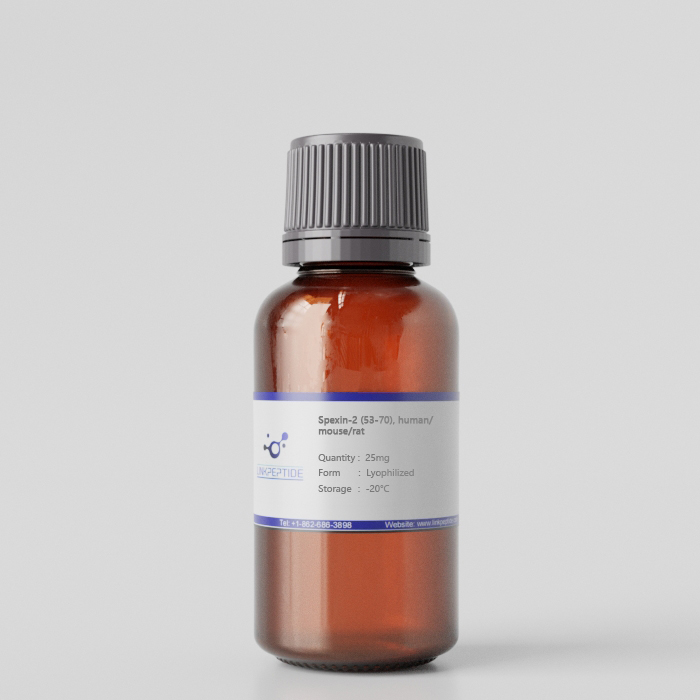
Product Name: Spexin-2 (53-70), human/mouse/rat
Sequence One Letter Code: FISDQSRRKDLSDRPLPE-OH
Sequence Three Letter Code: Phe-Ile-Ser-Asp-Gln-Ser-Arg-Arg-Lys-Asp-Leu-Ser-Asp-Arg-Pro-Leu-Pro-Glu-OH
Chemical Formula:C92H151N29O31
Molecular Weight: 2159.5
Purity: 95%
Form: Lyophilized
Storage Conditions: - 20 °C
Research Area: Cardiovascular Disease Research
Source / Species: Human, mouse, rat
Conjugation: Unconjugated
Code Nacres: NA.26
Application: Spexin-2 (53–70) is a non-amidated synthetic peptide derived from the prohormone proNPQ and is conserved across mammalian species. As a neuroendocrine regulator, spexin-2 participates in cardiovascular and renal physiological processes. Experimental administration in animal models has been shown to decrease heart rate and increase urine output, implicating the peptide in autonomic control, fluid balance, and hemodynamic regulation. Spexin-2 is used in studies examining peptide hormone signaling, cardiovascular function, and renal physiology. It provides a useful tool for investigating neuroendocrine mechanisms governing blood pressure control, diuresis, and systemic homeostasis.
Current Research: Spexin-2 (53–70) is a synthetic, non-amidated peptide derived from the prohormone proNPQ and represents a conserved neuropeptide sequence across mammalian species. Although structurally related to spexin-1 (often referred to simply as spexin), spexin-2 is encoded within a distinct region of the precursor and exhibits partially overlapping yet functionally distinguishable physiological effects. Its conservation suggests evolutionary importance in neuroendocrine regulation. Current research identifies spexin-2 as a modulator of cardiovascular and renal physiology. Experimental administration in animal models has demonstrated a reduction in heart rate (negative chronotropic effect) and an increase in urine output (diuretic response). These findings implicate spexin-2 in autonomic regulation of cardiac function and in modulation of renal fluid handling. The observed bradycardic effect suggests involvement of central autonomic pathways or direct cardiac receptor-mediated signaling. Mechanistically, spexin family peptides are known to interact with galanin receptor subtypes (GALR2 and GALR3), both members of the G protein–coupled receptor (GPCR) family. While receptor specificity of spexin-2 is still under investigation, evidence suggests engagement of similar galaninergic signaling pathways. Activation of these receptors can influence intracellular calcium dynamics, MAPK signaling cascades, and cAMP levels, thereby affecting vascular tone, cardiac electrophysiology, and renal tubular transport processes. In cardiovascular research, spexin-2 is used to explore peptide-mediated regulation of hemodynamics. Studies assess heart rate variability, blood pressure changes, and vascular resistance following systemic or central administration. The peptide’s influence on autonomic output is often evaluated through pharmacologic blockade of sympathetic or parasympathetic pathways to determine whether its effects are centrally mediated or involve direct peripheral receptor activation. Renal physiology studies focus on spexin-2–induced diuresis and potential natriuretic effects. Increased urine output observed in experimental models suggests modulation of renal tubular reabsorption or renal blood flow. Investigations typically measure urine volume, electrolyte excretion, and glomerular filtration parameters to clarify whether spexin-2 influences tubular transporters, aquaporin expression, or renal sympathetic activity. Emerging research also examines spexin-2 within the broader context of neuroendocrine integration. Cardiovascular and renal homeostasis are tightly coordinated with metabolic and stress-responsive pathways. Given that spexin family peptides are expressed in central nervous system nuclei associated with autonomic and endocrine control, spexin-2 may function as a signaling mediator linking metabolic state to circulatory and fluid balance regulation. From a methodological perspective, Spexin-2 (53–70) is applied in in vivo infusion models, isolated organ preparations, and receptor activation assays. Cardiovascular measurements may include telemetry-based heart rate monitoring, arterial pressure recording, and echocardiographic assessment. In vitro systems assess receptor signaling using calcium imaging or phosphorylation assays in cells expressing candidate receptors. Comparative studies between spexin-1 and spexin-2 aim to delineate functional divergence within the proNPQ-derived peptide family. Differences in amidation status, receptor affinity, and downstream signaling bias may underlie distinct physiological outcomes. Such analyses contribute to understanding how small variations in peptide sequence and post-translational modification shape neuroendocrine signaling specificity. Overall, Spexin-2 (53–70) serves as a biologically relevant tool for investigating neuroendocrine mechanisms that govern cardiovascular dynamics, renal fluid balance, and systemic homeostasis. Its documented effects on heart rate and diuresis support its application in research focused on autonomic regulation, peptide hormone signaling, and integrated control of blood pressure and volume status.
Get a Quote
 LinkPeptide