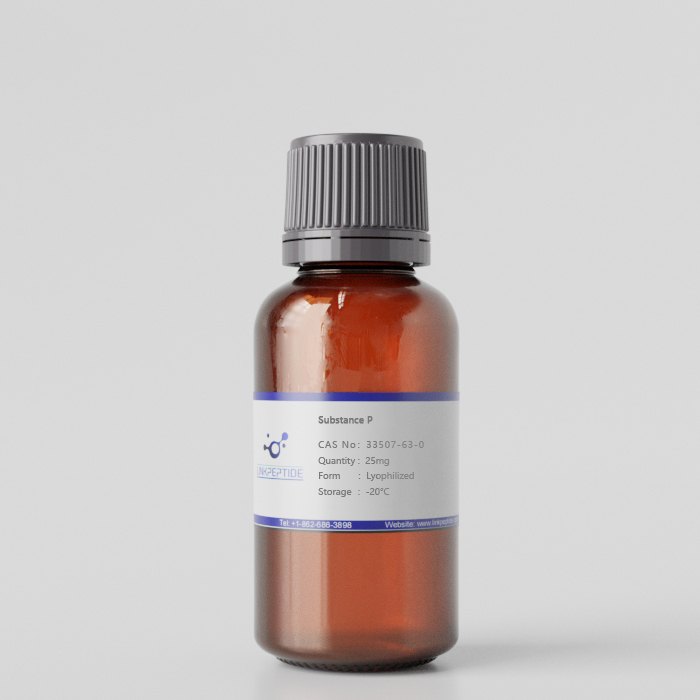
Product Name: Substance P
Sequence One Letter Code: RPKPQQFFGLM-NH2
Sequence Three Letter Code: H-Arg-Pro-Lys-Pro-Gln-Gln-Phe-Phe-Gly-Leu-Met-NH2
Cas No: 33507-63-0
Chemical Formula:C63H98N18O13S
Molecular Weight: 1347.7
Purity: ≥ 95%
Form: Lyophilized
Storage Conditions: - 20 °C
Research Area: CC(C)C[C@@H](C(=O)N[C@@H](CCSC)C(=O)N)NC(=O)CNC(=O)[C@H](CC1=CC=CC=C1)NC(=O)[C@H](CC2=CC=CC=C2)NC(=O)[C@H](CCC(=O)N)NC(=O)[C@H](CCC(=O)N)NC(=O)[C@@H]3CCCN3C(=O)[C@H](CCCCN)NC(=O)[C@@H]4CCCN4C(=O)[C@H](CCCN=C(N)N)N
SMILES: (2S)-2-[[(2S)-1-[(2S)-6-amino-2-[[(2S)-1-[(2S)-2-amino-5-(diaminomethylideneamino)pentanoyl]pyrrolidine-2-carbonyl]amino]hexanoyl]pyrrolidine-2-carbonyl]amino]-N-[(2S)-5-amino-1-[[(2S)-1-[[(2S)-1-[[2-[[(2S)-1-[[(2S)-1-amino-4-methylsulfanyl-1-oxobutan-2-yl]amino]-4-methyl-1-oxopentan-2-yl]amino]-2-oxoethyl]amino]-1-oxo-3-phenylpropan-2-yl]amino]-1-oxo-3-phenylpropan-2-yl]amino]-1,5-dioxopentan-2-yl]pentanediamide
IUPAC: ADNPLDHMAVUMIW-CUZNLEPHSA-N
INCHIKEY: InChI=1S/C63H98N18O13S/c1-37(2)33-45(57(89)74-41(53(68)85)27-32-95-3)73-52(84)36-72-54(86)46(34-38-15-6-4-7-16-38)78-58(90)47(35-39-17-8-5-9-18-39)79-56(88)42(23-25-50(66)82)75-55(87)43(24-26-51(67)83)76-59(91)49-22-14-31-81(49)62(94)44(20-10-11-28-64)77-60(92)48-21-13-30-80(48)61(93)40(65)19-12-29-71-63(69)70/h4-9,15-18,37,40-49H,10-14,19-36,64-65H2,1-3H3,(H2,66,82)(H2,67,83)(H2,68,85)(H,72,86)(H,73,84)(H,74,89)(H,75,87)(H,76,91)(H,77,92)(H,78,90)(H,79,88)(H4,69,70,71)/t40-,41-,42-,43-,44-,45-,46-,47-,48-,49-/m0/s1
INCHI:
guinea pig
Source / Species: Unconjugated
Conjugation: Conjugation Type: NA.26
Code Nacres: Substance P is an 11-amino-acid neuropeptide of the tachykinin family that functions as both a neurotransmitter and neuromodulator. It is produced from the preprotachykinin A precursor and is released mainly from sensory nerve terminals. Substance P plays an essential role in pain transmission, neurogenic inflammation, vasodilation, and neuroimmune communication. Acting primarily through the neurokinin-1 receptor, it regulates inflammatory signaling and neuronal excitability. This peptide is widely used in research on nociception, inflammatory disease mechanisms, sensory neuron biology, NK1 receptor signaling, vascular responses, and neuroimmune interactions.
Application: Substance P is an undecapeptide neuropeptide belonging to the tachykinin family and is one of the most widely studied endogenous ligands for the neurokinin-1 receptor, also known as NK1R. It is distributed throughout the central nervous system, peripheral nervous system, sensory neurons, immune cells, vascular tissues, and gastrointestinal tract. Because Substance P participates in nociceptive transmission, inflammatory signaling, smooth muscle contraction, vascular permeability, and neuroimmune communication, it remains a valuable peptide tool for pain, inflammation, neuroscience, and disease-mechanism research. In current research, Substance P is strongly associated with the SP/NK1R signaling axis. NK1R is a G protein-coupled receptor that mediates many of the biological effects of Substance P, including intracellular calcium mobilization, MAPK activation, cytokine production, and inflammatory mediator release. Recent reviews describe Substance P as a neurotransmitter, neuromodulator, and neurotrophic factor, with substantial SP and NK1R expression in the brain and important roles in neurological signaling and disease pathways. One major research area is pain biology. Substance P is released from primary sensory neurons and contributes to nociceptive transmission in the spinal cord and peripheral tissues. It has been studied in models of inflammatory pain, neuropathic pain, visceral pain, migraine, arthritis, and tissue injury. In these systems, Substance P helps researchers investigate how neuropeptides amplify pain signaling, promote neurogenic inflammation, and interact with other mediators such as calcitonin gene-related peptide, prostaglandins, cytokines, and bradykinin. The peptide is often used to activate NK1R-dependent pathways or to evaluate the effects of NK1R antagonists. Substance P is also important in neuroinflammation research. The SP/NK1R axis has been implicated in inflammatory responses associated with infectious and neurodegenerative diseases of the central nervous system. Reviews on SP and NK1R in neuroinflammation describe their involvement in bacterial, viral, parasitic, and neurodegenerative disease contexts, highlighting Substance P as a bridge between neural signaling and immune activation. This makes Substance P useful in studies involving microglia, astrocytes, endothelial cells, leukocyte trafficking, blood-brain barrier permeability, and cytokine release. In immunology, Substance P is studied as a neuroimmune mediator. NK1R expression has been reported in immune-relevant cell types, and SP signaling can influence T-cell activity, macrophage activation, mast cell degranulation, cytokine secretion, and inflammatory recruitment. Recent biophysical and signaling research notes that NK1R is found in the nervous system, endothelial cells, smooth muscle, and T-cell immune synapse contexts. These features make Substance P relevant for research into chronic inflammation, allergic responses, autoimmunity, infection-associated inflammation, and tissue repair. Substance P is also used in gastrointestinal and respiratory biology. In the gut, tachykinin signaling contributes to motility, secretion, enteric nervous system activity, and inflammatory responses. In the respiratory system, Substance P has been studied in airway hyperresponsiveness, cough reflex, bronchoconstriction, and inflammatory cell recruitment. These effects make it useful in models of asthma, chronic cough, inflammatory bowel disease, and neurogenic inflammation. Another active area involves cancer biology. Substance P and NK1R signaling have been investigated in tumor cell proliferation, migration, angiogenesis, survival signaling, and tumor-associated inflammation. NK1R antagonists have attracted interest as research tools for evaluating whether blocking Substance P-mediated signaling can suppress tumor-promoting pathways. While this field remains model-dependent, Substance P is useful for studying how neuropeptide signaling interacts with cancer-associated inflammation and microenvironmental regulation. Overall, Substance P is a foundational neuropeptide for investigating NK1 receptor activation, nociception, neurogenic inflammation, immune signaling, vascular permeability, gastrointestinal physiology, respiratory responses, and neurodegenerative disease mechanisms. Its defined peptide structure and broad biological relevance make it a practical tool for researchers studying the interface between the nervous system, immune system, and inflammatory disease pathways.
Current Research: Apelin-36, human is a 36–amino acid bioactive peptide derived from the C-terminal region of the preproapelin precursor protein. It functions as an endogenous ligand for the apelin receptor (APJ), a class A G protein–coupled receptor (GPCR) structurally related to the angiotensin II type 1 receptor. Apelin-36 represents one of several processed isoforms of apelin and exhibits high receptor affinity with a distinct signaling and functional profile compared to shorter fragments such as apelin-13 or apelin-17. Apelin–APJ Receptor Signaling Binding of apelin-36 to APJ activates intracellular signaling pathways primarily through G_i/o protein coupling. This interaction inhibits adenylate cyclase activity, modulates cAMP levels, and triggers downstream cascades including ERK1/2 MAP kinase activation, PI3K/Akt signaling, and intracellular calcium mobilization. APJ signaling can also recruit β-arrestins, contributing to receptor internalization and signal modulation. The signaling profile of apelin-36 differs quantitatively and temporally from shorter apelin peptides, with reports indicating slower receptor internalization and sustained signaling responses in certain cell systems. Cardiovascular Regulation Apelin-36 plays a significant role in cardiovascular physiology. Activation of APJ in vascular endothelial cells stimulates nitric oxide production, promoting vasodilation and contributing to blood pressure regulation. In cardiac tissue, apelin signaling enhances myocardial contractility and influences cardiac remodeling processes. Experimental applications in cardiovascular research include: Vascular reactivity assays Cardiac contractility studies Endothelial nitric oxide signaling analysis Models of heart failure and hypertension Because APJ signaling counterbalances certain components of the renin–angiotensin system, apelin-36 is frequently studied in the context of cardiovascular homeostasis. Fluid Balance and Neuroendocrine Effects Apelin and its receptor are expressed in the central nervous system, particularly in hypothalamic nuclei involved in fluid balance and vasopressin regulation. Apelin-36 influences water intake, vasopressin secretion, and neuroendocrine control of fluid homeostasis. Its central actions make it relevant for studies examining neurogenic blood pressure control and hormone-mediated regulation of hydration status. Metabolic Functions Apelin signaling contributes to metabolic regulation, including glucose homeostasis, insulin sensitivity, and adipose tissue function. In metabolic research, apelin-36 is used to investigate: Glucose uptake pathways Insulin signaling modulation Adipocyte differentiation and lipid metabolism Energy balance mechanisms Differential activity among apelin isoforms supports comparative studies of receptor pharmacology and downstream metabolic effects. Antiviral and HIV-Related Research Apelin-36 has been reported to inhibit infection of APJ-expressing cells by certain HIV-1 strains. Because APJ can function as a co-receptor for specific viral isolates, apelin binding may competitively interfere with viral entry. This property has stimulated interest in apelin peptides within virology research aimed at understanding receptor usage and viral tropism. Applications in Research Apelin-36, human is widely used in: APJ receptor pharmacology studies Intracellular signaling pathway analysis Cardiovascular and vascular biology models Metabolic regulation research Viral entry and receptor competition assays Its full-length 36–residue structure provides a valuable tool for examining isoform-specific receptor dynamics and signal bias. Experimental Advantages High-affinity endogenous APJ ligand Distinct signaling profile relative to shorter apelin fragments Suitable for in vitro and in vivo experimental models Applicable across cardiovascular, metabolic, and virological research domains Research Significance Apelin-36, human is a key reagent for investigating APJ receptor–mediated signaling and the physiological roles of the apelinergic system. By influencing cardiovascular tone, neuroendocrine regulation, metabolic pathways, and receptor interactions relevant to viral entry, it supports comprehensive mechanistic studies across multiple fields of biomedical research.
Get a Quote
 LinkPeptide