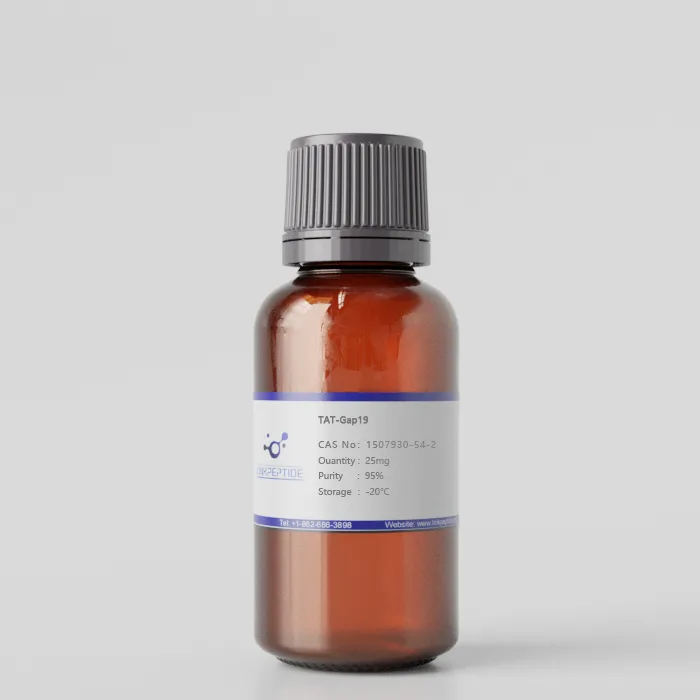
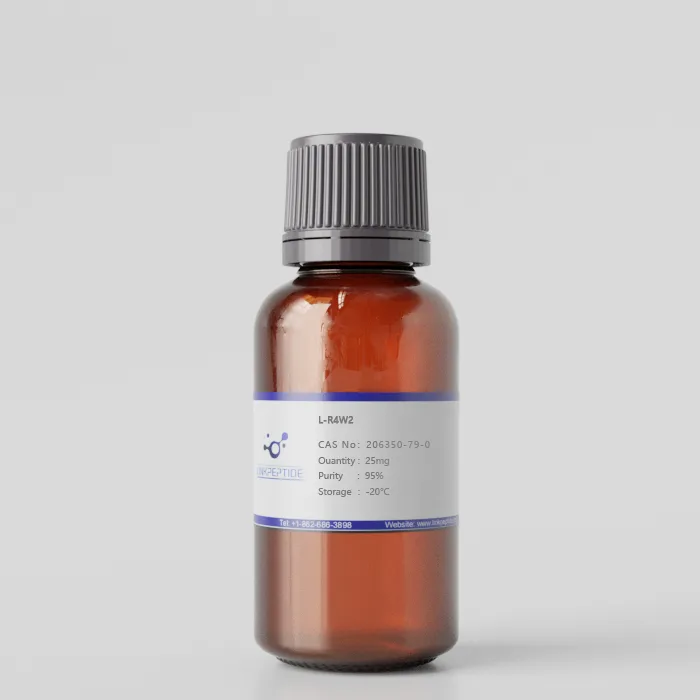
Product Name:TAT-Gap19
CAS No:1507930-54-2
Purity:95%
Molar Mass:2703.25
Chemical Formula:C119H212N46O26
Storage:Store at -20 degrees Celsius
Sequence:YGRKKRRQRRRKQIEIKKFK
Target:Cx43 HC
Application:TAT-Gap19 is a peptide inhibitor designed to selectively block connexin43 (Cx43) hemichannels, which are involved in cell communication and calcium signaling. Cx43 hemichannels play a key role in maintaining tissue homeostasis, particularly in the heart and nervous system. TAT-Gap19, with its cell-penetrating TAT sequence, inhibits these channels without affecting gap junction communication between cells, making it a useful tool for research on pathological conditions where aberrant hemichannel activity is involved, such as cardiac arrhythmias, ischemia-reperfusion injury, and neuroinflammation. Its selective action makes it important in studying Cx43-related functions and potential therapeutic interventions.
Current Research:
TAT-Gap19 is a synthetic peptide that selectively inhibits connexin43 (Cx43) hemichannels without affecting gap junction channels (GJCs). This specificity makes it a valuable tool for investigating the distinct roles of Cx43 hemichannels in various physiological and pathological processes.
Structural Composition
TAT-Gap19 comprises the Gap19 peptide sequence derived from the intracellular loop of Cx43, fused to the HIV-1 transactivator of transcription (TAT) peptide. The TAT sequence enhances the peptide's cell permeability, facilitating its intracellular delivery and enabling it to traverse the blood-brain barrier.
Mechanism of Action
By binding to the intracellular loop of Cx43, TAT-Gap19 prevents the opening of hemichannels, thereby inhibiting the release of signaling molecules such as ATP and glutamate. Importantly, it does not interfere with the function of GJCs, allowing for the selective study of hemichannel-mediated effects.
Research Applications
TAT-Gap19 has been instrumental in elucidating the role of Cx43 hemichannels in various conditions:
Neuroprotection: Studies have shown that TAT-Gap19 can reduce neuronal damage by inhibiting hemichannel-mediated ATP release, highlighting its potential in treating neurodegenerative diseases.
Cardiovascular Research: By modulating hemichannel activity, TAT-Gap19 has been used to investigate cardiac arrhythmias and myocardial ischemia-reperfusion injury, providing insights into novel therapeutic strategies.
Inflammation: TAT-Gap19 has demonstrated anti-inflammatory effects by reducing the release of pro-inflammatory mediators through hemichannels, suggesting its utility in inflammatory disease models.
Conclusion
TAT-Gap19 serves as a potent and selective inhibitor of Cx43 hemichannels, offering researchers a precise tool to dissect the specific contributions of these channels in health and disease. Its ability to cross cellular membranes and the blood-brain barrier further enhances its applicability in both in vitro and in vivo studies.
Reference:
Get a Quote
 LinkPeptide