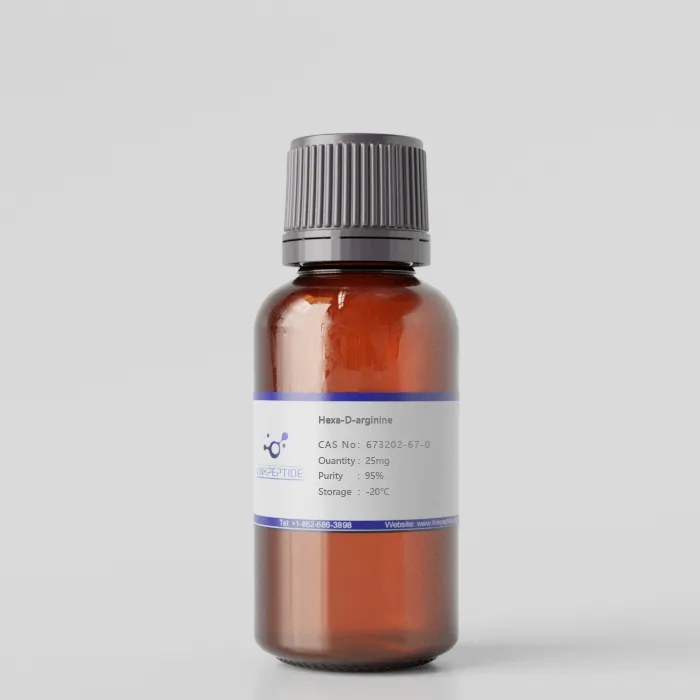
Product Name:Hexa-D-arginine
CAS No:673202-67-0
Purity:95%
Molar Mass:954.16
Chemical Formula:C36H75N25O6
Storage:Store at -20 degrees Celsius
Sequence:RRRRRR
Target:furin
Application:
Hexa-D-arginine is a synthetic peptide composed of six D-arginine residues, which is used as a cell-penetrating peptide (CPP). Due to its positively charged arginine residues, it facilitates the transport of various molecules, such as proteins, nucleic acids, and drugs, across cellular membranes. Unlike its L-arginine counterpart, Hexa-D-arginine is resistant to protease degradation, making it more stable in biological systems. This peptide is commonly used in drug delivery research and molecular biology studies to enhance cellular uptake of therapeutic agents, making it a valuable tool for developing novel delivery systems for therapeutics targeting intracellular processes.
Current Research:
Hexa-D-arginine, also known as Furin Inhibitor II, is a synthetic hexapeptide composed entirely of D-arginine residues. It functions as a potent and stable inhibitor of furin, a proprotein convertase involved in the activation of various precursor proteins.
Inhibitory Activity
Hexa-D-arginine exhibits strong inhibitory effects on furin, with a dissociation constant (K_i) of approximately 106 nM. It also inhibits other proprotein convertases, such as PACE4 (K_i ≈ 580 nM) and PC1 (K_i ≈ 13.2 μM), though with varying potency. Notably, it does not inhibit PC2, indicating selectivity among proprotein convertases.
Mechanism of Action
By inhibiting furin, Hexa-D-arginine prevents the proteolytic activation of various pathogenic proteins. This inhibition blocks the cleavage of bacterial toxins like Pseudomonas aeruginosa exotoxin A and anthrax toxin, thereby reducing their toxicity.
Research Applications
Hexa-D-arginine is utilized in studies investigating the role of furin in disease processes, including:
Infectious Diseases: Evaluating the activation of bacterial and viral proteins by host cell proteases.
Cancer Research: Exploring the processing of growth factors and receptors involved in tumor progression.
Metabolic Disorders: Studying the maturation of prohormones and other metabolic regulators.
Conclusion
As a potent furin inhibitor, Hexa-D-arginine serves as a valuable tool in biomedical research, aiding in the understanding of proteolytic processing in health and disease.
Reference:
Get a Quote
 LinkPeptide