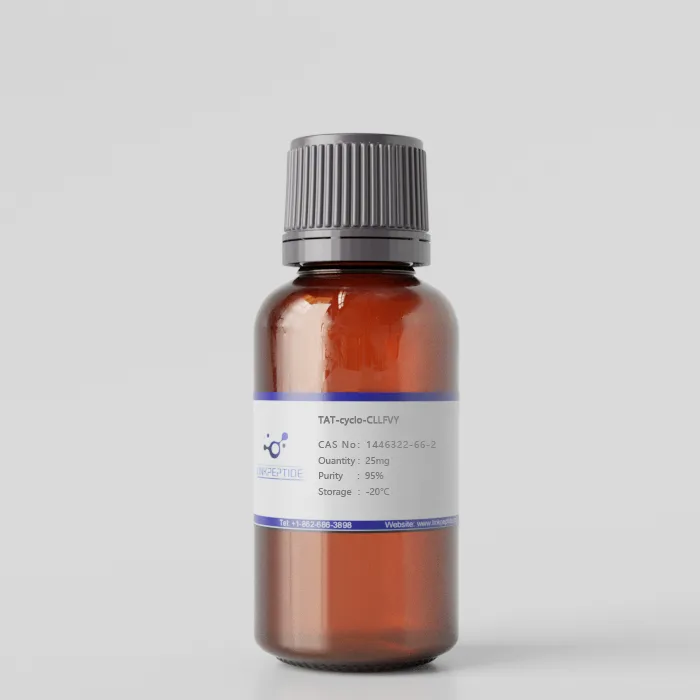
Product Name:TAT-cyclo-CLLFVY
CAS No:1446322-66-2
Purity:95%
Molar Mass:2559.08
Chemical Formula:C111H188N42O24S2
Storage:Store at -20 degrees Celsius
Sequence:CGRKKRRQRRRPPQ.cyclo(CLLFVY)
Target:HIF-1
Application:TAT-cyclo-CLLFVY is related to HIF-1 (Hypoxia-Inducible Factor 1), a transcription factor that plays a key role in cellular response to low oxygen levels (hypoxia). HIF-1 regulates the expression of genes involved in angiogenesis, metabolism, and survival under hypoxic conditions. The TAT-cyclo-CLLFVY peptide likely inhibits or modulates the activity of HIF-1, making it a valuable tool for studying hypoxia-related processes in diseases such as cancer, where HIF-1 activation is often linked to tumor growth, angiogenesis, and metastasis. Its cell-penetrating ability through the TAT sequence allows for efficient intracellular delivery to target HIF-1-driven pathways.
Current Research:
TAT-cyclo-CLLFVY is a synthetic cyclic hexapeptide conjugated to the HIV-1 TAT peptide sequence, designed to inhibit the heterodimerization of hypoxia-inducible factor 1 (HIF-1) subunits, thereby disrupting hypoxia signaling pathways in cancer cells.
Structural Composition
The peptide comprises a cyclic hexapeptide sequence, cyclo-CLLFVY, linked to the TAT peptide sequence (YGRKKRRQRRR). The cyclization of CLLFVY enhances its stability and binding affinity, while the TAT sequence facilitates cellular uptake by enabling translocation across the cell membrane.
Mechanism of Action
TAT-cyclo-CLLFVY selectively inhibits the dimerization of HIF-1?? and HIF-1?? subunits by binding to the PAS-B domain of HIF-1??. This interaction prevents the formation of the active HIF-1 complex, thereby reducing HIF-1-mediated transcriptional activity under hypoxic conditions. Notably, TAT-cyclo-CLLFVY does not affect the dimerization of HIF-2?? with HIF-1??, indicating its specificity for HIF-1.
Biological Activity
In vitro studies have demonstrated that TAT-cyclo-CLLFVY effectively inhibits hypoxia-induced HIF-1 activity, leading to decreased expression of downstream targets such as vascular endothelial growth factor (VEGF) and carbonic anhydrase IX (CAIX) in osteosarcoma and breast cancer cell lines. Additionally, it reduces the tubulization of hypoxic human umbilical vein endothelial cells (HUVECs), indicating its potential to impair angiogenesis.
Research Applications
Due to its ability to modulate hypoxia signaling, TAT-cyclo-CLLFVY serves as a valuable tool in cancer research, particularly in studying the role of HIF-1 in tumor progression and angiogenesis. Its specificity and efficacy make it a promising candidate for developing therapeutic strategies targeting hypoxia-related pathways in cancer.
Conclusion
TAT-cyclo-CLLFVY is a potent and selective inhibitor of HIF-1 heterodimerization, offering significant potential in cancer research and therapy by disrupting hypoxia-induced signaling pathways.
Reference:
Get a Quote
 LinkPeptide