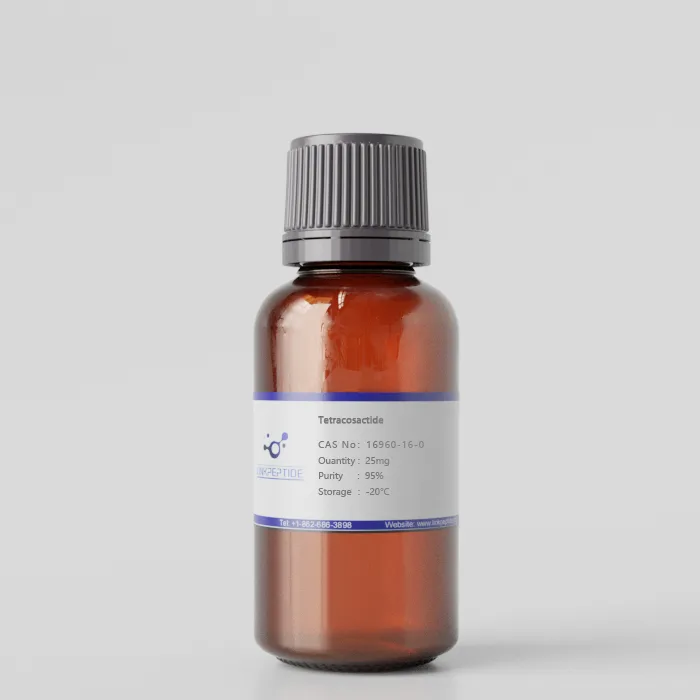
Product Name:Tetracosactide
Form:Acetate salt
Purity:95%
Storage:-20oC
Cas No:16960-16-0
Molar Mass:2933.4
Chemical Formula:C136H210N40O31S?
Synonyms:Tetracosactida; Tetracosactrin; VICOTROPE; Cortrosyn
IUPAC Name:(2S)-1-[(2S)-2-[[(2S)-2-[[(2S)-6-amino-2-[[(2S)-2-[[(2S)-1-[(2S)-2-[[(2S)-2-[[(2S)-6-amino-2-[[(2S)-6-amino-2-[[2-[[(2S)-2-[[(2S)-1-[(2S)-6-amino-2-[[2-[[(2S)-2-[[(2S)-2-[[(2S)-2-[[(2S)-2-[[(2S)-2-[[(2S)-2-[[(2S)-2-[[(2S)-2-[[(2S)-2-amino-3-hydroxypropanoyl]amino]-3-(4-hydroxyphenyl)propanoyl]amino]-3-hydroxypropanoyl]amino]-4-methylsulfanylbutanoyl]amino]-4-carboxybutanoyl]amino]-3-(1H-imidazol-4-yl)propanoyl]amino]-3-phenylpropanoyl]amino]-5-carbamimidamidopentanoyl]amino]-3-(1H-indol-3-yl)propanoyl]amino]acetyl]amino]hexanoyl]pyrrolidine-2-carbonyl]amino]-3-methylbutanoyl]amino]acetyl]amino]hexanoyl]amino]hexanoyl]amino]-5-carbamimidamidopentanoyl]amino]-5-carbamimidamidopentanoyl]pyrrolidine-2-carbonyl]amino]-3-methylbutanoyl]amino]hexanoyl]amino]-3-methylbutanoyl]amino]-3-(4-hydroxyphenyl)propanoyl]pyrrolidine-2-carboxylic acid
SMILES:CC(C)[C@@H](C(=O)NCC(=O)N[C@@H](CCCCN)C(=O)N[C@@H](CCCCN)C(=O)N[C@@H](CCCNC(=N)N)C(=O)N[C@@H](CCCNC(=N)N)C(=O)N1CCC[C@H]1C(=O)N[C@@H](C(C)C)C(=O)N[C@@H](CCCCN)C(=O)N[C@@H](C(C)C)C(=O)N[C@@H](CC2=CC=C(C=C2)O)C(=O)N3CCC[C@H]3C(=O)O)NC(=O)[C@@H]4CCCN4C(=O)[C@H](CCCCN)NC(=O)CNC(=O)[C@H](CC5=CNC6=CC=CC=C65)NC(=O)[C@H](CCCNC(=N)N)NC(=O)[C@H](CC7=CC=CC=C7)NC(=O)[C@H](CC8=CNC=N8)NC(=O)[C@H](CCC(=O)O)NC(=O)[C@H](CCSC)NC(=O)[C@H](CO)NC(=O)[C@H](CC9=CC=C(C=C9)O)NC(=O)[C@H](CO)N
InChIKey:ZOEFCCMDUURGSE-SQKVDDBVSA-N
InChI:InChI=1S/C136H210N40O31S/c1-75(2)109(127(200)154-71-106(181)156-88(31-13-17-52-137)114(187)158-89(32-14-18-53-138)115(188)159-91(35-21-56-149-134(142)143)116(189)164-96(37-23-58-151-136(146)147)131(204)175-60-25-39-104(175)126(199)173-111(77(5)6)128(201)163-90(33-15-19-54-139)120(193)171-110(76(3)4)129(202)169-101(65-80-43-47-84(180)48-44-80)132(205)176-61-26-40-105(176)133(206)207)172-125(198)103-38-24-59-174(103)130(203)95(34-16-20-55-140)157-107(182)70-153-113(186)99(66-81-68-152-87-30-12-11-29-85(81)87)167-117(190)92(36-22-57-150-135(144)145)160-121(194)98(63-78-27-9-8-10-28-78)166-123(196)100(67-82-69-148-74-155-82)168-118(191)93(49-50-108(183)184)161-119(192)94(51-62-208-7)162-124(197)102(73-178)170-122(195)97(165-112(185)86(141)72-177)64-79-41-45-83(179)46-42-79/h8-12,27-30,41-48,68-69,74-77,86,88-105,109-111,152,177-180H,13-26,31-40,49-67,70-73,137-141H2,1-7H3,(H,148,155)(H,153,186)(H,154,200)(H,156,181)(H,157,182)(H,158,187)(H,159,188)(H,160,194)(H,161,192)(H,162,197)(H,163,201)(H,164,189)(H,165,185)(H,166,196)(H,167,190)(H,168,191)(H,169,202)(H,170,195)(H,171,193)(H,172,198)(H,173,199)(H,183,184)(H,206,207)(H4,142,143,149)(H4,144,145,150)(H4,146,147,151)/t86-,88-,89-,90-,91-,92-,93-,94-,95-,96-,97-,98-,99-,100-,101-,102-,103-,104-,105-,109-,110-,111-/m0/s1
Sequence:SYSMEHFRWGKPVGKKRRPVKVYP
Application:Tetracosactide (also known as tetracosactrin or Synacthen) is a synthetic analogue of adrenocorticotropic hormone (ACTH) that stimulates the adrenal cortex to produce glucocorticoids, mineralocorticoids, and adrenal androgens. It is primarily used for the diagnosis of adrenal insufficiency via the ACTH stimulation test and as a therapeutic agent in conditions requiring corticosteroid response, such as inflammatory and autoimmune diseases. Tetracosactide has been studied for its potential in managing multiple sclerosis, nephrotic syndrome, and rheumatoid arthritis. Ongoing research explores its use in endocrine disorders and neuroinflammatory diseases, expanding its clinical applications beyond traditional adrenal function assessment.
Current Research:Tetracosactide is a synthetic ACTH analogue that plays a crucial role in stimulating the hypothalamic-pituitary-adrenal (HPA) axis. It is widely used in endocrinology, rheumatology, and nephrology for both diagnostic and therapeutic purposes. Recent research focuses on its expanding therapeutic potential in immune-mediated diseases, neuroinflammation, and adrenal function modulation. Adrenal Insufficiency and the ACTH Stimulation Test Tetracosactide remains the gold standard for evaluating adrenal insufficiency, including primary adrenal insufficiency (Addison??s disease) and secondary adrenal insufficiency caused by pituitary dysfunction. The short Synacthen test (SST) is commonly used to assess adrenal reserve, while the long Synacthen test evaluates adrenal atrophy and responsiveness. Current studies are refining optimal dosage protocols and investigating biomarkers for more accurate cortisol response assessment. Autoimmune and Inflammatory Diseases Tetracosactide has shown promise in managing autoimmune and inflammatory disorders due to its ability to enhance endogenous corticosteroid release. Research highlights its efficacy in: Multiple Sclerosis (MS): Some studies suggest that Tetracosactide may reduce the severity of MS relapses by modulating neuroinflammation and promoting remyelination, making it a potential alternative to high-dose corticosteroids. Rheumatoid Arthritis (RA): Due to its anti-inflammatory and immunomodulatory effects, Tetracosactide is being studied for its role in managing steroid-resistant arthritis. Inflammatory Bowel Disease (IBD): Preliminary data suggest that ACTH analogs, including Tetracosactide, may reduce gut inflammation in Crohn??s disease and ulcerative colitis by stimulating endogenous corticosteroid secretion. Nephrology: Nephrotic Syndrome and Glomerular Diseases Tetracosactide is being explored as a steroid-sparing therapy in nephrotic syndrome (NS), particularly in patients with minimal change disease (MCD) and focal segmental glomerulosclerosis (FSGS). Studies indicate that ACTH analogs might exert direct podocyte-stabilizing effects independent of their adrenal-stimulating function. Ongoing clinical trials are assessing its long-term efficacy and safety in steroid-dependent NS patients. Endocrine and Metabolic Disorders Given its impact on adrenal function, Tetracosactide is under investigation for: Congenital Adrenal Hyperplasia (CAH): Studies are evaluating its potential in modulating adrenal steroidogenesis in CAH patients. Cushing??s Syndrome Diagnosis: Research is improving ACTH stimulation protocols for more accurate differentiation between Cushing??s disease and ectopic ACTH secretion. Obesity and Metabolic Syndrome: Some experimental models suggest that ACTH analogs may influence lipid metabolism and insulin sensitivity, making Tetracosactide a potential candidate for metabolic disease research. Emerging Research Areas Beyond its conventional uses, Tetracosactide is being explored for: Neuroprotective properties in neurodegenerative diseases such as Alzheimer??s and Parkinson??s disease, leveraging its role in neurosteroid synthesis. Chronic fatigue syndrome (CFS) and fibromyalgia, where HPA axis dysregulation is suspected. Oncology applications, particularly in adrenal and pituitary tumors to assess hormonal activity. As research continues, Tetracosactide remains a versatile tool in endocrinology, nephrology, and autoimmune disease management, with potential for expanding therapeutic applications in modern medicine.
Get a Quote
 LinkPeptide