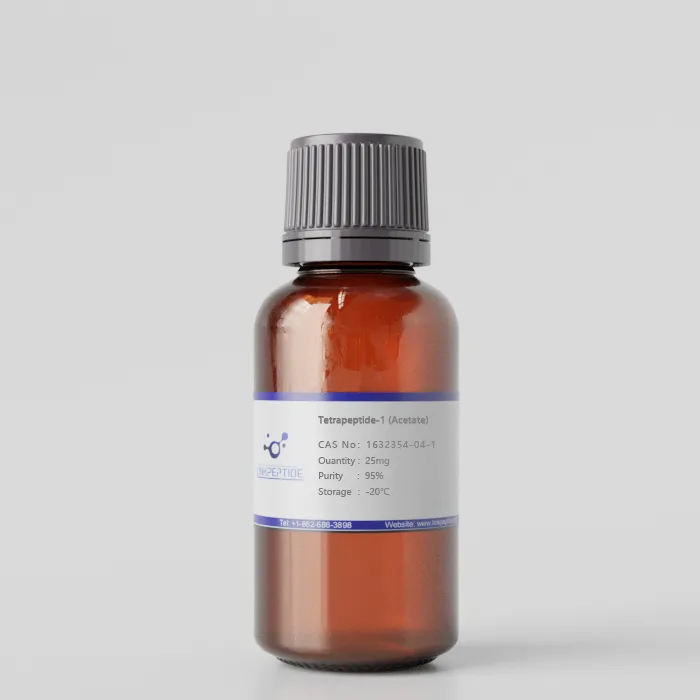
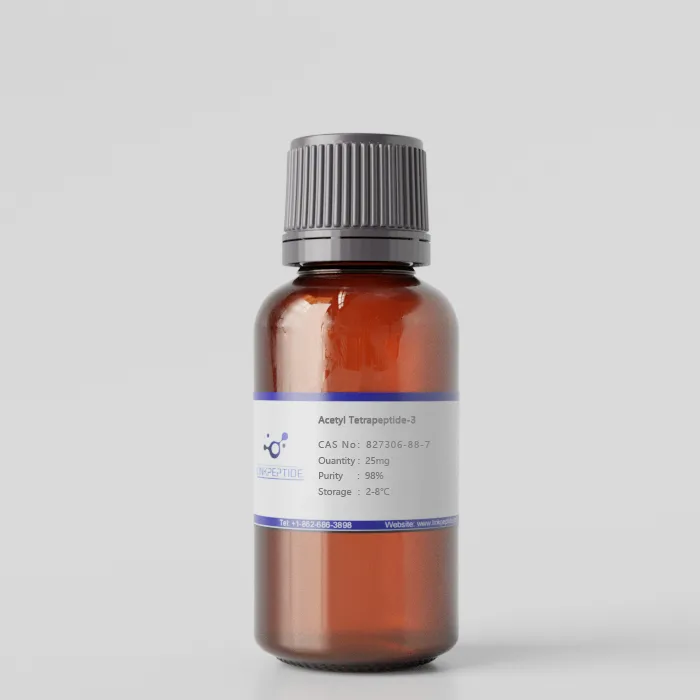
Product Name: Tetrapeptide-1 (Acetate)
Cas No: 1632354-04-1
Purity: 95%
Storage: Keep in dark and cool dry place -5~8 degree Celsius
Sequence: Leu-Pro-Thr-Val-OH
Molar Mass: 428.5
Chemical Formula: C20H36N4O6
Synonyms: orb2277279; HY-P5248; DA-58446; CS-0863856
IUPAC Name: (2S)-2-[[(2S,3R)-2-[[(2S)-1-[(2S)-2-amino-4-methylpentanoyl]pyrrolidine-2-carbonyl]amino]-3-hydroxybutanoyl]amino]-3-methylbutanoic acid
SMILES: C[C@H]([C@@H](C(=O)N[C@@H](C(C)C)C(=O)O)NC(=O)[C@@H]1CCCN1C(=O)[C@H](CC(C)C)N)O
InChIKey: BIKXAJOSLRDPNM-YXMSTPNBSA-N
InChI: InChI=1S/C20H36N4O6/c1-10(2)9-13(21)19(28)24-8-6-7-14(24)17(26)23-16(12(5)25)18(27)22-15(11(3)4)20(29)30/h10-16,25H,6-9,21H2,1-5H3,(H,22,27)(H,23,26)(H,29,30)/t12-,13+,14+,15+,16+/m1/s1
Application:
Tetrapeptide-1 (Acetate) is a bioactive peptide known for its skin-repairing and barrier-supporting properties. Composed of four amino acids, it helps promote a healthier skin appearance by supporting natural renewal processes and enhancing resistance to environmental stressors. In cosmetic research, Tetrapeptide-1 is widely used to explore soothing activity, improved hydration balance, and strengthened epidermal function. Its excellent stability and water solubility make it suitable for incorporation into serums, moisturizers, and restorative skincare formulations aimed at calming sensitive skin, improving smoothness, and reinforcing overall skin resilience.
Current Research:
Current Research & Cosmetic Relevance of Tetrapeptide-1 (Acetate)
Tetrapeptide-1 (Acetate) is a short, bioengineered peptide widely used in modern skincare for its skin-calming, barrier-supporting, and anti-aging effects. While many peptides target collagen or firming, Tetrapeptide-1 sits in a unique category: it is designed to help the skin recover from environmental stress, inflammation, and irritation, making it highly relevant for sensitive-skin, anti-redness, and “strengthening barrier” formulations.
Tetrapeptide-1 is a four–amino-acid peptide, often supplied in acetate salt form for stability and formulation compatibility. Its sequence is inspired by natural skin-signaling molecules that regulate repair processes. Because it is small, it has good water solubility and can be incorporated into serums, essences, emulsions, eye treatments, and post-procedure skincare.
While the exact sequence varies by supplier, the functional concept remains consistent: Tetrapeptide-1 acts as a skin-repair signaling peptide, guiding skin to behave in a calmer, more resilient way.
One of the strongest research themes around Tetrapeptide-1 is its barrier-supportive behavior. Studies show that it can:
Promote more efficient recovery after barrier disruption
Support the reorganization of key skin lipids
Reduce transepidermal water loss (TEWL)
Improve the quality and compactness of the stratum corneum
In practice, this translates to smoother skin texture, less flakiness, and improved overall resilience. These benefits make Tetrapeptide-1 ideal for formulations aimed at dryness, sensitivity, and “weakened barrier” conditions caused by pollution, over-exfoliation, or daily stress.
Tetrapeptide-1 is often highlighted for its ability to help skin respond better to irritation, redness triggers, and environmental aggressors. Research suggests that this peptide can:
Support a more balanced inflammatory response
Reduce the appearance of persistent redness
Enhance comfort after surfactant exposure, shaving, or cosmetic procedures
This makes Tetrapeptide-1 especially valuable in dermocosmetic formulations for reactive or redness-prone skin. Its soothing profile complements ingredients like niacinamide, oat derivatives, and beta glucans without adding stinging or sensitizing potential.
Although Tetrapeptide-1 is primarily associated with calming and barrier repair, newer research also demonstrates measurable anti-aging benefits. These effects appear to stem from:
Improved barrier function, which slows visible aging over time
Support for healthy extracellular matrix conditions
Reduced oxidative stress from pollution and UV exposure (cosmetic level)
As a result, Tetrapeptide-1 is increasingly included in anti-aging serums, especially those targeting dullness, uneven texture, and fine lines caused by environmental factors.
The peptide is also gaining popularity in blue-light and anti-pollution skincare, since environmental stress is now understood to accelerate aging through inflammation and oxidative damage. Tetrapeptide-1 fits perfectly into the “exposome defense” narrative widely used in marketing.
Tetrapeptide-1 combines well with many cosmetic ingredients, creating synergistic formulas:
With hyaluronic acid → reinforces hydration and plumping
With ceramides or fatty acids → boosts barrier repair
With peptides that target collagen (e.g., palmitoyl peptides) → provides a calming, balancing effect that improves tolerability
With antioxidants → adds a soothing dimension to “anti-stress” serums
In multi-peptide complexes, Tetrapeptide-1 is often included to enhance skin comfort and reduce irritation from stronger anti-aging ingredients.
Because it is extremely gentle and well tolerated, Tetrapeptide-1 is widely used in:
Eye creams to reduce puffiness and visible redness
Post-procedure soothing serums
Barrier-repair creams for sensitive skin
Anti-redness toners and essences
Baby or ultra-mild skincare formulas
Its calming, low-irritation profile makes it a preferred peptide for “minimalist,” “clean,” and “microbiome-friendly” product lines.
Get a Quote
 LinkPeptide