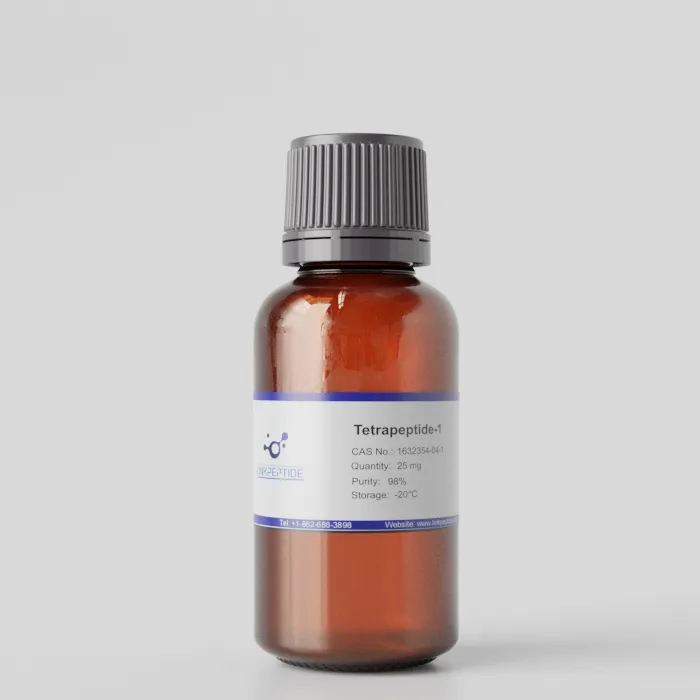
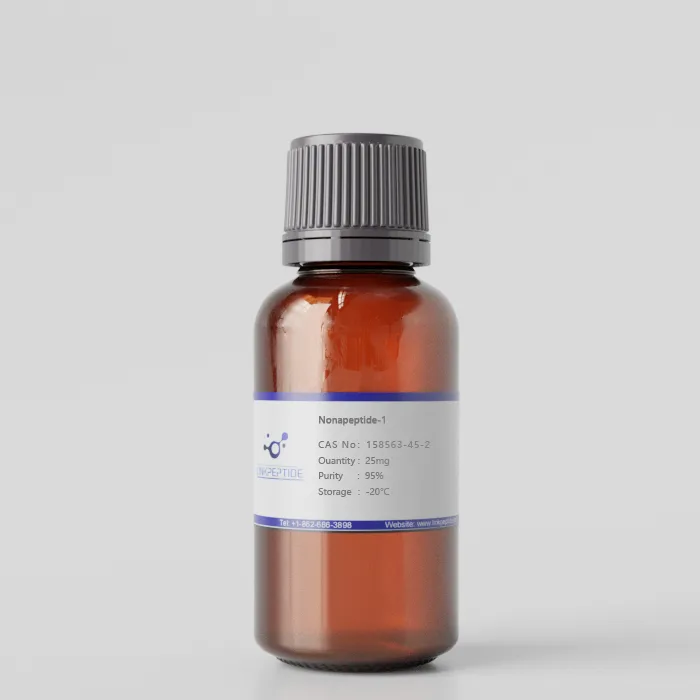
Product Name: Tetrapeptide-1
Cas No: 1632354-04-1
Purity: 98%
Form: Acetate Salt
Chemical Formula: C20H36N4O6
Molar Mass: 428.51
Synonyms: orb2277279; HY-P5248; DA-58446
IUPAC Name: (2S)-2-[[(2S,3R)-2-[[(2S)-1-[(2S)-2-amino-4-methylpentanoyl]pyrrolidine-2-carbonyl]amino]-3-hydroxybutanoyl]amino]-3-methylbutanoic acid
SMILES: CC@HC)C(=O)O)NC(=O)[C@@H]1CCCN1C(=O)C@HN)O
InChIKey: BIKXAJOSLRDPNM-YXMSTPNBSA-N
InChI: InChI=1S/C20H36N4O6/c1-10(2)9-13(21)19(28)24-8-6-7-14(24)17(26)23-16(12(5)25)18(27)22-15(11(3)4)20(29)30/h10-16,25H,6-9,21H2,1-5H3,(H,22,27)(H,23,26)(H,29,30)/t12-,13+,14+,15+,16+/m1/s1
Storage: -20 degree Celsius
Sequence: LPTV
Application:
Tetrapeptide-1 (GQPR) is a skin-conditioning peptide known for supporting natural skin renewal and helping maintain a balanced extracellular matrix. Its sequence, Gly-Gln-Pro-Arg, is associated with improved skin resilience and a more refined appearance. This tetrapeptide is often used to promote a healthier-looking complexion by reinforcing barrier function and reducing visible signs of irritation or stress. Its mild yet effective profile makes it ideal for daily skincare formulations such as toners, hydrating serums, and restoring creams. Tetrapeptide-1 pairs well with soothing botanicals and niacinamide, giving formulators a versatile bioactive for calm, radiant, and smooth-looking skin.
Current Research:
Tetrapeptide-1 (GQPR) – Current Research Overview
Tetrapeptide-1 is a biomimetic peptide with the sequence Gly-Gln-Pro-Arg (GQPR). In cosmetic science it is primarily recognized as a skin-conditioning and restorative active that supports barrier function, helps modulate low-grade inflammation, and contributes to a more even, calm complexion. The sequence is derived from a fragment associated with immunoglobulin G (IgG), and this origin underpins its positioning as a “signal peptide” involved in controlling local inflammatory responses and matrix turnover. Current research and technical literature describe Tetrapeptide-1 as a versatile ingredient for sensitive skin, anti-redness, and “skin immunity” concepts, as well as an adjunct in anti-aging formulas.
GQPR was originally identified as a short peptide fragment generated during the breakdown of immunoglobulin G. In physiological systems, such fragments can participate in feedback regulation of inflammatory and immune processes. By isolating and synthesizing this specific sequence, Tetrapeptide-1 was developed as a cosmetic active aimed at gently rebalancing skin that is prone to irritation, redness, and environmental stress. Its small size and water solubility make it easy to incorporate into modern formulations such as serums, toners, gels, and light emulsions.
From a conceptual standpoint, Tetrapeptide-1 is positioned at the intersection of immunocosmetics and barrier science, offering a peptide-based way to support skin’s natural defenses without relying on classical anti-inflammatory drugs.
A core theme in current research on Tetrapeptide-1 is its influence on pro-inflammatory mediators. In vitro studies using keratinocytes and reconstructed skin models report that Tetrapeptide-1 can reduce the expression or release of certain cytokines and chemokines associated with irritation and subclinical inflammation, such as IL-1α and TNF-α. By dampening these signals, the peptide may help limit the cascade that leads to redness, stinging, and long-term barrier disruption.
Some experimental work also suggests that Tetrapeptide-1 can reduce the activation of proteases and other enzymes involved in inflammation-driven tissue damage. This regulatory effect is subtle rather than suppressive, aligning with its cosmetic use as a modulator instead of a pharmacological anti-inflammatory. In the cosmetic context, this translates into claims such as “soothing,” “anti-redness,” “comforting,” and “ideal for sensitive skin.”
Another important area of investigation is the peptide’s role in maintaining and restoring skin barrier integrity. Studies on epidermal models indicate that Tetrapeptide-1 can support the expression of barrier-related proteins and lipids, helping to restore optimal stratum corneum organization. Improved barrier quality reduces transepidermal water loss (TEWL), leading to better hydration and reduced susceptibility to external aggressors such as pollution, temperature changes, and harsh surfactants.
Indirectly, Tetrapeptide-1 is also described as influencing extracellular matrix dynamics. While its effects on collagen and elastin are generally more modest than those of classic “firming” peptides, stabilizing the epidermal environment and reducing chronic low-grade inflammation helps protect dermal structures over time. This forms the basis for including Tetrapeptide-1 not only in calming products but also in comprehensive anti-aging routines, where maintaining a healthy barrier and limiting “inflammaging” are crucial.
Cosmetic industry evaluations of Tetrapeptide-1 highlight visible improvements in redness, comfort, and overall complexion uniformity. In human tests, formulations containing Tetrapeptide-1 have been associated with reductions in erythema scores, increased subjective comfort, and faster recovery after irritation challenges such as chemical or environmental stressors. Many of these studies are conducted by ingredient suppliers and rely on biophysical measurements (e.g., colorimetry, TEWL) combined with visual scoring.
Some trials have also reported improvements in fine lines and texture when Tetrapeptide-1 is used in combination with moisturizing and barrier-supportive bases. These anti-aging observations are generally incremental rather than dramatic, but they fit the current view that controlling inflammation and maintaining barrier integrity contributes to long-term preservation of skin quality.
Tetrapeptide-1 is considered safe at typical cosmetic use levels and is widely used in leave-on products. Toxicological assessments have not identified significant irritation, sensitization, or phototoxicity at the concentrations employed in skincare. Its gentle mode of action makes it particularly suitable for:
Sensitive and reactive skin lines
Post-procedure or recovery-focused products
Anti-pollution and urban-stress defense formulas
Daily moisturizers and serums designed for long-term “skin resilience”
Because it is a small, non-ionic peptide, Tetrapeptide-1 is also compatible with a broad range of formulation styles, including minimal and “clean” formulations where the total number of ingredients is intentionally limited.
Current and emerging work around Tetrapeptide-1 explores synergies with other actives—for example, pairing it with niacinamide, panthenol, ceramide complexes, or microbiome-friendly ingredients to build multi-layered barrier and soothing benefits. There is also interest in more advanced delivery systems, such as encapsulation or association with lamellar lipid structures, to support prolonged release and enhanced deposition in the upper layers of the skin.
Overall, Tetrapeptide-1 is increasingly viewed as a foundational peptide for formulations targeting sensitive, stressed, or inflamed skin, and as a valuable supporting player in broader anti-aging strategies built around barrier health and inflammation control.
Reference:
Get a Quote
 LinkPeptide