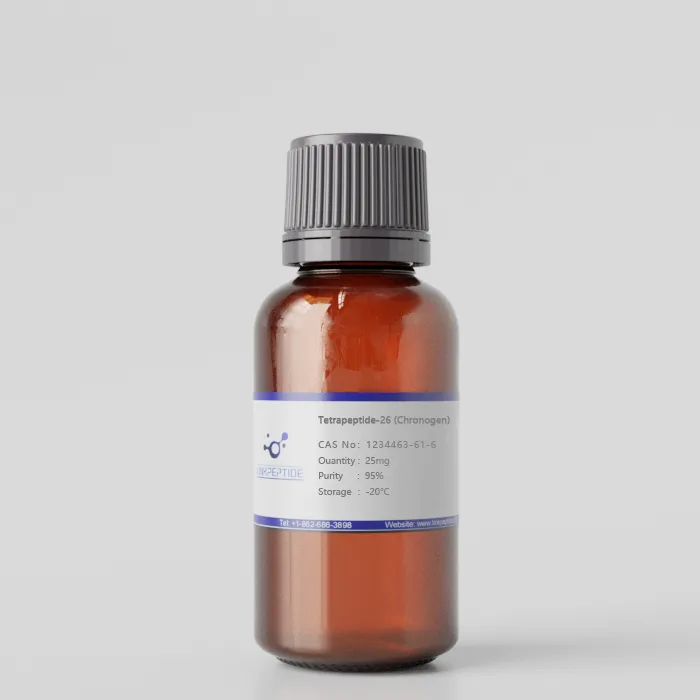
Product Name: Tetrapeptide-26 (Chronogen)
Cas No: 1234463-61-6
Purity: 95%
Storage: Keep in dark and cool dry place -5~8 degree Celsius
Sequence: H-Ser-Pro-Leu-Gln-NH2
Molar Mass: 442.5
Chemical Formula: C19H34N6O6
IUPAC Name: (2S)-2-[[(2S)-2-[[(2S)-1-[(2S)-2-amino-3-hydroxypropanoyl]pyrrolidine-2-carbonyl]amino]-4-methylpentanoyl]amino]pentanediamide
SMILES: CC(C)C[C@@H](C(=O)N[C@@H](CCC(=O)N)C(=O)N)NC(=O)[C@@H]1CCCN1C(=O)[C@H](CO)N
InChIKey: XUMLWJDGGVUUNI-XUXIUFHCSA-N
InChI: InChI=1S/C19H34N6O6/c1-10(2)8-13(17(29)23-12(16(22)28)5-6-15(21)27)24-18(30)14-4-3-7-25(14)19(31)11(20)9-26/h10-14,26H,3-9,20H2,1-2H3,(H2,21,27)(H2,22,28)(H,23,29)(H,24,30)/t11-,12-,13-,14-/m0/s1
Application:
Tetrapeptide-26 (Chronogen) is a biomimetic peptide developed to support the skin’s natural circadian rhythm and enhance daily repair processes. By boosting DNA protection and cellular resilience, Chronogen helps fortify the skin against UV and environmental stress while promoting a more radiant, well-rested appearance. In cosmetic research, it is valued for improving skin vitality, evening tone, and reducing visible signs of fatigue. Its excellent stability and compatibility with serums, essences, and day–night treatments make Tetrapeptide-26 ideal for formulations focused on defending the skin’s integrity, supporting recovery, and restoring a smoother, healthier-looking complexion.
Current Research:
Tetrapeptide-26 (Chronogen): Current Research Overview
Tetrapeptide-26, trade name Chronogen?, is a synthetic anti-aging tetrapeptide designed using molecular biology and epigenetic concepts to target the skin’s circadian clock and DNA repair systems. Chemically, it’s a short peptide with the sequence Ser–Pro–Leu–Gln-NH? (SPLQ-NH?) and a molecular weight around 442.5 Da.
Unlike classic collagen signal peptides, Tetrapeptide-26 is positioned as a chrono-protective peptide: it boosts the expression of clock genes in keratinocytes to coordinate defense against UV and environmental damage with optimized repair, day and night.
Mechanism of Action: Clock Genes, DNA Repair, and UV Defense
Skin cells follow a circadian rhythm: during the day they emphasize protection; at night they shift toward repair and regeneration. With age, stress, and irregular lifestyles, this rhythm becomes less efficient. Tetrapeptide-26 was developed to support and “re-train” this system at the genetic level.
In keratinocyte models, Tetrapeptide-26 has been shown to up-regulate key clock genes:
CLOCK (Circadian Locomotor Output Cycles Kaput)
BMAL1 (Basic Helix-Loop-Helix ARNT-Like 1)
PER1 (Period 1)
These genes form the core molecular clock that controls cellular defense cycles, including antioxidant responses, stress signaling, and timing of DNA repair. Enhancing their expression helps synchronize and strengthen the skin’s natural protective rhythm.
By stimulating clock gene expression, Tetrapeptide-26 increases the production of proteins involved in DNA repair and cell defense. Technical data show that it:
Enhances keratinocyte survival after UV and environmental stress.
Promotes the expression of DNA repair enzymes and protective factors, supporting more efficient correction of UV-induced lesions.
This is why it’s often described as a peptide that protects by day and repairs by night, strengthening skin’s resilience against photoaging.
A notable claim is that Tetrapeptide-26 can activate defense pathways independently of the external day/night cycle, meaning its benefits are not restricted to a specific application time. In practice, this allows brands to position it in all-day or anytime anti-aging formulas, while still leveraging the circadian-biology story.
Place in Modern Cosmetic Peptide Science
Within peptide taxonomy, Tetrapeptide-26 belongs to:
Chrono-biological / circadian peptides (like Tripeptide-32),
DNA-repair and photoprotection-support actives,
Anti-aging peptides for urban/environmental stress.
Like Tripeptide-32, it targets clock-controlled defense and repair, but sources highlight that Tetrapeptide-26 more strongly enhances BMAL1 expression, a key CLOCK partner, potentially improving the overall efficiency of the molecular clock complex.
Conceptually, it fits well with:
“24/7 defense & repair” anti-aging ranges,
“Urban shield” formulas addressing UV, pollution, and lifestyle stress,
After-sun and photoaging-focused care, where circadian repair is critical.
In Vitro, Ex Vivo, and Application Data
Most data currently available are manufacturer and technical-source studies rather than large independent clinical trials, but they are fairly consistent:
In vitro / ex vivo findings
Increased mRNA expression of CLOCK, BMAL1, PER1 in keratinocytes after Tetrapeptide-26 treatment.
Improved keratinocyte viability and reduced markers of UV-induced damage in treated skin models.
Indications of enhanced DNA repair capacity and better maintenance of barrier-related functions under environmental stress.
Cosmetic-style evaluations
Formulas containing Tetrapeptide-26 are reported to reduce signs of photoaging, such as dullness and roughness, and to support smoother texture and improved radiance over several weeks of use.
These are typical cosmetic-grade studies (small samples, short durations), so marketing claims should stay clearly within appearance and support language rather than therapeutic promises.
Get a Quote
 LinkPeptide