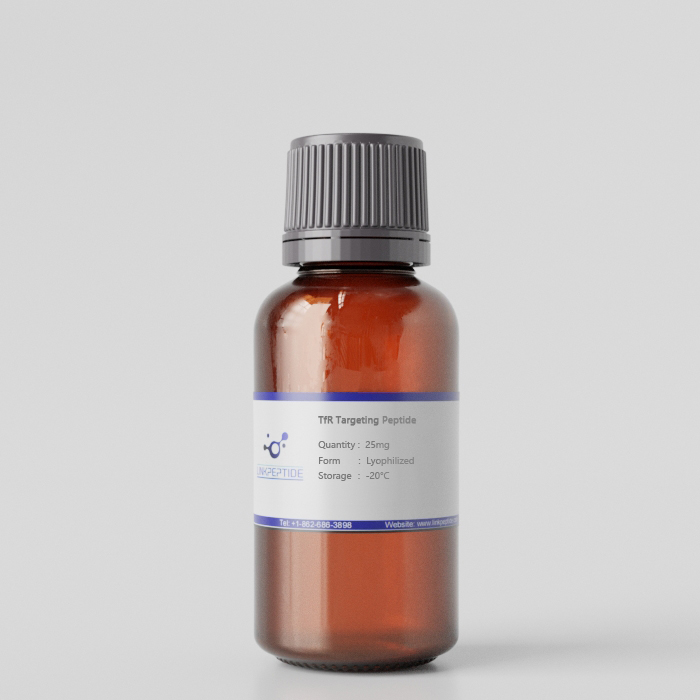
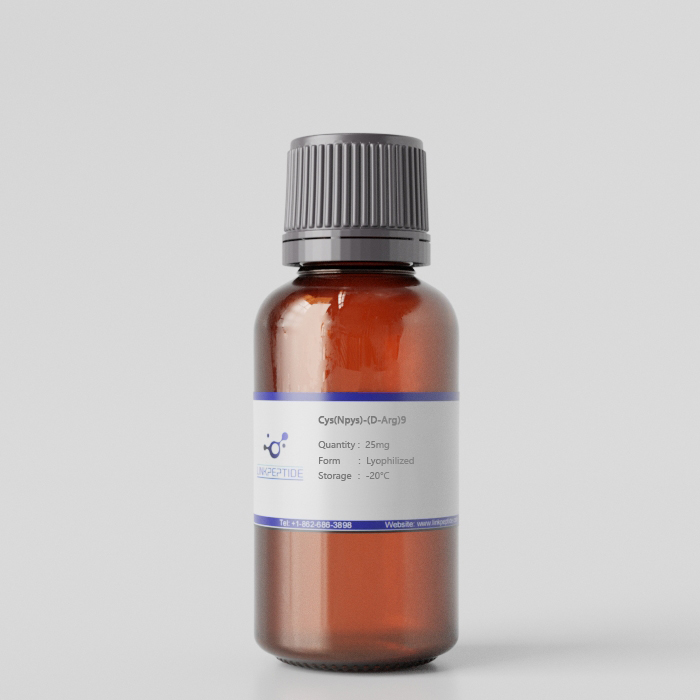
Product Name: TfR Targeting Peptide
Sequence One Letter Code: THRPPMWSPVWP
Sequence Three Letter Code: H-Thr-His-Arg-Pro-Pro-Met-Trp-Ser-Pro-Val-Trp-Pro-OH
Molecular Weight: 1490.8
Purity: 95%
Form: Lyophilized
Storage Conditions: - 20 °C
Research Area: Cardiovascular Disease Research
Conjugation: Unconjugated
Code Nacres: NA.26
Application: TfR Targeting Peptide is a synthetic 12-mer designed to bind the transferrin receptor (TfR), which is highly expressed in proliferating cells and at the blood–brain barrier. Upon binding, the peptide undergoes receptor-mediated endocytosis, enabling efficient cellular internalization. This property makes it a valuable tool for studying receptor trafficking, endocytosis mechanisms, and cellular uptake pathways. Due to its targeting capability, the peptide is widely explored as a delivery vector for transporting small molecules, imaging agents, and therapeutics into TfR-expressing tissues. It is particularly useful in research focused on brain delivery and cancer targeting, where TfR is upregulated. The peptide supports investigations into targeted drug delivery, receptor biology, and transport across biological barriers.
Current Research: Targeted delivery strategies are increasingly important in biomedical research, particularly for improving the specificity and efficiency of therapeutic and diagnostic agents. One of the most widely explored targets for such strategies is the transferrin receptor (TfR), a membrane protein involved in iron uptake that is highly expressed in proliferating cells and at the blood–brain barrier (BBB). The TfR Targeting Peptide is a synthetic 12-amino-acid peptide engineered to bind this receptor with high affinity, enabling receptor-mediated internalization and intracellular delivery. Because of its ability to exploit endogenous transport pathways, this peptide has become a valuable tool for studying endocytosis, receptor trafficking, and targeted delivery systems, particularly in cancer biology and central nervous system (CNS) research. Transferrin Receptor Biology and Function The transferrin receptor (TfR), also known as CD71, is a transmembrane glycoprotein responsible for mediating the uptake of transferrin-bound iron into cells. Iron is essential for cellular processes such as DNA synthesis, mitochondrial respiration, and cell proliferation. As a result, TfR expression is upregulated in rapidly dividing cells, including many types of cancer cells. In addition to its role in peripheral tissues, TfR is highly expressed on the endothelial cells of the blood–brain barrier, where it facilitates transport of iron into the brain. This makes TfR an attractive target for delivering molecules across the BBB, a major challenge in drug development for neurological diseases. Mechanism of Receptor-Mediated Endocytosis The TfR Targeting Peptide is designed to bind specifically to the extracellular domain of the transferrin receptor. Upon binding, the peptide–receptor complex is internalized via clathrin-mediated endocytosis, a well-characterized cellular uptake pathway. Once inside the cell, the complex is trafficked through endosomal compartments, where cargo molecules linked to the peptide can be released into the cytoplasm or further transported depending on their design. This mechanism allows researchers to study: Receptor internalization dynamics Endosomal trafficking pathways Intracellular delivery efficiency Recycling or degradation of receptor–ligand complexes Because the process mimics natural transferrin uptake, it provides a physiologically relevant model for studying receptor-mediated transport. Applications in Targeted Drug Delivery One of the most significant advantages of the TfR Targeting Peptide is its ability to function as a delivery vector. By conjugating the peptide to therapeutic agents, imaging probes, or nanoparticles, researchers can direct these cargos to TfR-expressing cells and tissues. This strategy is particularly valuable in: Cancer targeting, where TfR is overexpressed in many tumor types Brain delivery, enabling transport across the blood–brain barrier Targeted imaging, improving localization of diagnostic agents Nanoparticle-based drug delivery systems The peptide’s targeting capability enhances cellular uptake and may improve the specificity of delivery compared with non-targeted approaches. Role in Blood–Brain Barrier Research Crossing the blood–brain barrier remains a major obstacle in the treatment of neurological disorders. The TfR Targeting Peptide provides a promising approach to overcome this challenge by leveraging receptor-mediated transcytosis. In BBB models, the peptide can facilitate transport of conjugated molecules across endothelial cells into the brain parenchyma. This makes it a valuable tool for studying: Transport mechanisms across the BBB Optimization of CNS drug delivery systems Interaction between targeting ligands and endothelial receptors Such studies are critical for developing therapies for conditions such as neurodegenerative diseases, brain tumors, and central nervous system disorders. Applications in Receptor Biology and Cellular Uptake Studies Beyond delivery applications, the TfR Targeting Peptide is widely used in basic research to investigate receptor biology and endocytic pathways. By tracking the peptide or its conjugates, researchers can gain insights into: Receptor expression and distribution Ligand–receptor binding kinetics Intracellular trafficking routes Cellular uptake efficiency in different cell types These studies contribute to a deeper understanding of how cells regulate membrane receptors and internalize external molecules. A Valuable Tool for Targeted Therapeutic Research The TfR Targeting Peptide represents a powerful platform for exploring targeted delivery and receptor-mediated transport. Its ability to bind the transferrin receptor and undergo efficient internalization makes it highly versatile for both mechanistic studies and applied research. As interest in precision medicine and targeted therapies continues to grow, tools that enable selective delivery to specific cell populations are increasingly important. By supporting investigations into drug delivery, receptor trafficking, and transport across biological barriers, the TfR Targeting Peptide plays a key role in advancing research in cancer, neuroscience, and translational medicine.
Get a Quote
 LinkPeptide