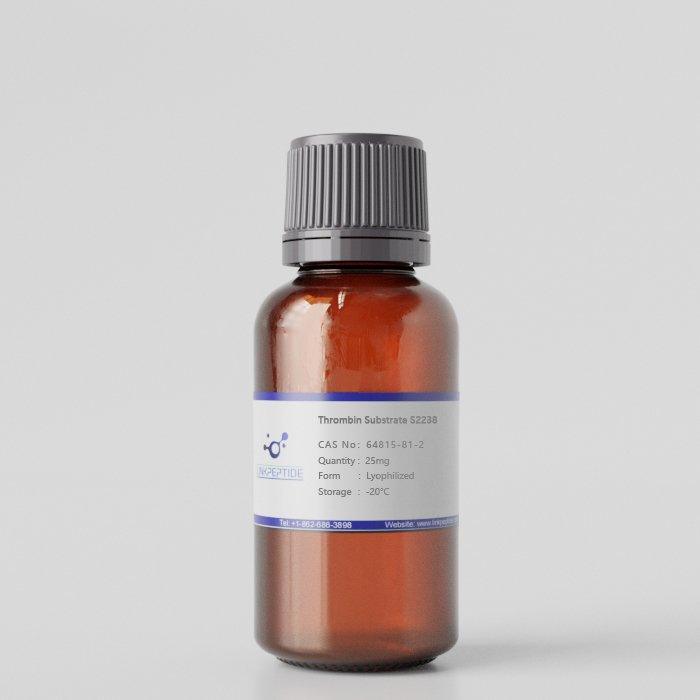
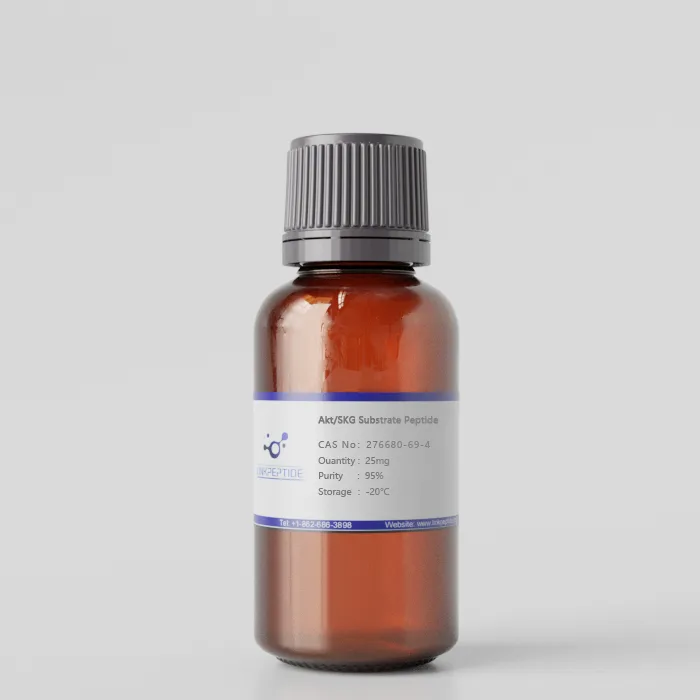
Product Name: Thrombin Substrate S2238 1 mg
Sequence One Letter Code: f-Pip-R-pNA
Sequence Three Letter Code: H-D-Phe-Pip-Arg-pNA
Cas No: 64815-81-2
Chemical Formula:C27H36N8O5
Molecular Weight: 552.6
Purity: 95%
Form: Lyophilized
Storage Conditions: - 20 °C Protected from light
Research Area: peptide substrate
SMILES: C1CCN([C@@H](C1)C(=O)N[C@@H](CCCN=C(N)N)C(=O)NC2=CC=C(C=C2)[N+](=O)[O-])C(=O)[C@@H](CC3=CC=CC=C3)N
IUPAC: (2S)-1-[(2R)-2-amino-3-phenylpropanoyl]-N-[(2S)-5-(diaminomethylideneamino)-1-(4-nitroanilino)-1-oxopentan-2-yl]piperidine-2-carboxamide
INCHIKEY: YDMBNDUHUNWWRP-VJBWXMMDSA-N
INCHI:
InChI=1S/C27H36N8O5/c28-21(17-18-7-2-1-3-8-18)26(38)34-16-5-4-10-23(34)25(37)33-22(9-6-15-31-27(29)30)24(36)32-19-11-13-20(14-12-19)35(39)40/h1-3,7-8,11-14,21-23H,4-6,9-10,15-17,28H2,(H,32,36)(H,33,37)(H4,29,30,31)/t21-,22+,23+/m1/s1
Source / Species: human
Conjugation: Conjugated
Conjugation Type: Conjugates
Code Nacres: NA.26
Application: This chromogenic peptide substrate is designed for quantitative measurement of thrombin activity. Upon proteolytic cleavage by thrombin, the substrate releases a chromophore detectable by absorbance at 405 nm, enabling straightforward kinetic and endpoint assays. The assay format supports precise monitoring of enzyme activity and inhibitor potency. This substrate is widely used in coagulation research, enzyme kinetics studies, anticoagulant screening, and quality control applications involving thrombin function. It provides a reliable tool for investigations into hemostasis, thrombotic disorders, and thrombin-mediated cellular signaling.
Current Research: Thrombin is a central enzyme in the blood coagulation cascade, playing a critical role in converting soluble fibrinogen into insoluble fibrin during clot formation. Beyond its function in hemostasis, thrombin also participates in platelet activation, inflammation, and cell signaling through protease-activated receptors (PARs). Because of its pivotal biological functions, thrombin activity is widely studied in fields ranging from coagulation biology and cardiovascular disease research to anticoagulant drug development. One of the most widely used approaches for monitoring thrombin activity is the use of chromogenic peptide substrates, which allow rapid and quantitative measurement of enzymatic activity in biochemical assays. Thrombin in Hemostasis and Cellular Signaling Thrombin is a serine protease generated from its precursor prothrombin during the coagulation cascade. Once activated, thrombin performs several essential functions. Its most well-known role is the cleavage of fibrinogen to form fibrin, which polymerizes to create the structural framework of a blood clot. Thrombin also activates clotting factors V, VIII, XI, and XIII, amplifying the coagulation process and stabilizing fibrin networks. In addition to these coagulation functions, thrombin acts as a signaling molecule in many cell types. Through activation of protease-activated receptors (PARs), thrombin can influence endothelial cell function, platelet aggregation, inflammation, and vascular remodeling. Because thrombin participates in both physiological hemostasis and pathological thrombosis, accurate measurement of its enzymatic activity is essential for studying coagulation disorders and evaluating therapeutic interventions. Principle of Chromogenic Peptide Substrates Chromogenic peptide substrates are designed to mimic natural protease recognition sequences while incorporating a color-generating reporter group. In the case of thrombin assays, the substrate contains a peptide sequence specifically recognized and cleaved by thrombin. Attached to this peptide is a chromogenic leaving group that becomes detectable once released by enzymatic cleavage. When thrombin cleaves the peptide bond within the substrate, the reaction releases the chromophore, which generates a color signal measurable by spectrophotometry, typically at 405 nm. The increase in absorbance over time is directly proportional to the amount of substrate cleavage, allowing researchers to track enzymatic activity quantitatively. This reaction format offers several advantages. Because the signal can be measured continuously, researchers can perform real-time kinetic assays that reveal enzyme reaction rates. Alternatively, endpoint measurements can be taken after a fixed incubation period to evaluate total activity under defined conditions. Quantitative Measurement of Thrombin Activity Chromogenic thrombin substrates provide a straightforward method for quantifying enzyme activity in both purified systems and complex biological samples. By monitoring absorbance at 405 nm, researchers can determine reaction velocities, enzyme concentrations, and catalytic efficiency. In enzyme kinetics studies, the rate of chromophore release can be used to calculate parameters such as Km, Vmax, and catalytic turnover rates. These measurements help characterize how thrombin interacts with substrates and how environmental factors such as pH, ionic strength, or cofactors influence enzymatic function. Because the chromogenic signal is robust and easily detected, these assays are particularly well suited for microplate-based experimental formats, enabling rapid analysis of multiple samples simultaneously. Applications in Anticoagulant Drug Screening One of the most important uses of chromogenic thrombin substrates is in the screening and evaluation of anticoagulant compounds. Many therapeutic strategies for preventing thrombosis aim to inhibit thrombin activity directly or indirectly. Examples include direct thrombin inhibitors such as dabigatran and other small-molecule inhibitors under investigation. In inhibitor assays, candidate compounds are incubated with thrombin prior to substrate addition. If a compound effectively inhibits thrombin, the rate of chromogenic substrate cleavage decreases, resulting in a reduced absorbance signal. By comparing reaction rates across different inhibitor concentrations, researchers can determine inhibitory potency and dose–response relationships. These assays are widely used in drug discovery programs aimed at identifying new anticoagulant agents with improved safety and efficacy profiles. Role in Coagulation and Thrombosis Research Chromogenic thrombin substrates are also essential tools for studying coagulation mechanisms and thrombotic disorders. Researchers investigating conditions such as deep vein thrombosis, stroke, and disseminated intravascular coagulation often rely on these assays to evaluate thrombin generation and activity. In laboratory research, chromogenic assays help clarify how coagulation factors interact, how mutations affect thrombin function, and how regulatory proteins influence clot formation. Because thrombin activity is tightly controlled by inhibitors such as antithrombin and protein C, these substrates can also be used to study regulatory pathways that maintain hemostatic balance. Quality Control and Analytical Applications Beyond basic research, chromogenic thrombin substrates are used in quality control and analytical testing. For example, they can help verify the activity of recombinant thrombin preparations or monitor enzyme stability during production and storage. In clinical laboratory settings, similar chromogenic assays are sometimes applied to evaluate components of the coagulation system. A Reliable Tool for Studying Thrombin Function Chromogenic peptide substrates provide a simple, sensitive, and quantitative approach for measuring thrombin activity. By generating a measurable absorbance signal upon enzymatic cleavage, these substrates enable precise monitoring of thrombin kinetics, inhibitor activity, and enzyme regulation. As a result, chromogenic thrombin substrates remain widely used in coagulation research, anticoagulant drug screening, enzyme kinetics analysis, and quality control applications. Their reliability and ease of use make them valuable tools for advancing our understanding of hemostasis, thrombotic disease mechanisms, and thrombin-mediated cellular signaling pathways.
Get a Quote
 LinkPeptide