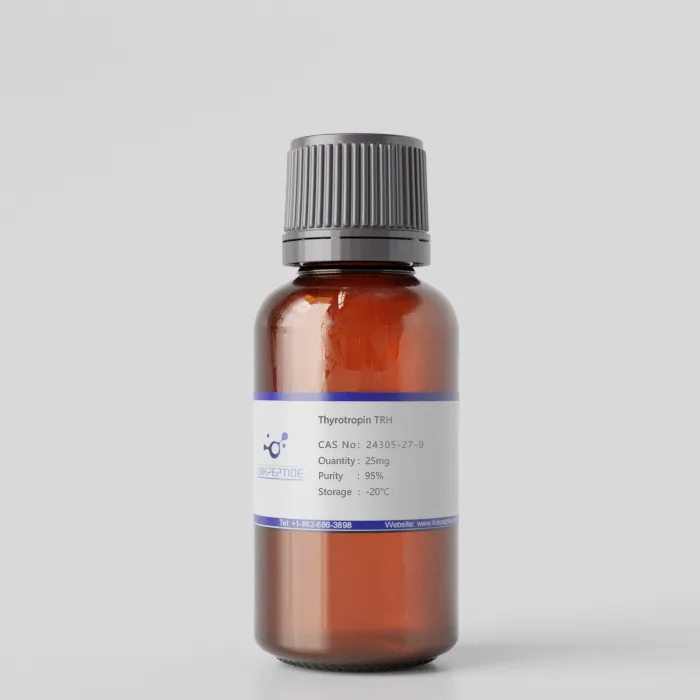
Product Name:Thyrotropin TRH
Cas No:24305-27-9
Purity:95%
Chemical Formula:C16H22N6O4
Molar Mass:362.38
Synonyms:protirelin; 24305-27-9; Thyroliberin; Lopremone; Synthetic TRH; Rifathyroin
IUPAC Name:(2S)-N-[(2S)-1-[(2S)-2-carbamoylpyrrolidin-1-yl]-3-(1H-imidazol-5-yl)-1-oxopropan-2-yl]-5-oxopyrrolidine-2-carboxamide
SMILES:C1C[C@H](N(C1)C(=O)[C@H](CC2=CN=CN2)NC(=O)[C@@H]3CCC(=O)N3)C(=O)N
InChIKey:XNSAINXGIQZQOO-SRVKXCTJSA-N
InChI:InChI=1S/C16H22N6O4/c17-14(24)12-2-1-5-22(12)16(26)11(6-9-7-18-8-19-9)21-15(25)10-3-4-13(23)20-10/h7-8,10-12H,1-6H2,(H2,17,24)(H,18,19)(H,20,23)(H,21,25)/t10-,11-,12-/m0/s1
Storage:-20 degree Celsius
Sequence:XHP
Application:Thyrotropin-Releasing Hormone (TRH) is a naturally occurring tripeptide (L-pyroglutamyl–L-histidyl–L-proline amide) synthesized in the hypothalamus and secreted into the hypophyseal portal circulation to regulate thyroid-stimulating hormone (TSH) release from the anterior pituitary. TRH is essential in maintaining thyroid hormone homeostasis, indirectly influencing metabolism, growth, and neurodevelopment. Beyond its endocrine role, TRH also acts as a neurotransmitter and neuromodulator, with effects on arousal, mood, cognition, and autonomic function. It is used in research involving thyroid axis function, CNS disorders, and hormonal feedback mechanisms, particularly under stress, aging, and metabolic dysregulation.
Current Research:
Introduction: What Is TRH?
Thyrotropin-Releasing Hormone (TRH) is a tripeptide hormone produced primarily in the paraventricular nucleus of the hypothalamus, composed of L-pyroglutamyl–L-histidyl–L-proline amide. TRH is best known as the initiating signal in the hypothalamic-pituitary-thyroid (HPT) axis, where it stimulates the release of thyroid-stimulating hormone (TSH) from the anterior pituitary gland.
Though first identified for its endocrine function, TRH is now understood to act widely throughout the central nervous system (CNS) and peripheral tissues, exerting neurotransmitter-like and neuromodulatory effects involved in mood, thermoregulation, appetite, and arousal.
Endocrine Function: HPT Axis Regulation
TRH is the primary hypothalamic regulator of thyroid function. Its pathway is as follows:
Synthesized in the hypothalamus and secreted into the median eminence
Travels via the hypophyseal portal system to the anterior pituitary
Binds to TRH receptors on thyrotrophs, stimulating TSH release
TSH then acts on the thyroid gland to promote the production of T3 and T4 hormones
These thyroid hormones play a pivotal role in metabolism, cardiovascular regulation, thermogenesis, and neurodevelopment, making TRH essential for both homeostasis and adaptation to physiological stress.
Neuroregulatory and CNS Effects
In addition to its endocrine function, TRH is found in various regions of the brainstem, spinal cord, hippocampus, and limbic system, where it influences:
Arousal and wakefulness
Mood stabilization (notably anti-depressant effects)
Motor control and coordination
Autonomic regulation, including gastrointestinal motility and thermoregulation
TRH interacts with neurotransmitter systems such as dopamine, serotonin, acetylcholine, and GABA, and has been studied as a rapid-acting antidepressant, particularly in treatment-resistant or bipolar depression.
TRH in Aging and Neurodegeneration
TRH production tends to decline with age, contributing to decreased HPT axis responsiveness and neuroendocrine dysregulation. Research has shown that:
Reduced TRH signaling may contribute to age-related cognitive decline, slower metabolism, and thyroid underactivity
Exogenous TRH or TRH analogs can enhance cognitive function, especially under conditions of stress or neurodegeneration
TRH has neuroprotective effects in models of Parkinson’s, Alzheimer’s, and ALS, supporting neuronal survival and reducing oxidative stress
This has led to increasing interest in TRH as a geroprotective neuropeptide with both endocrine and CNS rejuvenating properties.
Therapeutic and Diagnostic Use
TRH is used in both experimental and clinical settings to evaluate pituitary function, especially in cases of suspected:
Secondary hypothyroidism (pituitary dysfunction)
Tertiary hypothyroidism (hypothalamic dysfunction)
Delayed puberty or endocrine resistance syndromes
It is also being explored as a therapeutic agent in:
Refractory depression and bipolar disorder
Narcolepsy and hypersomnia
Spinal cord injury, where it may aid in motor recovery and autonomic stabilization
Modified TRH analogs with extended half-life and blood-brain barrier penetration are under development for neurological applications.
Biochemistry and Stability
TRH is rapidly degraded by serum peptidases, giving it a short half-life (~5 minutes) in circulation. For research and therapeutic use, analogs or specialized delivery methods (e.g., intrathecal, intranasal, or parenteral infusion) are often employed to overcome bioavailability limitations.
Research formulations of TRH or TRH-mimetics are carefully stabilized for in vivo and in vitro models assessing hormone secretion, mood regulation, or CNS resilience.
Conclusion
Thyrotropin-Releasing Hormone (TRH) is a multifunctional tripeptide with central roles in thyroid regulation, neuroendocrine balance, and brain signaling. While best known for its role in the HPT axis, TRH’s impact on mood, arousal, and cognition has broadened its research relevance. With ongoing exploration in neuropsychiatric therapy, endocrinology, and aging resilience, TRH remains a key subject in the development of next-generation peptide-based therapeutics.
Reference:
Get a Quote


 LinkPeptide