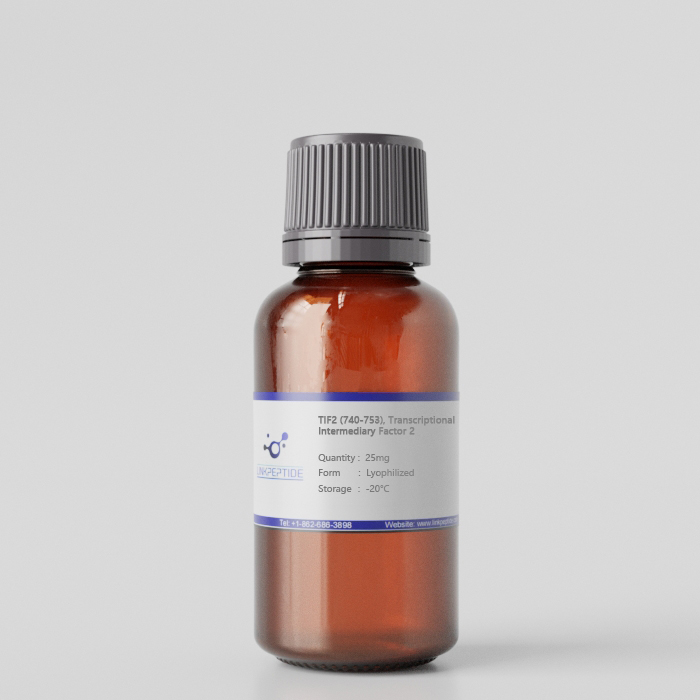
Product Name: TIF2 (740-753), Transcriptional Intermediary Factor 2
Sequence One Letter Code: KENALLRYLLDKDD
Sequence Three Letter Code: H-Lys-Glu-Asn-Ala-Leu-Leu-Arg-Tyr-Leu-Leu-Asp-Lys-Asp-Asp-OH
Chemical Formula:C75H124N20O25
Molecular Weight: 1706
Purity: 95%
Form: Lyophilized
Storage Conditions: - 20 °C
Research Area: Endocrinology Disease Research
Source / Species: Human, mouse, rat
Conjugation: Unconjugated
Code Nacres: NA.26
Application: TIF2 (740–753) is a synthetic peptide representing the NR box B3 region of transcriptional intermediary factor 2, a member of the p160 co-activator family. This region contains the conserved LXXLL motif that mediates ligand-dependent interactions between nuclear receptors and transcriptional co-regulators. The peptide is widely used in biochemical and structural assays to study nuclear receptor–coactivator binding, receptor activation mechanisms, and transcriptional complex assembly. It supports investigations into hormone-dependent gene expression, receptor specificity, and modulation of transcriptional regulation pathways.
Current Research: Transcriptional intermediary factor 2 (TIF2), also known as SRC-2 or GRIP1, is a member of the p160 family of nuclear receptor coactivators that regulate hormone-dependent gene expression. These coactivators function by bridging ligand-activated nuclear receptors to the basal transcriptional machinery and chromatin-modifying enzymes. Central to this interaction is the conserved LXXLL motif—often referred to as the “NR box”—which mediates direct binding to the ligand-binding domain (LBD) of nuclear receptors in a ligand-dependent manner. TIF2 (740–753) is a synthetic peptide corresponding to the NR box B3 region of TIF2 and contains this canonical LXXLL sequence, making it a widely used reagent for biochemical and structural studies of receptor–coactivator recognition. The LXXLL motif adopts an α-helical conformation upon binding to the activated nuclear receptor LBD. Ligand binding to receptors such as estrogen receptor (ER), androgen receptor (AR), glucocorticoid receptor (GR), thyroid hormone receptor (TR), and peroxisome proliferator-activated receptors (PPARs) induces a conformational rearrangement in helix 12 of the LBD. This creates a hydrophobic coactivator-binding groove that selectively accommodates the amphipathic α-helix formed by the LXXLL-containing peptide. TIF2 (740–753) serves as a minimal functional element that recapitulates this interaction interface, enabling detailed characterization of receptor–coactivator engagement. In biochemical binding assays, TIF2 (740–753) is frequently used to quantify ligand-dependent recruitment of coactivators. Techniques such as fluorescence polarization (FP), surface plasmon resonance (SPR), and isothermal titration calorimetry (ITC) allow determination of binding affinities between the peptide and purified nuclear receptor LBDs. These measurements provide insight into receptor activation states and the influence of agonists, antagonists, or selective receptor modulators on coactivator recruitment. Because the peptide is short and structurally defined, it supports reproducible and high-throughput assay formats suitable for screening receptor modulators. Structural biology has extensively employed TIF2-derived NR box peptides to resolve co-crystal structures of nuclear receptors in complex with ligands and coactivator fragments. X-ray crystallography and NMR spectroscopy studies using TIF2 (740–753) have elucidated the molecular determinants of specificity in receptor–coactivator interactions. These structures reveal how flanking residues surrounding the LXXLL core influence binding orientation and receptor selectivity. Subtle sequence variations among NR boxes in different p160 coactivators contribute to differential receptor affinity, a feature that can be probed using this defined peptide. The TIF2 (740–753) peptide is also valuable in investigating mechanisms of transcriptional complex assembly. Nuclear receptor activation requires coordinated recruitment of coactivators, histone acetyltransferases (e.g., CBP/p300), mediator components, and chromatin remodelers. By competitively inhibiting endogenous coactivator binding, synthetic NR box peptides can disrupt transcriptional activation in cell-free systems, clarifying the functional importance of coactivator engagement. Such competitive assays have demonstrated that blocking the LXXLL–LBD interface attenuates hormone-induced transcriptional responses. In the context of endocrine signaling research, TIF2 (740–753) supports studies of hormone-dependent gene regulation and receptor specificity. Differences in coactivator affinity contribute to selective transcriptional programs initiated by various nuclear receptors. Comparative binding analyses using the TIF2 B3 peptide help define how distinct receptors discriminate among coactivator motifs and how ligand structure influences this selectivity. This has particular relevance in the development of selective estrogen receptor modulators (SERMs) and other receptor-targeted therapeutics. Additionally, the peptide is employed in drug discovery efforts aimed at modulating protein–protein interactions within the nuclear receptor signaling axis. Small molecules designed to inhibit or stabilize receptor–coactivator binding can be evaluated using competitive assays with TIF2 (740–753), providing mechanistic insight into their mode of action. In summary, TIF2 (740–753) represents the NR box B3 region of a p160 coactivator and contains the conserved LXXLL motif critical for ligand-dependent nuclear receptor binding. As a minimal and well-characterized interaction module, it serves as a versatile tool in biochemical, structural, and pharmacological studies. By enabling precise analysis of receptor–coactivator engagement, this peptide advances understanding of transcriptional regulation, hormone signaling specificity, and therapeutic modulation of nuclear receptor pathways.
Get a Quote
 LinkPeptide