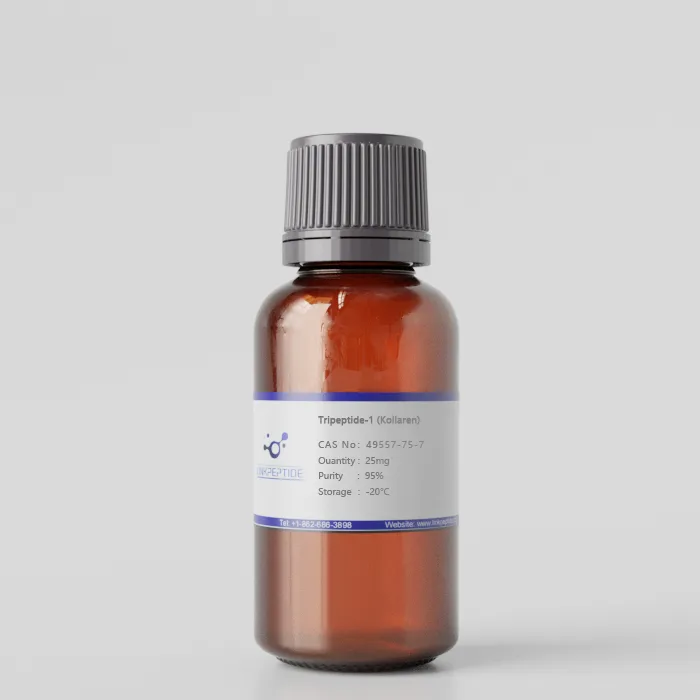
Product Name: Tripeptide-1 (Kollaren)
Cas No: 49557-75-7
Purity: 95%
Storage: Keep in dark and cool dry place -5~8 degree Celsius
Sequence: H-Gly-His-Lys-OH
Molar Mass: 340.38
Chemical Formula: C14H24N6O4
IUPAC Name: (2S)-6-amino-2-[[(2S)-2-[(2-aminoacetyl)amino]-3-(1H-imidazol-5-yl)propanoyl]amino]hexanoic acid
SMILES: C1=C(NC=N1)C[C@@H](C(=O)N[C@@H](CCCCN)C(=O)O)NC(=O)CN
InChIKey: MVORZMQFXBLMHM-QWRGUYRKSA-N
InChI: InChI=1S/C14H24N6O4/c15-4-2-1-3-10(14(23)24)20-13(22)11(19-12(21)6-16)5-9-7-17-8-18-9/h7-8,10-11H,1-6,15-16H2,(H,17,18)(H,19,21)(H,20,22)(H,23,24)/t10-,11-/m0/s1
Application:
Tripeptide-1 (Kollaren) is a biomimetic peptide designed to support visible skin repair, firmness, and improved texture by stimulating key components of the extracellular matrix. Known for promoting collagen, elastin, and fibronectin synthesis, Kollaren helps enhance elasticity and reduce the appearance of fine lines. In cosmetic research, it is widely used to rejuvenate dull or stressed skin and reinforce structural integrity for a smoother, more youthful look. Its excellent stability and compatibility with serums, creams, and advanced anti-aging formulations make Tripeptide-1 ideal for treatments targeting firmness, resilience, and long-term skin revitalization.
Current Research:
Tripeptide-1, commercially known as Kollaren? in some raw-material lines, is a short signal peptide widely used as a matrix-repair and firming active. It is typically supplied as glycine–histidine–lysine (GHK) or closely related sequences and is often grouped with “matrikine” peptides—small protein fragments that signal skin cells to rebuild the extracellular matrix (ECM). These peptides are recognized by fibroblasts as indicators of damage, triggering collagen and elastin synthesis and general tissue renewal.
Mechanism of Action: Matrikine Signal for ECM Repair
Tripeptide-1’s activity is anchored in the concept of matrikines: bioactive fragments released when ECM proteins such as collagen are broken down. Instead of being inert, these fragments act like tiny messengers that tell cells “repair is needed here.” Tripeptide-1 mimics this type of fragment and binds to specific receptors on fibroblasts in the dermis.
In in vitro and ex vivo models, Tripeptide-1 has been associated with:
Up-regulation of collagen synthesis, particularly collagen I and III, which are critical for firmness and dermal density.
Increased production of other ECM components, including fibronectin and certain proteoglycans, contributing to better tissue cohesion and resilience.
Improved cell adhesion and communication, helping organize the dermal network more efficiently.
This leads to a denser, more structured dermis, reduced wrinkle depth, and improved skin firmness when used consistently in topical formulations.
Role Within Modern Cosmetic Peptide Science
Within the taxonomy of cosmetic peptides, Tripeptide-1 is generally classified as a signal / matrikine peptide rather than a neurotransmitter, slimming, or pigment-regulating peptide. Its key roles:
Matrix rebuilding – stimulating fibroblasts to synthesize collagen and other ECM components.
Anti-wrinkle and firming – improving skin texture and elasticity through structural support.
Supportive synergy – frequently combined with other peptides (for example, palmitoyl tetrapeptides or copper complexes) in “peptide cocktails” for more global anti-aging benefits.
Kollaren-type tripeptides are often marketed as “tissue repair peptides” and appear in products targeting crow’s feet, nasolabial folds, loss of firmness, and post-stress skin repair. Because they address structural aspects rather than just surface moisturization, they fit well into premium anti-aging and “dermal architecture” concepts.
In Vitro, Ex Vivo, and Application Data
Most of the available information for Tripeptide-1 in its Kollaren-branded form comes from supplier studies and technical dossiers, along with some broader literature on GHK-type tripeptides. Collectively, these data support the following picture:
In vitro (cell culture) findings
Increased fibroblast proliferation and metabolic activity, indicating enhanced regenerative capacity.
Up-regulated expression of collagens and fibronectin, associated with improved dermal support.
In some setups, reduced expression of enzymes that degrade ECM (such as matrix metalloproteinases), helping to maintain the newly synthesized matrix for longer.
Ex vivo skin model findings
Skin explants treated with Tripeptide-1 show thicker, denser dermal layers with better organization of collagen fibers.
Microscopic analysis suggests improved junction between epidermis and dermis, which can support firmness and resistance to mechanical stress.
Cosmetic-style use tests
Formulations containing Tripeptide-1, alone or in combination with other peptides, have been reported to reduce the appearance of fine lines and wrinkles after several weeks of twice-daily application.
Users typically report improved firmness, elasticity, and skin smoothness, consistent with the matrix-remodeling mechanism.
These are typical small-to-medium cosmetic studies rather than large clinical trials, so claims should remain clearly aesthetic (appearance-focused).
Safety and Formulation Considerations
Tripeptide-1 is supplied as a high-purity synthetic peptide, sometimes in free form and sometimes as part of a more complex cosmetic active (e.g., combined with carriers, copper, or other peptides). Key formulation points:
Use levels – Generally used at low concentrations in serums, lotions, eye creams, and anti-aging moisturizers.
Compatibility – Water-soluble and compatible with a wide range of emulsions and gel systems when formulated under peptide-friendly conditions (moderate temperature, suitable pH).
Safety – Supplier toxicology summaries typically report good skin tolerance and no significant irritation or sensitization at recommended use levels, in line with other small cosmetic peptides.
It is intended strictly for topical cosmetic use, not for systemic or medical applications.
Get a Quote
 LinkPeptide