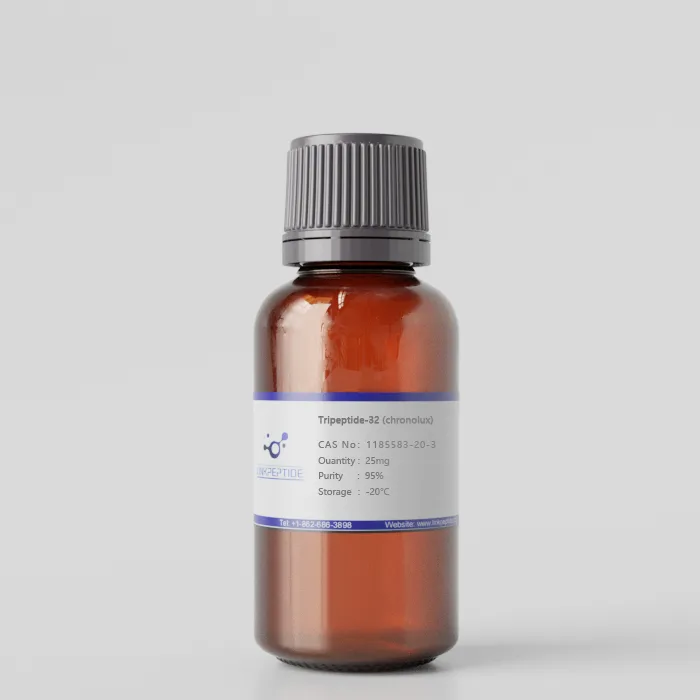
Product Name: Tripeptide-32 (chronolux)
Cas No: 1185583-20-3
Purity: 95%
Storage: Keep in dark and cool dry place -5~8 degree Celsius
Sequence: H-Ser-Thr-Pro-NH2
Molar Mass: 302.33
Chemical Formula: C12H22N4O5
IUPAC Name: (2S)-1-[(2S,3R)-2-[[(2S)-2-amino-3-hydroxypropanoyl]amino]-3-hydroxybutanoyl]pyrrolidine-2-carboxamide
SMILES: C[C@H]([C@@H](C(=O)N1CCC[C@H]1C(=O)N)NC(=O)[C@H](CO)N)O
InChIKey: FUYMMLFZSQBBKU-XGEHTFHBSA-N
InChI: InChI=1S/C12H22N4O5/c1-6(18)9(15-11(20)7(13)5-17)12(21)16-4-2-3-8(16)10(14)19/h6-9,17-18H,2-5,13H2,1H3,(H2,14,19)(H,15,20)/t6-,7+,8+,9+/m1/s1
Application:
Tripeptide-32 (Chronolux) is a biomimetic peptide designed to support the skin’s natural night-time repair cycle by helping regulate circadian rhythm–related pathways. Known for enhancing nighttime rejuvenation, it promotes improved cellular recovery, smoother texture, and a healthier, more radiant complexion. In cosmetic research, Tripeptide-32 is valued for reducing signs of daily stress, improving hydration balance, and enhancing overall skin vitality. Its excellent stability and compatibility with serums, essences, and restorative moisturizers make it ideal for overnight treatments targeting revitalization, resilience, and a refreshed, well-rested appearance by morning.
Current Research:
Tripeptide-32 (Chronolux): Current Research Overview
Tripeptide-32, widely known under the trade name Chronolux?, is a synthetic tripeptide positioned as a circadian-rhythm / chrono-repair peptide for anti-aging skincare. It’s a short sequence built from three amino acids—proline, serine, and threonine—typically in amide form, designed for good water solubility and skin compatibility.
This peptide is best known as the signature active in certain high-end “night repair” serums, where it is promoted as helping the skin synchronize its natural day/night rhythm: protection by day and intensified repair at night.
Mechanism of Action: Circadian Clock + Cell Survival
The core scientific story around Tripeptide-32 is its reported ability to interact with circadian clock genes in skin cells.
In vitro and technical data describe Tripeptide-32 as a PER1-targeting bioactive peptide that can influence the expression of PER1 and CLOCK—two key genes that regulate circadian rhythm.
By modulating these genes, Tripeptide-32 is proposed to align cellular repair processes with the night phase, when the skin is less exposed to UV and environmental aggressors.
This circadian “tuning” is marketed as helping skin repair DNA damage, restore structure, and optimize renewal overnight, even when sleep patterns or lifestyle are irregular.
Technical dossiers and peptide databases report that Tripeptide-32:
Increases keratinocyte survival under stress by activating clock-related protective pathways.
Stimulates the synthesis of cell-repair proteins linked to circadian signaling, contributing to better resilience and recovery after environmental insults such as UV exposure.
In theory, this helps maintain barrier integrity, delay premature aging, and keep the epidermis functioning more like “well-rested” skin.
Beyond the clock narrative, several ingredient guides highlight that Tripeptide-32:
Has water-binding properties, supporting hydration by helping skin retain moisture.
Shows antioxidant and anti-glycation potential in cosmetic positioning, helping to limit free-radical and sugar-induced damage to structural proteins.
Together, these actions support smoother texture, improved radiance, and better overall skin quality.
Place in Modern Cosmetic Peptide Science
Within the cosmetic peptide taxonomy, Tripeptide-32 sits in a relatively unique niche:
It is a chrono-biology / circadian-rhythm peptide, not just a classic collagen signal peptide.
It’s positioned as a “skin clock tuner” that helps synchronize protection and repair cycles with day and night.
This fits into broader trends where brands focus on skin’s biological rhythms, “sleep beauty,” and jet-lag or shift-worker skincare. Tripeptide-32 is frequently combined with:
Antioxidants (to handle daytime damage),
Barrier-support ingredients (lipids, humectants),
DNA-repair or soothing actives (for night-time recovery).
The result is a strong story around 24-hour defense and renewal.
In Vitro and Evidence Landscape
Available information on Tripeptide-32 is largely from patents, ingredient suppliers, and brand-owned data, with relatively little independent, peer-reviewed research published so far:
Laboratory sources describe Tripeptide-32 as PER1-targeting, able to regulate circadian rhythm and stimulate repair-protein synthesis in cell models.
Secondary reviews mention increased keratinocyte survival, improved barrier-related parameters, and protection against UV-related damage in vitro.
Independent ingredient reviewers note that, while the hydrating and general peptide benefits are very plausible, the circadian gene-tuning claims currently rely mostly on proprietary data rather than broad third-party confirmation.
So, mechanistically, the clock-gene story is compelling but still somewhat speculative at the topical, in-vivo level. It’s wise to frame it as supporting the skin’s natural rhythms rather than making hard medical claims.
Safety and Formulation Considerations
Tripeptide-32 (Chronolux) is supplied as a high-purity synthetic peptide and appears in cosmetic peptide catalogs as a skin-repair / anti-aging peptide with no special restriction flags.
Key practical points:
Use levels: typically very low peptide concentrations in serums and creams, often within complex “night repair” blends.
Format: water-soluble, usually delivered in aqueous or glycerin solutions; compatible with standard emulsion and serum systems when processed at moderate temperatures.
Tolerance: raw-material documentation and independent ingredient reviews describe Tripeptide-32 as well tolerated, with no notable irritation issues at cosmetic levels.
Get a Quote
 LinkPeptide