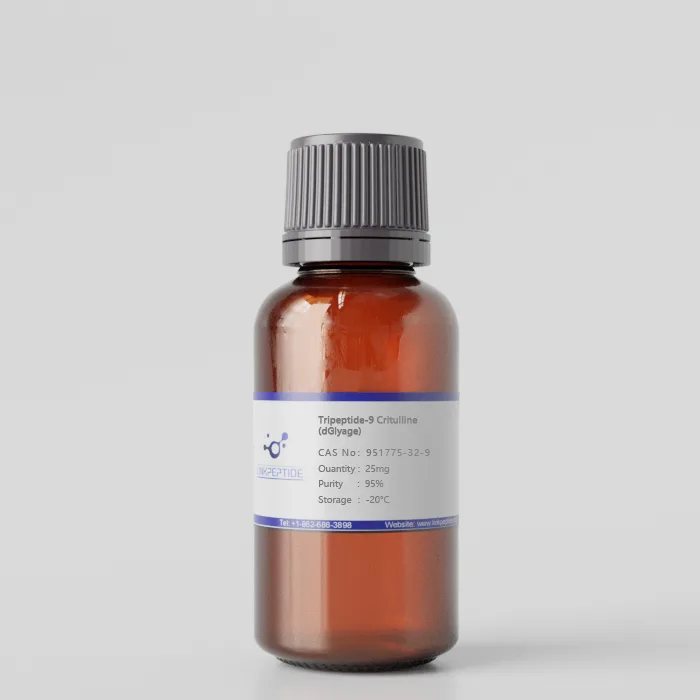
Product Name: Tripeptide-9 Critulline (dGlyage)
Cas No: 951775-32-9
Purity: 95%
Storage: Keep in dark and cool dry place -5~8 degree Celsius
Molar Mass: 517.58
Chemical Formula: C21H39N7O8
Synonyms: L-Ornithine, L-lysyl-L-??-aspartyl-L-valyl-N5-(aminocarbonyl)-; L-Lysyl-L-??-aspartyl-L-valyl-N5-(aminocarbonyl)-L-ornithine; DGlyage; Tripeptide-9 L-Citrulline; KDVX; H-Lys-Asp-Val-Cit-OH; L-Lysyl-L-??-aspartyl-L-valyl-L-citrulline
IUPAC Name: (S)-2-((S)-2-((S)-3-carboxy-2-((S)-2,6-diaminohexanamido)propanamido)-3-methylbutanamido)-5-ureidopentanoic acid
SMILES: O=C(N)NCCCC(NC(=O)C(NC(=O)C(NC(=O)C(N)CCCCN)CC(=O)O)C(C)C)C(=O)O
InChIKey: NYNYFYFJGZGLIV-YXWQFLTLSA-N
InChI: InChI=1S/C21H39N7O8/c1-11(2)16(19(33)26-13(20(34)35)7-5-9-25-21(24)36)28-18(32)14(10-15(29)30)27-17(31)12(23)6-3-4-8-22/h11-14,16H,3-10,22-23H2,1-2H3,(H,26,33)(H,27,31)(H,28,32)(H,29,30)(H,34,35)(H3,24,25,36)/t12-,13-,14-,16-/m0/s1
Application:
Tripeptide-9 Citrulline (dGlyage) is an advanced biomimetic peptide designed to help protect the skin from glycation-related damage and visible premature aging. By targeting pathways associated with protein stiffening and sugar-induced oxidative stress, dGlyage supports smoother texture, enhanced elasticity, and improved skin clarity. It is widely used in cosmetic research focused on reducing dullness, refining fine lines, and restoring youthful radiance. With excellent solubility and formulation versatility, Tripeptide-9 Citrulline integrates easily into serums, creams, and anti-aging treatments aimed at combating glycation, strengthening the skin??s structural matrix, and promoting a brighter, healthier-looking complexion.
Current Research:
Tripeptide-9 Citrulline (dGlyage): Current Research Overview
Tripeptide-9 Citrulline, commercial name dGlyage?, is a synthetic tripeptide specially developed as an anti-glycation and DNA-protective active. It’s designed to interact with transition metal ions (especially copper and iron), which catalyze a cascade of reactions leading to free-radical formation, protein glycation, and DNA lesions during skin aging.
Rather than acting as a classic antioxidant or sugar-trap, Tripeptide-9 Citrulline is positioned as a metal-chelating, multi-target defense peptide: it captures metal ions, thereby interrupting radical-generating pathways and limiting downstream damage to DNA and dermal structures.
Mechanism of Action: Metal Chelation, Anti-Glycation, DNA Defense
Key mechanistic studies have focused on the peptide’s ability to complex Cu(II) and other transition metals. Using UV–Vis spectroscopy, electrochemical methods, and electrophoresis, researchers showed that Tripeptide-9 Citrulline forms stable complexes with copper:
Characteristic changes in absorption spectra and the presence of isosbestic points indicate defined peptide–metal complexes.
Cyclic voltammetry shows shifts in copper redox peaks as peptide concentration increases, confirming direct interaction with Cu(II)/Cu(I).
Because Cu(II) and Fe(II/III) are central to Fenton and Fenton-like reactions that generate highly reactive hydroxyl radicals, chelating these ions helps reduce radical formation at the source.
In vitro electrophoretic assays using plasmid or model DNA have shown that Tripeptide-9 Citrulline can protect DNA from strand breaks and structural alterations triggered by metal-catalyzed radical generation (Fenton systems). DNA incubated with transition metals and H?O? shows typical nicking and fragmentation, whereas co-treatment with the peptide significantly preserves DNA integrity.
This leads to the central positioning of dGlyage as a “DNA care” peptide: it helps maintain genomic stability under oxidative and glycation stress rather than simply scavenging radicals after the fact.
Transition metals also participate in reactions that generate advanced glycation end products (AGEs). AGEs are responsible for protein cross-linking, stiffness, yellowing, and loss of elasticity in skin. By capturing these metals, Tripeptide-9 Citrulline indirectly slows AGE formation, supporting:
Less yellowing and dullness,
Better preservation of collagen and elastin flexibility,
A more uniform, youthful tone over time.
Place in Modern Cosmetic Peptide Science
Within the cosmetic peptide landscape, Tripeptide-9 Citrulline sits in an interesting niche:
Metal-chelating / DNA-protective peptide rather than a typical collagen-signal peptide.
Anti-glycation and photo-pollution defense ingredient, targeting upstream catalysts (metals) rather than only downstream radicals.
A good fit for “DNA care”, “anti-glycation”, “urban aging” and “digital/UV defense” narratives.
It pairs well with:
Antioxidants (vitamin C, E, polyphenols),
Barrier and ECM supporters (ceramides, peptides, HA),
Sunscreens and blue-light filters in comprehensive “anti-photoaging” systems.
In Vitro and Application-Level Data
Most data are from technical and supplier sources plus an independent chelation study, but they’re consistent:
Metal interaction: robust Cu(II) chelation demonstrated via spectroscopy and electrochemistry, with expected extension to Fe(II) and similar ions.
DNA protection: electrophoretic assays show reduced DNA damage in Fenton-like systems when Tripeptide-9 Citrulline is present, supporting its use as a DNA-stabilizing cosmetic peptide.
Anti-glycation positioning: technical summaries emphasize reduced formation of glycation-related byproducts and preservation of biomolecule integrity under metal-mediated stress.
While large, independent human trials are limited, these mechanistic data align well with broader literature on metal-catalyzed aging processes in skin.
Get a Quote
 LinkPeptide