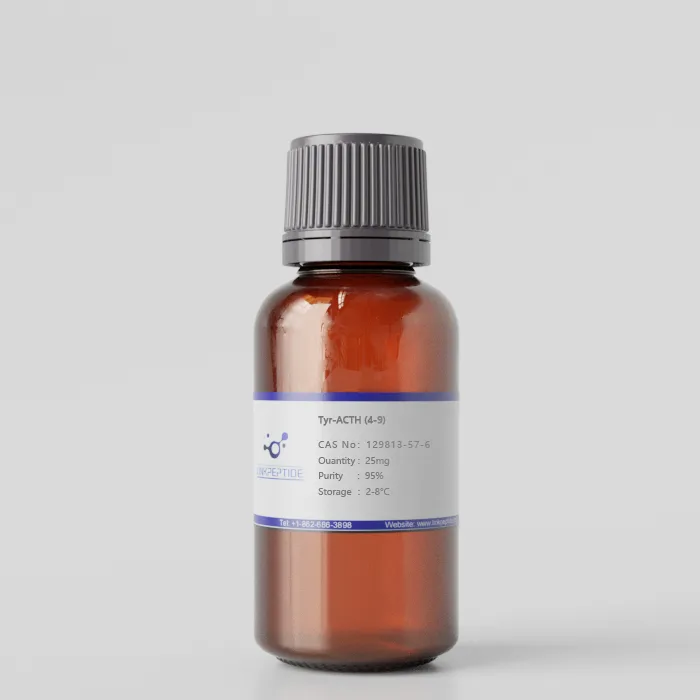
Product Name:Tyr-ACTH (4-9)
Form:TFA salt
Purity:95%
Storage:2-8 degree Celsius
Cas No:129813-57-6
Molar Mass:1068.2
Chemical Formula:C51H65N13O11S
IUPAC Name:4-[[2-[[2-amino-3-(4-hydroxyphenyl)propanoyl]amino]-4-methylsulfanylbutanoyl]amino]-5-[[1-[[1-[[1-[[1-carboxy-2-(1H-indol-3-yl)ethyl]amino]-5-(diaminomethylideneamino)-1-oxopentan-2-yl]amino]-1-oxo-3-phenylpropan-2-yl]amino]-3-(1H-imidazol-5-yl)-1-oxopropan-2-yl]amino]-5-oxopentanoic acid
SMILES:CSCCC(C(=O)NC(CCC(=O)O)C(=O)NC(CC1=CN=CN1)C(=O)NC(CC2=CC=CC=C2)C(=O)NC(CCCN=C(N)N)C(=O)NC(CC3=CNC4=CC=CC=C43)C(=O)O)NC(=O)C(CC5=CC=C(C=C5)O)N
InChIKey:LABZPEAYQTYYEF-UHFFFAOYSA-N
InChI:InChI=1S/C51H65N13O11S/c1-76-21-19-39(59-44(68)35(52)22-30-13-15-33(65)16-14-30)47(71)61-38(17-18-43(66)67)46(70)63-41(25-32-27-55-28-58-32)49(73)62-40(23-29-8-3-2-4-9-29)48(72)60-37(12-7-20-56-51(53)54)45(69)64-42(50(74)75)24-31-26-57-36-11-6-5-10-34(31)36/h2-6,8-11,13-16,26-28,35,37-42,57,65H,7,12,17-25,52H2,1H3,(H,55,58)(H,59,68)(H,60,72)(H,61,71)(H,62,73)(H,63,70)(H,64,69)(H,66,67)(H,74,75)(H4,53,54,56)
Sequence:Tyr-Met-Glu-His-Phe-Arg-Trp
Application:
Tyr-ACTH (4-9) is a synthetic fragment of the adrenocorticotropic hormone (ACTH) that includes an N-terminal tyrosine modification. This peptide sequence (Tyr-Pro-Gly-Lys-Lys-Arg) represents a biologically active region within ACTH known to influence melanocortin receptor signaling. Research suggests that ACTH fragments play a role in neuroregulation, stress responses, and immune modulation. Tyr-ACTH (4-9) is commonly used in studies on neurotransmission, cognitive function, and inflammatory processes. Due to its structural properties, it is also investigated for potential applications in neuroprotection and metabolic regulation, particularly in conditions involving adrenal dysfunction, memory impairment, and neuroinflammation.
Current Research:
Introduction
ACTH fragments have gained significant attention in neurobiology and endocrinology due to their ability to interact with melanocortin receptors and influence multiple physiological processes. Tyr-ACTH (4-9) is a truncated form of ACTH, modified with an N-terminal tyrosine residue, which may enhance its biological activity. Studies suggest that this peptide fragment is involved in neural function, cognitive processes, and inflammatory regulation, making it a subject of interest in neurodegenerative disorders, stress adaptation, and metabolic disease research.
Neuroprotective and Cognitive Effects
Research has highlighted the potential role of ACTH fragments in neuroprotection and cognitive enhancement. Tyr-ACTH (4-9) has been studied for its effects on learning and memory, particularly in models of cognitive decline. Some studies indicate that this peptide may enhance synaptic plasticity, neurotransmitter release, and neuronal survival, suggesting its potential utility in conditions such as Alzheimer’s disease and age-related cognitive impairment.
Additionally, ACTH-derived peptides have been associated with stress resilience and mood regulation. The melanocortin system, which includes ACTH and its derivatives, is implicated in anxiety and depression-related pathways. Animal studies suggest that Tyr-ACTH (4-9) may modulate neurotransmitter systems such as dopamine and serotonin, contributing to its potential antidepressant and anxiolytic effects.
Immunomodulation and Inflammation
The role of ACTH fragments in immune regulation has been extensively explored. Tyr-ACTH (4-9) appears to modulate inflammatory responses by interacting with melanocortin receptors present on immune cells. Research indicates that ACTH peptides can regulate cytokine production and inhibit excessive inflammatory responses, making them potential candidates for treating autoimmune diseases and inflammatory disorders such as multiple sclerosis and rheumatoid arthritis.
Moreover, ACTH-related peptides have been linked to neuroinflammation, a key factor in neurodegenerative diseases. Studies suggest that Tyr-ACTH (4-9) may help reduce neuroinflammatory markers, protecting against conditions such as Parkinson’s disease and traumatic brain injury.
Endocrine and Metabolic Implications
ACTH fragments are known to influence metabolic regulation through their interactions with the melanocortin system. Tyr-ACTH (4-9) may affect glucose metabolism, energy balance, and lipid homeostasis, which could be relevant in conditions such as obesity and type 2 diabetes. Although research in this area is still developing, preliminary studies suggest that ACTH fragments could play a role in metabolic adaptation to stress and nutritional changes.
Conclusion
Tyr-ACTH (4-9) is a promising ACTH-derived peptide with implications in neuroprotection, cognitive enhancement, immune modulation, and metabolic regulation. Its ability to influence neurotransmitter systems, inflammatory pathways, and endocrine functions makes it a valuable tool in biomedical research. Ongoing studies continue to explore its potential therapeutic applications in neurological disorders, autoimmune diseases, and metabolic syndromes.
Get a Quote


 LinkPeptide