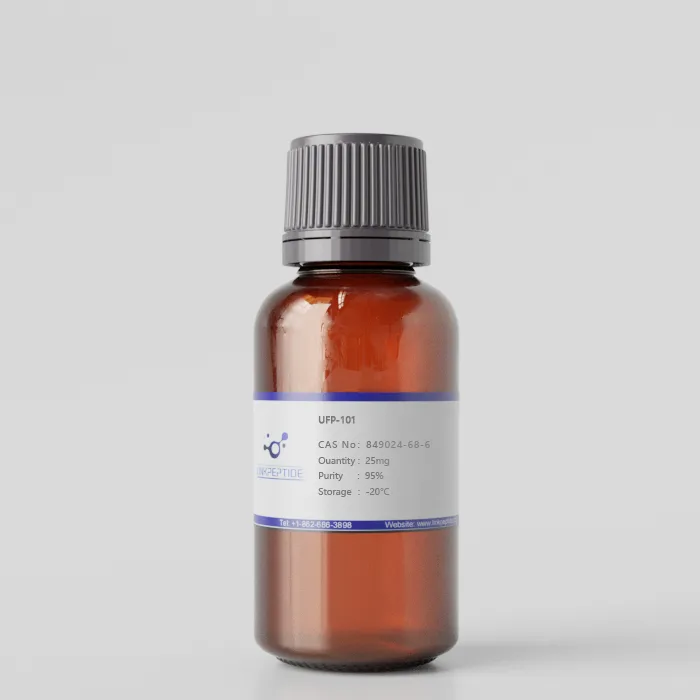
Product Name:UFP-101
CAS No:849024-68-6
Purity:95%
Molar Mass:1908.2
Chemical Formula:C82H138N32O21
Storage:Store at -20 degrees Celsius
Sequence:GGGFTGARKSARKRKNQ
Target:NPFF2
Application:
UFP-101 is a selective and potent antagonist of the neuropeptide FF (NPFF) receptor, specifically targeting the NPFF2 subtype. This compound is widely used in research to study the physiological and pharmacological roles of the NPFF system, which is involved in modulating pain, opioid tolerance, and neuroendocrine functions. UFP-101 helps to elucidate the mechanisms by which NPFF influences nociception, opioid analgesia, and stress responses, making it an important tool in preclinical studies focused on pain management, addiction, and neuropsychiatric disorders. Its specificity for NPFF2 receptors allows researchers to investigate the distinct pathways mediated by this receptor, contributing to the development of new therapeutic strategies.
Current Research:
UFP-101, also known as [Nphe¹,Arg¹⁴,Lys¹⁵]nociceptin-NH₂, is a synthetic peptide that functions as a potent and selective antagonist for the nociceptin/orphanin FQ (N/OFQ) receptor, also referred to as the NOP receptor. This receptor is a G-protein-coupled receptor involved in modulating various physiological processes, including pain perception, mood regulation, and immune responses.
Pharmacological Profile:
UFP-101 was designed by incorporating specific amino acid substitutions—namely, Nphe¹, Arg¹⁴, and Lys¹⁵—into the native N/OFQ peptide sequence. These modifications enhance its binding affinity and selectivity for the NOP receptor, effectively inhibiting the receptor's activity without eliciting intrinsic agonist effects. Binding studies have demonstrated that UFP-101 exhibits nanomolar affinity for the NOP receptor, making it a valuable tool for investigating NOP receptor-mediated signaling pathways.
Research Applications:
The high affinity and selectivity of UFP-101 for the NOP receptor have facilitated its use in various research domains:
Neuroscience: UFP-101 has been employed to elucidate the role of NOP receptors in modulating neurotransmitter systems, particularly serotonergic pathways. Studies indicate that UFP-101 exhibits pronounced antidepressant-like effects in different species and animal models, possibly by preventing the inhibitory effects of endogenous N/OFQ on brain monoaminergic (in particular serotonergic) neurotransmission.
Cardiovascular Research: Investigations into the cardiovascular implications of NOP receptor antagonism have revealed that UFP-101 can attenuate ventricular arrhythmias in models of acute myocardial ischemia. This suggests potential therapeutic applications in managing cardiac conditions associated with NOP receptor activity.
Immunology: UFP-101 has been utilized to explore the inflammatory role of N/OFQ and its receptor NOP within the microcirculation. In animal models of sepsis, UFP-101 administration resulted in reduced leukocyte adhesion and improved microvascular perfusion, indicating its potential as an anti-inflammatory agent.
Conclusion:
UFP-101 serves as a potent and selective NOP receptor antagonist, offering significant utility in the investigation of N/OFQ-NOP receptor system functions across various physiological and pathological contexts. Its application in preclinical studies has provided valuable insights into the therapeutic potential of targeting the NOP receptor in conditions such as depression, cardiovascular diseases, and inflammatory disorders. Ongoing research continues to elucidate the comprehensive pharmacological profile of UFP-101, underscoring its relevance in drug discovery and development.
Reference:
Get a Quote
 LinkPeptide

![[Phe1Ψ(CH2-NH)Gly2]Nociceptin(1-13)NH2](https://www.linkpeptide.com/wp-content/uploads/2024/10/Phe1¶aCH2-NHGly2Nociceptin1-13NH2-jpg.webp "[Phe1Ψ(CH2-NH)Gly2]Nociceptin(1-13)NH2")
![SCYLLATOXIN [Tyr2]-](https://www.linkpeptide.com/wp-content/uploads/2024/10/SCYLLATOXIN-Tyr2-jpg-2.webp "SCYLLATOXIN [Tyr2]-")