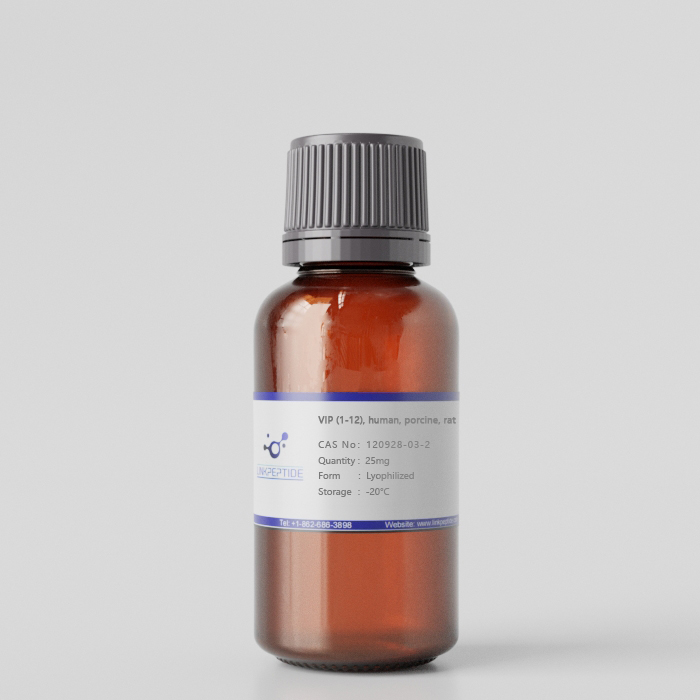
Product Name: VIP (1-12), human, porcine, rat
Sequence One Letter Code: HSDAVFTDNYTR
Sequence Three Letter Code: H-His-Ser-Asp-Ala-Val-Phe-Thr-Asp-Asn-Tyr-Thr-Arg-OH
Cas No: 120928-03-2
Chemical Formula:C61H88N18O22
Molecular Weight: 1425.6
Purity: 95%
Form: Lyophilized
Storage Conditions: - 20 °C
Research Area: Peptide Series
SMILES: CC(C)C(C(=O)NC(CC1=CC=CC=C1)C(=O)NC(C(C)O)C(=O)NC(CC(=O)O)C(=O)NC(CC(=O)N)C(=O)NC(CC2=CC=C(C=C2)O)C(=O)NC(C(C)O)C(=O)NC(CCCN=C(N)N)C(=O)O)NC(=O)C(C)NC(=O)C(CC(=O)O)NC(=O)C(CO)NC(=O)C(CC3=CN=CN3)N
IUPAC: 2-[[2-[[2-[[4-amino-2-[[2-[[2-[[2-[[2-[2-[[2-[[2-[[2-amino-3-(1H-imidazol-5-yl)propanoyl]amino]-3-hydroxypropanoyl]amino]-3-carboxypropanoyl]amino]propanoylamino]-3-methylbutanoyl]amino]-3-phenylpropanoyl]amino]-3-hydroxybutanoyl]amino]-3-carboxypropanoyl]amino]-4-oxobutanoyl]amino]-3-(4-hydroxyphenyl)propanoyl]amino]-3-hydroxybutanoyl]amino]-5-(diaminomethylideneamino)pentanoic acid
INCHIKEY: OZQVVUDUPMJWPH-UHFFFAOYSA-N
INCHI: InChI=1S/C61H88N18O22/c1-27(2)46(77-49(89)28(3)69-51(91)40(22-44(85)86)73-56(96)42(25-80)76-50(90)35(62)20-33-24-66-26-68-33)57(97)74-38(18-31-10-7-6-8-11-31)55(95)79-48(30(5)82)59(99)75-41(23-45(87)88)53(93)72-39(21-43(63)84)52(92)71-37(19-32-13-15-34(83)16-14-32)54(94)78-47(29(4)81)58(98)70-36(60(100)101)12-9-17-67-61(64)65/h6-8,10-11,13-16,24,26-30,35-42,46-48,80-83H,9,12,17-23,25,62H2,1-5H3,(H2,63,84)(H,66,68)(H,69,91)(H,70,98)(H,71,92)(H,72,93)(H,73,96)(H,74,97)(H,75,99)(H,76,90)(H,77,89)(H,78,94)(H,79,95)(H,85,86)(H,87,88)(H,100,101)(H4,64,65,67)
Source / Species: Human, Porcine
Conjugation: Unconjugated
Code Nacres: NA.26
Application: VIP (1–12) is an N-terminal fragment of vasoactive intestinal peptide conserved across human, porcine, and rat sequences and developed for analytical and biochemical applications. Owing to its defined molecular weight and consistent ionization behavior, it is widely used as a reference standard in mass spectrometry for method development, instrument calibration, and peptide identification validation. VIP (1–12) is suitable for peptide mapping, comparative proteomic studies, and workflow optimization, providing a reproducible standard for accurate mass determination and analytical quality control.
Current Research: VIP (1–12) is a synthetic N-terminal fragment of vasoactive intestinal peptide (VIP) comprising the first 12 amino acids of the full-length neuropeptide. This sequence is conserved across human, porcine, and rat species, ensuring structural consistency and predictable physicochemical behavior. Due to its defined molecular weight, stability, and reproducible ionization characteristics, VIP (1–12) is widely employed as an analytical reference peptide in mass spectrometry (MS)–based workflows. Although derived from a biologically active neuropeptide, VIP (1–12) is primarily developed for analytical and biochemical applications, rather than receptor signaling studies. Analytical Characteristics VIP (1–12) exhibits properties that make it particularly suitable as a mass spectrometry standard: Defined monoisotopic and average molecular mass Stable and reproducible electrospray ionization (ESI) response Predictable charge state distribution Clear fragmentation patterns under MS/MS conditions These features support reliable instrument calibration and validation across LC–MS and MALDI–MS platforms. Applications in Mass Spectrometry 1. Instrument Calibration and Method Development VIP (1–12) serves as a reference analyte during MS system setup and optimization. It can be used to: Validate mass accuracy and resolution Assess signal stability and sensitivity Optimize ionization parameters Confirm chromatographic performance Because of its consistent ionization behavior, it is useful for evaluating instrument reproducibility over time. 2. Peptide Mapping and MS/MS Validation In proteomic workflows, VIP (1–12) provides a well-characterized sequence for confirming fragmentation patterns and peptide identification algorithms. Its predictable b- and y-ion series make it suitable for testing collision-induced dissociation (CID) or higher-energy collisional dissociation (HCD) parameters. 3. Comparative Proteomic Studies As an external reference peptide, VIP (1–12) can be incorporated into experimental runs to: Benchmark retention time alignment Monitor batch-to-batch consistency Evaluate quantitative variability Support normalization strategies 4. Workflow Optimization and Quality Control VIP (1–12) is frequently used in method validation procedures for analytical laboratories. It enables routine verification of system suitability, particularly in peptide-focused assays. Advantages as a Reference Standard Cross-species conserved sequence Moderate length suitable for MS analysis Clean spectral profile Compatible with common LC–MS solvents and buffers Reliable performance in both qualitative and quantitative settings Experimental Considerations For optimal analytical performance, VIP (1–12) should be prepared in MS-compatible solvents (e.g., water/acetonitrile mixtures with low-percentage formic acid). Concentration ranges should be adjusted according to instrument sensitivity and intended application (calibration vs. sensitivity testing). Storage under appropriate conditions helps maintain peptide integrity and reproducibility.
Get a Quote
 LinkPeptide

![[Ala17]-MCH](https://www.linkpeptide.com/wp-content/uploads/2024/08/Ala17-MCH-jpg.webp "[Ala17]-MCH")