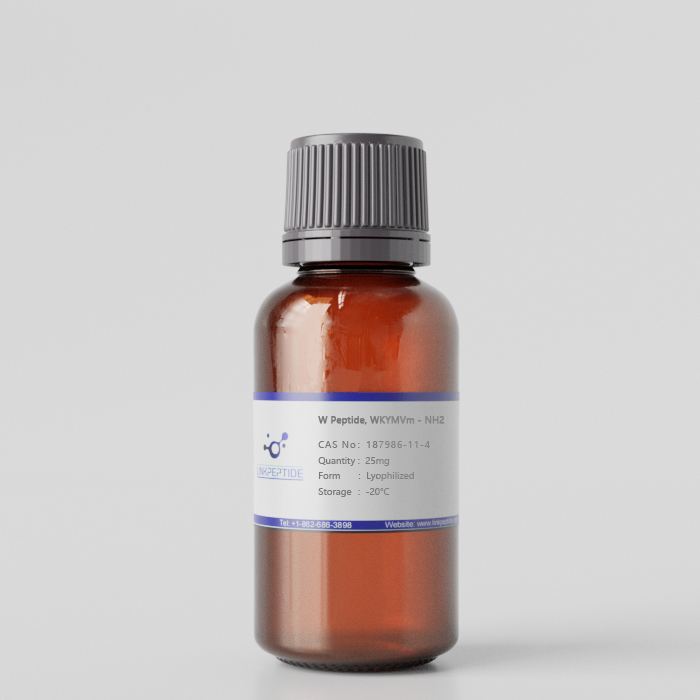
Product Name: W Peptide, WKYMVm - NH2
Sequence One Letter Code: WKYMVm-NH2
Sequence Three Letter Code: Trp-Lys-Tyr-Met-Val-D-Met-NH2
Cas No: 187986-11-4
Chemical Formula:C41H61N9O7S2
Molecular Weight: 856.1
Purity: 95%
Form: Lyophilized
Storage Conditions: - 20 °C
Research Area: Inflammation and Immunology Research
SMILES: CC(C)[C@@H](C(=O)N[C@@H](CCSC)C(=O)N)NC(=O)[C@H](CCSC)NC(=O)[C@H](CC1=CC=C(C=C1)O)NC(=O)[C@H](CCCCN)NC(=O)[C@H](CC2=CNC3=CC=CC=C32)N
IUPAC: (2S)-6-amino-2-[[(2S)-2-amino-3-(1H-indol-3-yl)propanoyl]amino]-N-[(2S)-1-[[(2S)-1-[[(2S)-1-[[(2S)-1-amino-4-methylsulfanyl-1-oxobutan-2-yl]amino]-3-methyl-1-oxobutan-2-yl]amino]-4-methylsulfanyl-1-oxobutan-2-yl]amino]-3-(4-hydroxyphenyl)-1-oxopropan-2-yl]hexanamide
INCHIKEY: FMBGOORJEKQQLG-LXOXETEGSA-N
INCHI:
InChI=1S/C41H61N9O7S2/c1-24(2)35(41(57)46-31(36(44)52)16-19-58-3)50-39(55)33(17-20-59-4)48-40(56)34(21-25-12-14-27(51)15-13-25)49-38(54)32(11-7-8-18-42)47-37(53)29(43)22-26-23-45-30-10-6-5-9-28(26)30/h5-6,9-10,12-15,23-24,29,31-35,45,51H,7-8,11,16-22,42-43H2,1-4H3,(H2,44,52)(H,46,57)(H,47,53)(H,48,56)(H,49,54)(H,50,55)/t29-,31-,32-,33-,34-,35-/m0/s1
Source / Species:
Conjugation: Unconjugated
Code Nacres: NA.26
Application: W Peptide (WKYMVm-NH₂) is a synthetic hexapeptide widely used in immunology and cell signaling research for its potent immunomodulatory properties. The sequence contains the consensus motif XKYX(P/V)M, which enables activation of phospholipase C–dependent signaling pathways in responsive cells. Upon receptor engagement, WKYMVm-NH₂ stimulates inositol phosphate production and downstream calcium mobilization in human neutrophils and transfected cell lines. Functionally, the peptide induces neutrophil chemotaxis, degranulation, and enhanced microbicidal activity, making it a valuable probe for studying innate immune responses. It is commonly applied to investigate receptor-mediated activation mechanisms, intracellular signaling cascades, and inflammatory effector functions. By modulating key pathways involved in host defense, W Peptide serves as a reliable experimental tool for dissecting neutrophil biology, inflammatory signaling networks, and receptor-driven immune cell activation in both basic and translational research models.
Current Research: W Peptide (WKYMVm-NH₂) is a synthetic hexapeptide extensively used in immunology and cell signaling research for its potent immunomodulatory activity. The sequence incorporates the consensus motif XKYX(P/V)M, which is associated with activation of phospholipase C (PLC)–dependent signaling pathways. This structural motif enables high-affinity interaction with specific G protein–coupled receptors on immune cells, leading to rapid intracellular signaling events. Upon receptor engagement, WKYMVm-NH₂ triggers activation of heterotrimeric G proteins and subsequent stimulation of PLC. This enzymatic activation promotes hydrolysis of phosphatidylinositol 4,5-bisphosphate, generating inositol trisphosphate (IP₃) and diacylglycerol (DAG). IP₃-mediated calcium release from intracellular stores results in transient elevations of cytosolic Ca²⁺, a central second messenger governing numerous immune cell functions. In parallel, DAG contributes to protein kinase C activation, amplifying downstream signaling cascades. These coordinated events position W Peptide as a robust activator of calcium-dependent cellular responses. In human neutrophils, WKYMVm-NH₂ induces rapid chemotactic migration toward concentration gradients, reflecting its capacity to mimic endogenous chemoattractant signaling. The peptide stimulates actin cytoskeleton rearrangement, polarization, and directed movement, making it an effective experimental tool for studying mechanisms of leukocyte trafficking. Additionally, W Peptide promotes degranulation and release of antimicrobial enzymes, enhancing the microbicidal capacity of neutrophils. Reactive oxygen species production and activation of downstream inflammatory mediators have also been observed following stimulation. Beyond primary immune cells, WKYMVm-NH₂ is frequently employed in transfected cell lines expressing relevant receptors to dissect receptor specificity, signaling bias, and downstream pathway activation. Its well-defined sequence and reproducible activity allow researchers to examine receptor–ligand interactions under controlled experimental conditions. This makes the peptide particularly useful in studies investigating receptor activation kinetics, desensitization processes, and cross-talk between signaling networks. In the broader context of innate immunity, W Peptide provides a valuable probe for examining how extracellular stimuli translate into intracellular signaling responses. By inducing robust calcium mobilization and PLC activation, it enables detailed analysis of early signaling events that precede cytokine production, phagocytosis, and inflammatory mediator release. These properties support mechanistic exploration of host defense pathways and immune cell activation dynamics. The peptide is also applied in inflammation research to evaluate how modulation of receptor-mediated pathways influences tissue responses. Experimental models often use WKYMVm-NH₂ to simulate acute inflammatory activation, providing insight into signaling cascades that regulate leukocyte recruitment and effector function. Because its activity is rapid and dose-dependent, it allows fine control over stimulation intensity in vitro. In translational research settings, W Peptide contributes to the study of immune dysregulation and therapeutic targeting strategies. By serving as a standardized agonist, it facilitates evaluation of small-molecule inhibitors, receptor antagonists, or pathway modulators designed to attenuate excessive inflammatory signaling. Its consistent performance across assay systems enhances reproducibility and comparability of results. Overall, WKYMVm-NH₂ is a reliable and versatile experimental tool for investigating receptor-driven immune cell activation. Through potent stimulation of PLC-dependent signaling and calcium mobilization, it enables comprehensive analysis of neutrophil biology, chemotaxis, degranulation, and inflammatory effector mechanisms. Its defined sequence and robust functional profile make it indispensable for both fundamental and translational studies of innate immune signaling networks.
Get a Quote
 LinkPeptide