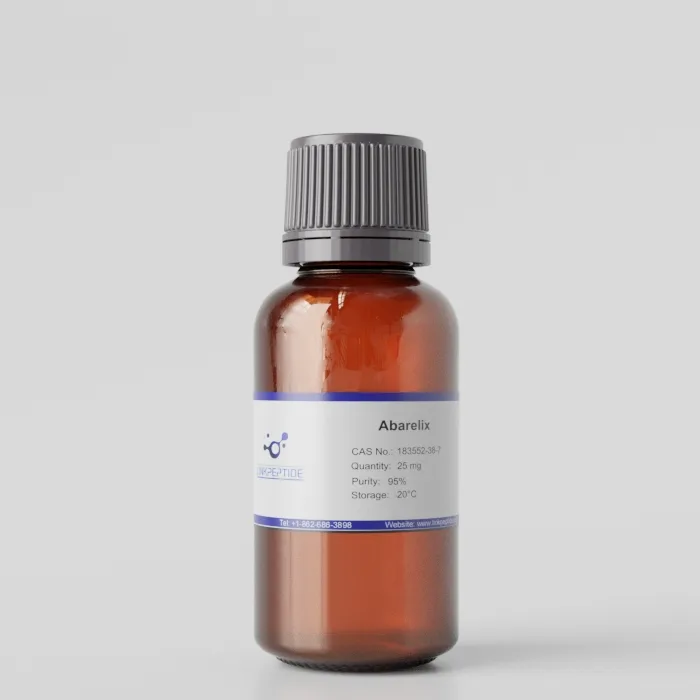
Product Name: Abarelix
Form: Acetate salt
CAS No: 183552-38-7
Molar Mass: 1416.06
Chemical Formula: C72H95ClN14O14
Synonyms: R3827; PPI 149
Storage: Store at -20℃
Sequence: XXXSYNLXPA
Target: gonadotrophin-releasing hormone
Application:
Abarelix (CAS: 183552-38-7) is a synthetic peptide antagonist of gonadotropin-releasing hormone (GnRH) receptors used in the treatment of advanced prostate cancer. It functions by competitively binding to GnRH receptors in the pituitary gland, thereby inhibiting the secretion of luteinizing hormone (LH) and follicle-stimulating hormone (FSH). This blockade leads to a reduction in testosterone production, which is crucial for the growth and progression of prostate cancer cells. Abarelix is particularly effective in patients with hormone-sensitive prostate cancer, offering a rapid and sustained suppression of testosterone levels without the initial testosterone surge associated with GnRH agonists. In pharmaceutical chemistry, abarelix's targeted antagonism of GnRH receptors represents a significant advancement in the management of advanced prostate cancer, providing a specific and effective therapeutic option for patients with this aggressive malignancy. Its application underscores its importance in oncology and improving outcomes for individuals with hormone-sensitive prostate cancer. Additionally, ongoing research explores abarelix's potential in combination therapies and its role in other hormone-related conditions, highlighting its versatility in endocrine therapeutics.
Current Research:
Abarelix is a synthetic gonadotropin-releasing hormone (GnRH) antagonist used in the management of prostate cancer. It works by blocking the GnRH receptors in the pituitary gland, thereby inhibiting the production of gonadotropins, including luteinizing hormone (LH) and follicle-stimulating hormone (FSH). This results in a decrease in the production of testosterone and other androgens, which can fuel the growth of prostate cancer cells. Abarelix is considered a non-pulsatile GnRH antagonist and is used to achieve medical castration in patients with advanced prostate cancer.
Mechanism of Action
Abarelix exerts its therapeutic effects by binding to and inhibiting the GnRH receptors located in the pituitary gland. Unlike GnRH agonists, which initially cause a surge in gonadotropins before leading to a reduction in hormone levels, abarelix directly suppresses the release of LH and FSH from the pituitary. This suppression leads to a subsequent decline in testosterone production by the testes. Testosterone is a key growth factor for prostate cancer cells, and by lowering its levels, abarelix helps to slow the progression of the disease. Additionally, abarelix does not induce the initial testosterone surge that is typically seen with GnRH agonists, which can cause flare-ups in prostate cancer symptoms.
Indications and Uses
Abarelix is primarily indicated for the treatment of advanced prostate cancer, particularly in cases where surgical castration or other treatments are not feasible or preferred. It is used as a form of medical castration to lower serum testosterone levels and inhibit androgen-driven tumor growth. The drug has been utilized to manage both hormone-sensitive and castration-resistant prostate cancer, providing an option for patients who require continuous suppression of testosterone without the side effects associated with surgical castration. Abarelix is typically administered as an intramuscular injection, with dosing schedules depending on the individual treatment plan and clinical response.
Efficacy and Clinical Benefits
Abarelix has demonstrated efficacy in reducing serum testosterone levels and slowing the progression of prostate cancer. Clinical trials have shown that abarelix effectively lowers testosterone to castrate levels within a few days of administration, and it maintains low testosterone levels for the duration of treatment. In comparison to GnRH agonists, abarelix has the advantage of avoiding the testosterone flare that can worsen symptoms during the initial phase of treatment. In addition to reducing testosterone, abarelix has been associated with improvements in symptoms of prostate cancer, including a reduction in pain and other signs of disease progression. However, its role in prostate cancer management has become limited due to the development of alternative therapies with improved safety profiles.
Safety and Tolerability
Abarelix has a generally favorable safety profile, but it is associated with some significant side effects. The most common adverse effects are injection site reactions, including pain, swelling, and erythema. Other reported side effects include hot flashes, fatigue, and gastrointestinal disturbances. A more serious concern is the risk of hypersensitivity reactions, which can include anaphylaxis, though these are rare. Since abarelix works by suppressing testosterone, its long-term use can lead to symptoms associated with low testosterone levels, such as decreased libido, erectile dysfunction, and loss of bone density. Despite these potential side effects, abarelix's ability to avoid the testosterone flare associated with GnRH agonists makes it a valuable treatment option for patients with advanced prostate cancer.
Advantages and Limitations
Abarelix offers the advantage of more rapid and complete suppression of testosterone levels compared to GnRH agonists, as it bypasses the initial surge in gonadotropin and testosterone levels. This feature makes it particularly useful in cases where a quick reduction in testosterone is desired, or where a flare due to GnRH agonists could exacerbate symptoms. However, its use has been limited due to the emergence of alternative therapies such as degarelix, which also provides continuous testosterone suppression with a more favorable safety and tolerability profile. Additionally, the need for frequent injections and the potential for hypersensitivity reactions may limit its broader use in clinical practice.
Future Directions
Ongoing research is focused on understanding the full range of clinical applications for GnRH antagonists like abarelix in the treatment of prostate cancer and other hormone-dependent cancers. Newer formulations and dosing regimens may improve patient compliance and reduce side effects. Research is also exploring the potential of combining GnRH antagonists with other targeted therapies or immunotherapies to enhance their efficacy and provide a more comprehensive approach to cancer management. Additionally, the development of agents with fewer side effects or that can be administered less frequently may increase the role of GnRH antagonists in the management of advanced prostate cancer.
Reference:
Get a Quote


 LinkPeptide