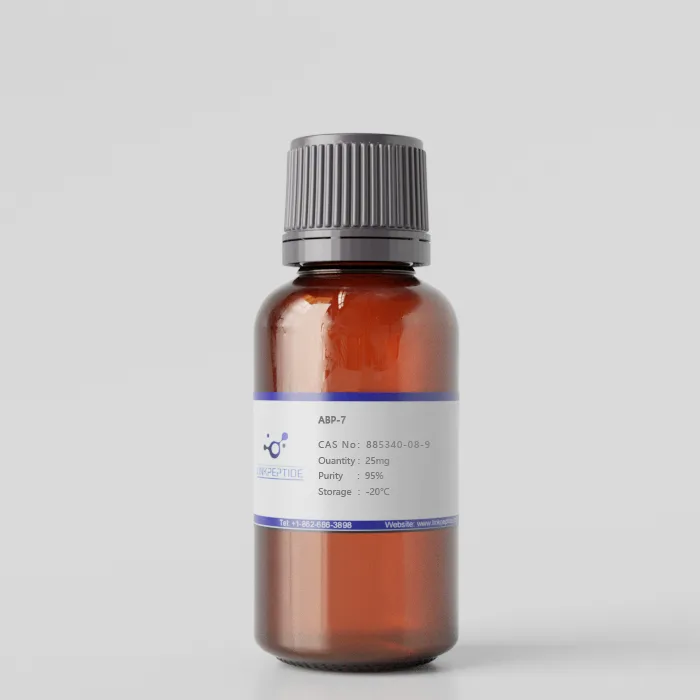
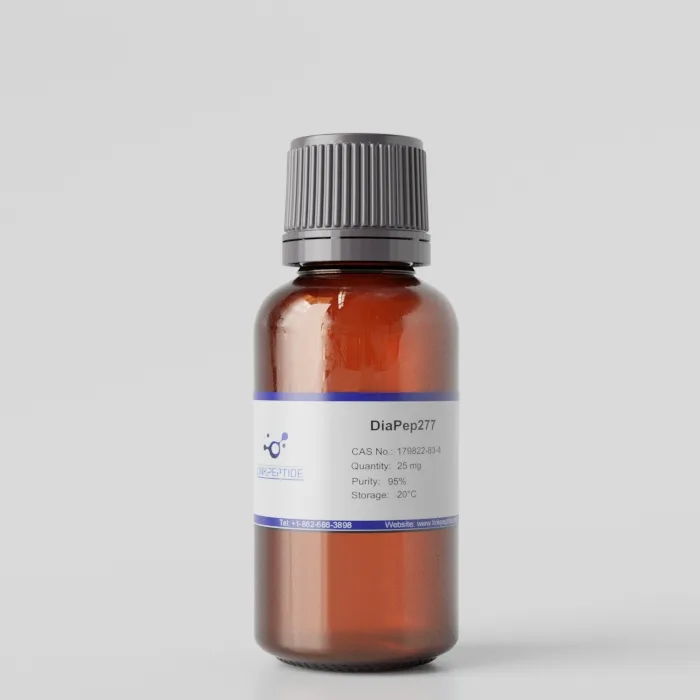
Product Name:ABP-7
Cas No:885340-08-9
Purity:95%
Chemical Formula:C38H68N10O14
Molar Mass:889
Synonyms:TB500
IUPAC Name:(2S)-2-[[(2S,3R)-2-[[(2S)-2-[[(2S,3R)-2-[[(2S)-2-[[(2S)-2-[[(2S)-2-acetamido-4-methylpentanoyl]amino]-6-aminohexanoyl]amino]-6-aminohexanoyl]amino]-3-hydroxybutanoyl]amino]-4-carboxybutanoyl]amino]-3-hydroxybutanoyl]amino]-5-amino-5-oxopentanoic acid
SMILES:C[C@H]([C@@H](C(=O)N[C@@H](CCC(=O)O)C(=O)N[C@@H]([C@@H](C)O)C(=O)N[C@@H](CCC(=O)N)C(=O)O)NC(=O)[C@H](CCCCN)NC(=O)[C@H](CCCCN)NC(=O)[C@H](CC(C)C)NC(=O)C)O
InChIKey:ADKDNDYYIZUVCZ-ZQNQAVPYSA-N
InChI:InChI=1S/C38H68N10O14/c1-19(2)18-27(42-22(5)51)35(58)44-23(10-6-8-16-39)32(55)43-24(11-7-9-17-40)33(56)47-30(20(3)49)36(59)45-25(13-15-29(53)54)34(57)48-31(21(4)50)37(60)46-26(38(61)62)12-14-28(41)52/h19-21,23-27,30-31,49-50H,6-18,39-40H2,1-5H3,(H2,41,52)(H,42,51)(H,43,55)(H,44,58)(H,45,59)(H,46,60)(H,47,56)(H,48,57)(H,53,54)(H,61,62)/t20-,21-,23+,24+,25+,26+,27+,30+,31+/m1/s1
Storage:-20 degree Celsius
Sequence:LKKTETQ
Application:ABP-7 (TB500) is a synthetic peptide derivative of thymosin beta-4, designed to accelerate tissue regeneration and support cellular repair mechanisms. This bioactive peptide enhances cell migration, angiogenesis, and inflammation modulation, making it ideal for wound healing, fibrosis studies, and tissue remodeling research. ABP-7 exhibits high stability and purity, ensuring consistent performance in laboratory settings. Frequently used in preclinical models, TB500 mimics the biological activities of endogenous peptides, offering researchers a powerful tool to investigate tissue repair dynamics, cardiac repair pathways, and muscular recovery mechanisms. ABP-7 is for research use only and not intended for human or veterinary applications.
Current Research:Introduction to TB500 and Its Mechanism TB500 is a synthetic analog of thymosin beta-4 (Tβ4), a naturally occurring peptide involved in numerous cellular processes, including cytoskeletal organization, cell migration, and angiogenesis. While thymosin beta-4 consists of 43 amino acids, TB500 is a short peptide fragment (Ac-SDKP) that retains key biological functions of the full-length molecule. It exerts its effects primarily by binding to actin, promoting actin polymerization and modulating cellular motility, a key process in tissue regeneration and wound repair. Regenerative and Anti-Inflammatory Effects Recent research has focused on TB500’s potential in tissue regeneration. Studies in rodent models have demonstrated accelerated healing in dermal wounds, corneal injuries, and cardiac tissue post-myocardial infarction. This is attributed to its role in promoting angiogenesis—formation of new blood vessels—and reducing inflammatory cytokine levels. Notably, TB500 stimulates the expression of vascular endothelial growth factor (VEGF), facilitating capillary formation and oxygenation in damaged tissue. In liver fibrosis models, TB500 has shown to reduce extracellular matrix deposition and suppress pro-fibrotic signaling pathways, such as TGF-β/Smad. Similarly, in lung and kidney injury studies, TB500 reduced fibrotic markers, highlighting its anti-inflammatory and anti-fibrotic dual action. These findings underscore its therapeutic promise for chronic inflammatory and fibrotic diseases. Applications in Cardiovascular Research Cardiovascular studies have spotlighted TB500 for its potential in cardiac repair post-injury. A notable preclinical study reported improved ejection fraction and ventricular remodeling in rats treated with TB500 after induced myocardial infarction. Researchers suggest that the peptide facilitates repair by mobilizing cardiac progenitor cells and promoting endothelial cell migration. Moreover, TB500 appears to reduce myocardial fibrosis, likely by suppressing pro-inflammatory cytokines and enhancing capillary density. These findings could have far-reaching implications for developing novel therapies targeting ischemic heart disease and heart failure. Muscle Regeneration and Sports Medicine In muscle injury and musculoskeletal disorders, TB500 has been observed to promote myogenesis (formation of muscle tissue) and inhibit muscle degradation pathways. It improves muscle fiber integrity and enhances recovery in models of muscular dystrophy and exercise-induced injury. Its role in upregulating satellite cell proliferation and facilitating myoblast migration makes it an intriguing candidate in sports medicine and degenerative muscle disease research. Athletic interest in TB500 has sparked concern due to its regenerative properties; however, it remains a research-only compound, and regulatory bodies such as WADA (World Anti-Doping Agency) have banned its use in professional sports. Neuroprotective Insights and Future Directions Emerging evidence suggests TB500 may possess neuroprotective capabilities. In preclinical models of stroke and spinal cord injury, administration of TB500 reduced neuronal apoptosis and promoted axonal regeneration. The proposed mechanisms include modulating oxidative stress, inhibiting microglial activation, and supporting neurovascular unit integrity. Although clinical trials are limited, early safety data from animal studies and anecdotal clinical reports suggest a favorable tolerance profile. Future research is aimed at optimizing dosage, understanding receptor targets, and validating its efficacy across larger animal and potential human models. Conclusion ABP-7 (TB500) continues to garner research interest due to its versatile biological functions in regeneration, inflammation control, and angiogenesis. From cardiac repair and muscle regeneration to anti-fibrotic and neuroprotective applications, TB500 holds vast potential. As new research unfolds, particularly in translational and clinical settings, ABP-7 is poised to be a valuable research peptide in therapeutic development across multiple domains.
Reference:
Get a Quote
 LinkPeptide