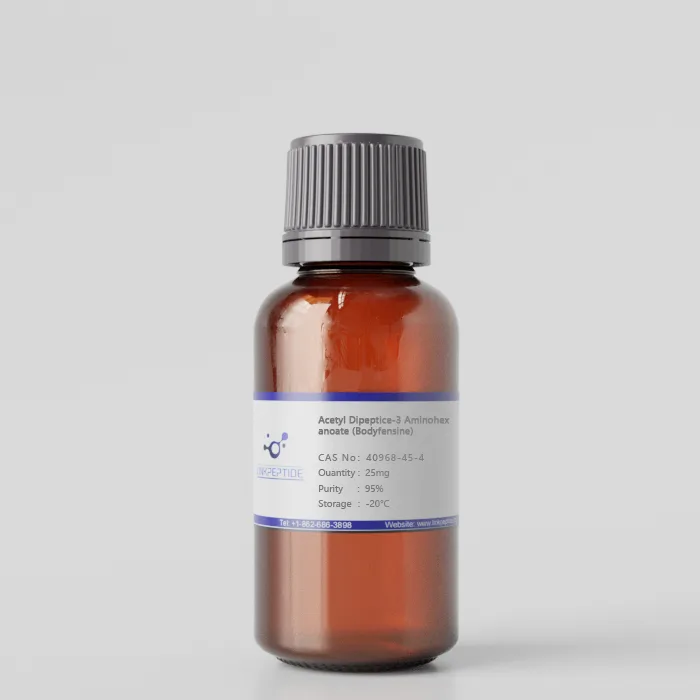
Product Name: Acetyl Dipeptice-3 Aminohexanoate (Bodyfensine)
Cas No: 40968-45-4
Purity: 95%
Storage: Keep in dark and cool dry place -5~8 degree Celsius
Sequence: Arg-Ala.Acetate
Molar Mass: 245.28
Chemical Formula: C9H19N5O3
IUPAC Name: (2S)-2-[[(2S)-2-amino-5-(diaminomethylideneamino)pentanoyl]amino]propanoic acid
SMILES: C[C@@H](C(=O)O)NC(=O)[C@H](CCCN=C(N)N)N
InChIKey: WVRUNFYJIHNFKD-WDSKDSINSA-N
InChI: InChI=1S/C9H19N5O3/c1-5(8(16)17)14-7(15)6(10)3-2-4-13-9(11)12/h5-6H,2-4,10H2,1H3,(H,14,15)(H,16,17)(H4,11,12,13)/t5-,6-/m0/s1
Application:
Acetyl Dipeptide-3 Aminohexanoate (Bodyfensine) is a biomimetic peptide designed to strengthen the skin’s natural defense system and support a clearer, healthier-looking complexion. By promoting optimal barrier integrity and helping regulate microbial balance, Bodyfensine is widely used in cosmetic research targeting blemish-prone, stressed, or sensitive skin. It supports studies on reducing visible imperfections, enhancing resilience, and improving overall skin smoothness. With excellent stability and compatibility across gels, serums, and lightweight emulsions, Acetyl Dipeptide-3 Aminohexanoate is ideal for formulations aimed at reinforcing skin protection while promoting a refined, balanced, and more radiant appearance.
Current Research:
Acetyl Dipeptide-3 Aminohexanoate (Bodyfensine): Current Research Overview
Acetyl Dipeptide-3 Aminohexanoate, trade name Bodyfensine?, is a synthetic bioactive tripeptide designed to reinforce the skin’s innate immune defense and help manage acne-prone, oily, and infection-sensitive skin. Structurally, it’s generally described as an acetylated dipeptide (Arg–Ala) linked to 6-aminohexanoic acid (often written as Ac-Arg-Ala-Ahx), giving it both cationic and slightly lipophilic character that supports interaction with keratinocytes and microbial membranes.
In cosmetics, Bodyfensine is positioned as a “skin defense peptide”: instead of directly killing bacteria like a classic antimicrobial, it stimulates the skin’s own antimicrobial peptides (AMPs), especially human β-defensin-2 and β-defensin-3, to rebalance the microbiome and reduce the risk of infection.
Mechanism of Action: β-Defensin Induction and Microbiome Balance
Bodyfensine’s main mechanism is up-regulation of human β-defensins (HBD-2 and HBD-3) in keratinocytes:
In vitro studies show that Acetyl Dipeptide-3 Aminohexanoate induces gene and protein expression of HBD-2 and HBD-3 in human skin cells.
These defensins are key innate immune peptides with broad antimicrobial activity against bacteria, fungi, and some viruses, and also act as immunomodulators that shape local inflammation and barrier homeostasis.
By boosting β-defensin levels, Bodyfensine helps:
Strengthen the first line of defense between skin and environment.
Maintain a healthy balance between commensal flora and pathogenic microbes (e.g., Cutibacterium acnes).
Potentially reduce the risk of infection and acne flares without relying on aggressive antiseptics or antibiotics.
Some technical sources also suggest secondary effects on sebaceous activity, with modulation of signaling in sebocytes that can decrease sebum output and improve oil balance, further supporting its use in oily and acne-prone skin.
This places Bodyfensine firmly within the modern concept of “microbiome-smart” cosmetics, where the goal is to train skin’s immunity rather than sterilize it.
Context in Current Peptide and AMP Research
More broadly, antimicrobial peptides (AMPs) such as defensins are now recognized as multifunctional regulators of innate and adaptive immunity, not just simple “natural antibiotics.” They help control infection, modulate inflammatory responses, and influence tissue repair.
Bodyfensine taps into this paradigm by leveraging the host’s own AMP system instead of introducing exogenous antibacterial agents. Compared with traditional anti-acne actives (benzoyl peroxide, high-level acids, classic antiseptics), this mechanism offers a gentler, barrier-respecting approach, which is attractive for long-term preventative care in sensitive or compromised skin.
Within cosmetic peptide taxonomy, Acetyl Dipeptide-3 Aminohexanoate can be classified as:
An AMP-inducing signal peptide,
A microbiome-modulating/anti-acne peptide, and
A barrier-support peptide with secondary soothing and anti-redness potential.
In Vitro, Ex Vivo, and Clinical Data
In vitro / mechanistic evidence (mainly from supplier and technical dossiers) shows:
Dose-dependent stimulation of HBD-2 and HBD-3 expression in keratinocyte cultures.
Improved resistance of skin cell models to bacterial challenge, consistent with higher AMP levels.
Application / clinical-style data reported in technical literature include:
In a small 28-day study on oily, acne-prone volunteers, twice-daily use of a cream containing 0.005% Acetyl Dipeptide-3 Aminohexanoate reportedly led to ~25% reduction in sebum and ~38% increase in hydration versus placebo on the contralateral side, with visible improvement in imperfections.
Other internal tests describe reduced number and redness of blemishes, smoother texture, and fewer new breakouts when used in daily care on acne-prone facial skin.
While these studies are relatively small and mostly manufacturer-driven (rather than large, peer-reviewed clinical trials), they are mechanistically consistent with the broader defensin biology and AMP-based skin defense research.
Safety and Formulation Considerations
Acetyl Dipeptide-3 Aminohexanoate is a high-purity synthetic peptide used at very low levels in leave-on products. Supplier and catalog data indicate:
No heavy metals and no significant skin or eye irritation at recommended use levels.
Good solubility in water and polyols (e.g., butylene glycol), usually supplied as a solution under the Bodyfensine trade name.
Suitable incorporation in lotions, gels, serums, masks, spot treatments, and even oral-care products, provided processing temperatures stay below ~40 °C to protect peptide integrity.
It is listed in modern cosmetic ingredient inventories as an anti-acne / antimicrobial / skin-conditioning peptide, with use restricted to cosmetic (non-therapeutic) claims
Get a Quote
 LinkPeptide