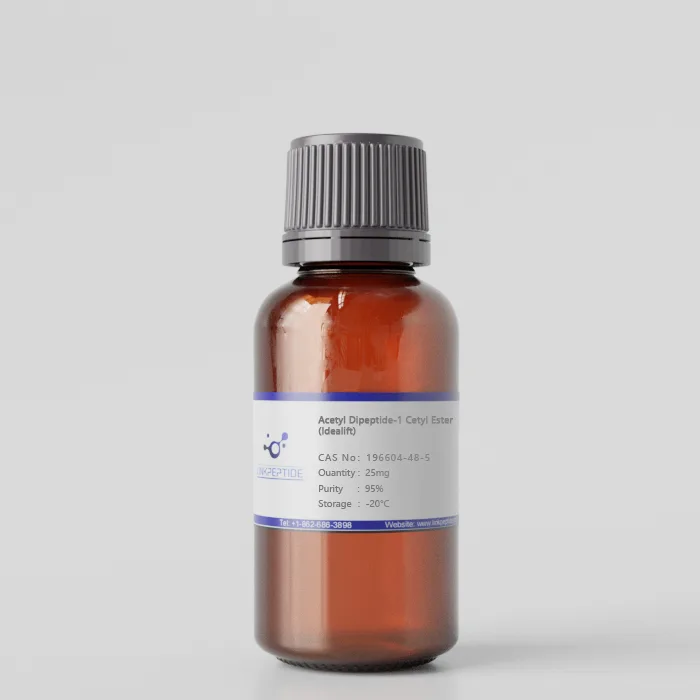
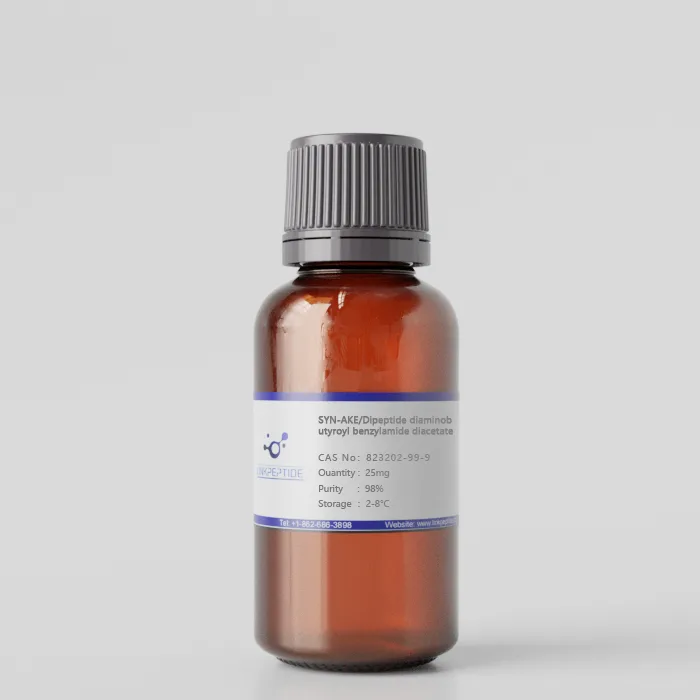
Product Name: Acetyl Dipeptide-1 Cetyl Ester (Idealift)
Cas No: 196604-48-5
Purity: 95%
Storage: Keep in dark and cool dry place -5~8 degree Celsius
Sequence: Ac-Tyr-Arg-OCet
Molar Mass: 603.8
Chemical Formula: C33H57N5O5
IUPAC Name: hexadecyl (2S)-2-[[(2S)-2-acetamido-3-(4-hydroxyphenyl)propanoyl]amino]-5-(diaminomethylideneamino)pentanoate
SMILES: CCCCCCCCCCCCCCCCOC(=O)[C@H](CCCN=C(N)N)NC(=O)[C@H](CC1=CC=C(C=C1)O)NC(=O)C
InChIKey: JFHZXDZUXGBFAQ-KYJUHHDHSA-N
InChI: InChI=1S/C33H57N5O5/c1-3-4-5-6-7-8-9-10-11-12-13-14-15-16-24-43-32(42)29(18-17-23-36-33(34)35)38-31(41)30(37-26(2)39)25-27-19-21-28(40)22-20-27/h19-22,29-30,40H,3-18,23-25H2,1-2H3,(H,37,39)(H,38,41)(H4,34,35,36)/t29-,30-/m0/s1
Application:
Acetyl Dipeptide-1 Cetyl Ester (Idealift) is a biomimetic lipo-dipeptide developed to help counteract skin sagging and improve visible firmness. By stimulating components involved in supporting skin tension and elasticity, Idealift aids in refining facial contours and promoting a lifted, more sculpted appearance. Its lipid-modified structure enhances penetration and stability, making it effective in research targeting improved resilience and reduced signs of aging. Idealift integrates seamlessly into serums, creams, and advanced firming treatments designed to restore suppleness, strengthen the skin’s support matrix, and deliver a smoother, more youthful-looking profile.
Current Research:
Acetyl Dipeptide-1 Cetyl Ester (Idealift): Research Overview
Acetyl Dipeptide-1 Cetyl Ester is a synthetic lipo-dipeptide designed to target sagging, cutaneous firmness, and mechanical resistance to gravity-related deformation. It consists of a small dipeptide (Acetyl Dipeptide-1) whose carboxyl end is esterified with a cetyl (C16) fatty alcohol, creating an amphiphilic molecule with both hydrophilic and lipophilic domains. In cosmetic science it is primarily known under the trade name Idealift and is classified as a firmness and anti-sagging signal peptide.
Acetyl Dipeptide-1 is a short peptide sequence that has been N-terminally acetylated to enhance stability against exopeptidases. Esterification with cetyl alcohol produces Acetyl Dipeptide-1 Cetyl Ester, with key features:
Dipeptide headgroup: hydrophilic, capable of interacting with cell-surface components and aqueous environments.
Cetyl ester tail (C16): lipophilic, allowing insertion into stratum corneum lipid domains and association with cell membranes.
Amphiphilic behavior: facilitates localization at oil–water interfaces in formulations and at lipid–aqueous interfaces in skin.
This architecture improves residence time in the upper skin layers, enhances contact with keratinocytes and fibroblasts, and reduces rapid enzymatic degradation of the dipeptide.
Research around Idealift positions Acetyl Dipeptide-1 Cetyl Ester as a “gravity-response” modulator, targeting pathways involved in:
Dermal and hypodermal structure supporting facial contours.
Mechanical resistance of skin to downward forces and deformation.
Synthesis and organization of elastic and anchoring elements that maintain firmness.
The peptide has been studied for its ability to stimulate the expression of key proteins involved in skin’s structural support, including components of the extracellular matrix and dermal–hypodermal interface.
In vitro and ex vivo studies on fibroblasts and skin explants report that Acetyl Dipeptide-1 Cetyl Ester can:
Increase expression of elastin and elastin-associated proteins, contributing to greater elastic recoil.
Upregulate selected ECM proteins involved in dermal support and cohesion, including certain collagens and adhesion molecules.
Support organization of elastic and collagen networks in the superficial and mid-dermis, relevant to sagging and loss of firmness.
These effects place the peptide within the category of elasticity-focused signal peptides, complementing classic collagen-stimulating matrikines with an emphasis on anti-sagging endpoints.
Sagging is not only a function of collagen content but of overall tissue mechanics: elastic fiber integrity, ECM density, dermal–hypodermal coupling, and adipose redistribution. Technology data for Idealift highlight:
Improved mechanical resistance in skin models subjected to stretch or gravitational analogues.
Enhanced appearance of lower-face contours and reduced ptosis in cosmetic studies when incorporated into topical formulas.
Better skin tension and firmness indices measured instrumentally (for example, via cutometry or other biomechanical devices).
Mechanistically, these outcomes are interpreted as the downstream result of improved ECM and elastic fiber status, rather than transient film-forming or swelling effects.
Some research describes Acetyl Dipeptide-1 Cetyl Ester in the broader context of tissue remodeling at the dermal–subcutaneous interface, with attention to:
Modulation of markers related to adipocyte–matrix interaction and dermal anchoring.
Support of structural integration between dermis and underlying tissues, helping maintain facial contour definition.
Although data in this area are more limited than for classical ECM markers, the ingredient is conceptually linked to the maintenance of three-dimensional architecture rather than only two-dimensional surface smoothing.
In cosmetic-style clinical evaluations, formulations containing Acetyl Dipeptide-1 Cetyl Ester are typically assessed for:
Sagging and ptosis scores along jawline, cheeks, and lower face.
Firmness and elasticity parameters obtained by mechanical measurements.
Contour definition and facial oval description through imaging and expert grading.
Reported improvements over several weeks of application are associated with the peptide’s multi-target action on elasticity, dermal support, and structural cohesion.
From a formulation perspective, Acetyl Dipeptide-1 Cetyl Ester:
Is amphiphilic, with good compatibility in emulsions, creams, and serums; it tends to partition into the oil phase or at the oil–water interface.
Is typically supplied in a solvent or dispersion suitable for direct incorporation during the cool-down phase of emulsification to protect peptide integrity.
Shows good stability under standard cosmetic pH and temperature ranges when protected from strong oxidants and prolonged high heat.
Is used at low active concentrations, consistent with its role as a signaling peptide rather than a bulk structural material.
Its lipophilic ester tail aids penetration and localization in the stratum corneum and upper dermis, while the peptide head remains available for biological interaction.
Summary
Acetyl Dipeptide-1 Cetyl Ester (Idealift) is an amphiphilic lipo-dipeptide developed to address skin sagging and loss of firmness by modulating elastic and structural components of the dermal matrix and dermal–subcutaneous interface. Research characterizes it as a gravity-targeted signal peptide that enhances elastin-related markers, supports ECM organization, and improves mechanical resistance and contour definition in experimental and cosmetic-use models.
Get a Quote
 LinkPeptide