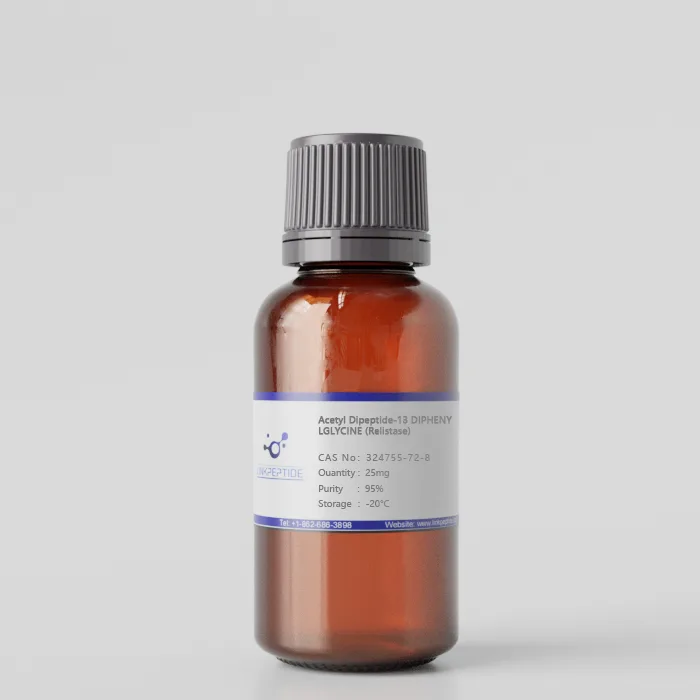
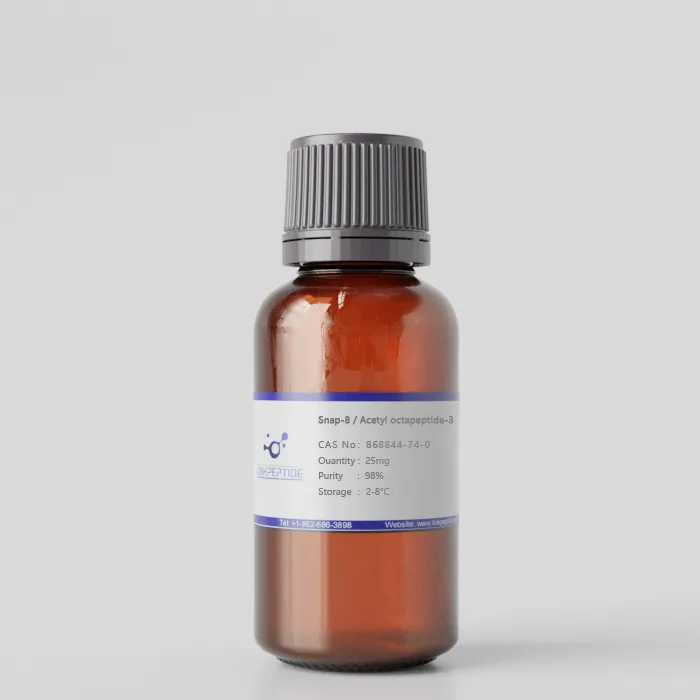
Product Name: Acetyl Dipeptide-13 DIPHENYLGLYCINE (Relistase)
Cas No: 324755-72-8
Purity: 95%
Storage: Keep in dark and cool dry place -5~8 degree Celsius
Sequence: palmitoyl-bAla-His-OH
Molar Mass: 464.6
Chemical Formula: C25H44N4O4
IUPAC Name: (2S)-2-[3-(hexadecanoylamino)propanoylamino]-3-(1H-imidazol-5-yl)propanoic acid
SMILES: CCCCCCCCCCCCCCCC(=O)NCCC(=O)N[C@@H](CC1=CN=CN1)C(=O)O
InChIKey: LNXLHAWHHNDIDC-QFIPXVFZSA-N
InChI: InChI=1S/C25H44N4O4/c1-2-3-4-5-6-7-8-9-10-11-12-13-14-15-23(30)27-17-16-24(31)29-22(25(32)33)18-21-19-26-20-28-21/h19-20,22H,2-18H2,1H3,(H,26,28)(H,27,30)(H,29,31)(H,32,33)/t22-/m0/s1
Application:
Acetyl Dipeptide-13 Diphenylglycine (Relistase) is a biomimetic peptide designed to help counteract loss of elasticity and visible skin sagging associated with aging. Known for its ability to support elastin preservation, Relistase is widely used in cosmetic research focused on improving firmness, enhancing resilience, and refining facial contours. Its unique dipeptide structure, combined with diphenylglycine for enhanced stability, enables targeted activity within the skin’s support matrix. Ideal for serums, creams, and advanced anti-aging formulations, Relistase contributes to a smoother, more toned, and youthful-looking appearance by promoting stronger, more elastic skin.
Current Research:
Acetyl Dipeptide-13 Diphenylglycine (Relistase): Current Research Overview
Acetyl Dipeptide-13 Diphenylglycine—commercially known as Relistase?—is a synthetic tetrapeptide developed to counteract one of the hallmark signs of skin aging: the loss of firmness caused by elastin degradation. Designed with a combination of natural and non-natural amino acids, this peptide is optimized for stability, dermal penetration, and targeted biological activity. Current research places Relistase among the most scientifically rational firmness-enhancing peptides available in cosmetic formulations.
Mechanistic Focus: Elastase Inhibition and ECM Protection
The backbone of Relistase research centers on its ability to inhibit elastase, a proteolytic enzyme responsible for breaking down elastin and other extracellular matrix (ECM) components. As skin ages—and especially under UV stress—elastase levels increase, leading to weakened dermal support, sagging, and reduced resilience.
In vitro studies show that Acetyl Dipeptide-13 Diphenylglycine significantly reduces elastase activity in a dose-dependent manner. By suppressing elastase, the peptide helps protect existing elastin fibers from enzymatic fragmentation. This mechanism aligns with one of the most validated pathways in anti-aging science, since elastin preservation correlates with improved skin tone and structure.
Research also indicates that Relistase may influence collagen homeostasis, particularly type I collagen, the most abundant structural protein in the dermis. Fibroblast studies report an increase in collagen synthesis markers after peptide exposure, suggesting a dual activity profile: preventing ECM breakdown while supporting ECM rebuilding.
Role in Modern Cosmetic Peptide Science
Within the broader context of cosmetic peptide development, Relistase is categorized as a matrix-protecting bioactive peptide, distinct from traditional signal peptides that only stimulate collagen. The current trend in anti-aging research emphasizes combined strategies—enzyme inhibition, antioxidation, and structural protein support—to achieve visible lifting and contour refinement.
Scientific reviews of skin-firming peptides frequently cite elastase inhibition as a high-value mechanism for targeting age-related sagging, particularly in areas where gravitational changes are pronounced (jawline, neck, décolleté). Relistase fits this modern profile by directly addressing the enzymatic imbalance that drives mid-to-late-stage skin laxity.
Moreover, peptide engineering research continues to validate the safety and efficacy advantages of short synthetic peptides. Their selective activity, low immunogenicity, and predictable structure-function relationships make them strong candidates for long-term topical use.
In Vitro and Ex Vivo Evidence
While large-scale clinical trials are limited, laboratory evidence for Relistase is robust and consistent:
These findings provide a strong scientific basis for its use in formulations designed to improve visible tightness and reduce the look of sagging skin.
Safety and Cosmetic Applications
Relistase is intended for topical, leave-on cosmetic applications, typically formulated at low peptide concentrations incorporated into creams, serums, and contour-defining products. Safety evaluations—including irritation and sensitization testing—indicate a high tolerance profile, consistent with other well-designed cosmetic peptides.
As with all cosmetic actives, Relistase is not positioned as a medical treatment. Its benefits relate to visible improvements in firmness, elasticity, and contour, rather than therapeutic changes to skin physiology.
Conclusion
Current research supports Acetyl Dipeptide-13 Diphenylglycine as a scientifically grounded cosmetic peptide targeting age-related loss of firmness. By combining elastase inhibition with potential collagen-supportive effects, it addresses two fundamental processes behind sagging skin. Although most data come from supplier studies and laboratory models, the mechanistic rationale is strong, and the ingredient aligns with modern peptide-based strategies for improving skin tone, elasticity, and structural resilience.
Get a Quote
 LinkPeptide