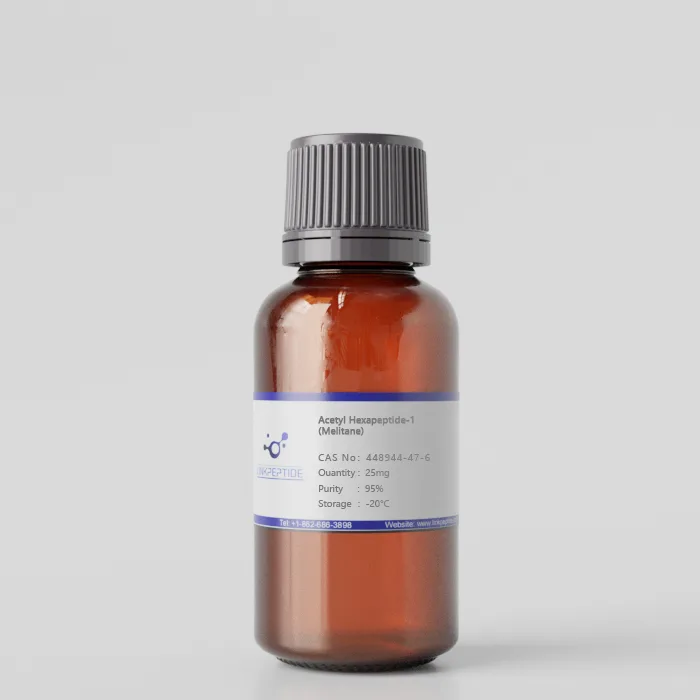
Product Name: Acetyl Hexapeptide-1 (Melitane)
Cas No: 448944-47-6
Purity: 95%
Storage: Keep in dark and cool dry place -5~8 degree Celsius
Sequence: bio-α-MSH peptide analog
Molar Mass: 870
Chemical Formula: C43H59N13O7
IUPAC Name: (2S)-2-acetamido-N-[(2S)-1-[[(2S)-1-[[(2R)-1-[[(2S)-1-[[(2S)-1-amino-3-(1H-indol-3-yl)-1-oxopropan-2-yl]amino]-5-(diaminomethylideneamino)-1-oxopentan-2-yl]amino]-1-oxo-3-phenylpropan-2-yl]amino]-3-(1H-imidazol-5-yl)-1-oxopropan-2-yl]amino]-1-oxopropan-2-yl]hexanamide
SMILES: CCCC[C@@H](C(=O)N[C@@H](C)C(=O)N[C@@H](CC1=CN=CN1)C(=O)N[C@H](CC2=CC=CC=C2)C(=O)N[C@@H](CCCN=C(N)N)C(=O)N[C@@H](CC3=CNC4=CC=CC=C43)C(=O)N)NC(=O)C
InChIKey: WPIQUSRULDNCKM-IFSWANACSA-N
InChI: InChI=1S/C43H59N13O7/c1-4-5-15-32(52-26(3)57)39(60)51-25(2)38(59)55-36(21-29-23-47-24-50-29)42(63)56-35(19-27-12-7-6-8-13-27)41(62)53-33(17-11-18-48-43(45)46)40(61)54-34(37(44)58)20-28-22-49-31-16-10-9-14-30(28)31/h6-10,12-14,16,22-25,32-36,49H,4-5,11,15,17-21H2,1-3H3,(H2,44,58)(H,47,50)(H,51,60)(H,52,57)(H,53,62)(H,54,61)(H,55,59)(H,56,63)(H4,45,46,48)/t25-,32-,33-,34-,35+,36-/m0/s1
Application:
Acetyl Hexapeptide-1 (Melitane) is a biomimetic peptide designed to help regulate melanocyte activity and promote a more balanced, even skin tone. By stimulating key pathways involved in the skin’s natural protective response, Melitane supports research focused on reducing the appearance of pigmentation irregularities while enhancing overall radiance. It also helps improve skin resilience against environmental stressors, making it suitable for brightening and photo-protection–oriented formulations. With excellent stability and compatibility across serums, emulsions, and daily care products, Acetyl Hexapeptide-1 is ideal for treatments targeting luminosity, clarity, and a healthier-looking complexion.
Current Research:
Acetyl Hexapeptide-1 (Melitane): Current Research Overview
Acetyl Hexapeptide-1, marketed as Melitane?, is a biomimetic peptide designed to mimic the activity of α-melanocyte-stimulating hormone (α-MSH), the key hormone that drives melanin production in skin and hair. It is a short, N-acetylated peptide derived from the N-terminal sequence of α-MSH, optimized for stability and cosmetic formulation.
In cosmetics, Melitane is positioned as a melanogenesis-modulating and photoprotective peptide, used both to stimulate protective pigmentation (tanning/photoprotection) and to ** help even out skin and hair color**.
Mechanism of Action: α-MSH Mimetic and MC1R Activation
The main target of Acetyl Hexapeptide-1 is the melanocortin 1 receptor (MC1R) on melanocytes. MC1R is the central switch that determines how much and what type of melanin is produced.
α-MSH biomimetic
Melitane is engineered to reproduce the functional part of α-MSH, allowing it to bind to MC1R and trigger similar intracellular signaling without using the full hormone. Once it binds MC1R, it activates the cAMP pathway, which in turn up-regulates melanogenesis genes.
Up-regulation of melanogenesis genes
In melanocyte and skin models, Melitane has been shown to increase expression and activity of:
Tyrosinase – the rate-limiting enzyme in melanin synthesis,
TRP-1 and TRP-2 – auxiliary enzymes for eumelanin formation,
Other melanocyte differentiation markers.
The result is increased melanin production and more organized pigment distribution through melanosome transfer to keratinocytes.
Shift toward eumelanin
MC1R activation favors eumelanin (brown/black pigment) over pheomelanin (red/yellow). Eumelanin is a more efficient natural photoprotectant, better at absorbing UV and neutralizing free radicals. This shift underlies the peptide’s photoprotective and anti-photoaging positioning.
Photoprotection and Anti-Photoaging Angle
Beyond simple tanning, current data and marketing dossiers emphasize Melitane as a “DNA- and cell-protection” peptide:
Reduced UV-induced damage: By increasing melanin and enhancing the eumelanin fraction, Melitane helps shield keratinocytes and fibroblasts from UV-induced oxidative stress. Experimental models show decreased UV-induced cell damage and fewer markers of DNA injury when the peptide is present.
Support of repair pathways: α-MSH signaling is known to influence anti-oxidant and DNA-repair pathways; Melitane, through MC1R, appears to support these same protective mechanisms, contributing to reduced inflammation and erythema after UV exposure.
Protection from visible/blue light (claimed): Some technical documents extend the story to visible and blue light, suggesting that reinforced melanogenesis and antioxidant status can help buffer against digital and urban light exposure, though this aspect is more marketing-driven than deeply published.
Altogether, Acetyl Hexapeptide-1 is often framed as an ingredient that enhances the skin’s own protective tanning response rather than providing an artificial dye or filter.
Skin-Tone and Hair-Pigmentation Applications
Because it modulates melanogenesis at a receptor level, Melitane is used in several cosmetic directions:
Pro-tanning and pre-sun care
Formulated in face and body products to encourage a faster, more uniform tan with less redness, used either before or during sun exposure (in combination with proper UV filters).
Tone evening and “healthy glow”
At moderate levels, supporting melanocyte function can help reduce the appearance of dull, uneven tone, giving a more homogeneous complexion with a subtle warm tone rather than strong depigmentation or bleaching.
Hair pigmentation / anti-gray claims
MC1R is also expressed in hair follicles. Melitane is therefore used in some anti-gray and hair-reviving products, positioned to help reactivate melanogenesis in the hair bulb and maintain or restore natural hair color intensity. Data here are mostly early or supplier-driven, but the mechanistic rationale is consistent with α-MSH biology.
Place in Modern Cosmetic Peptide Science
Within peptide taxonomy, Acetyl Hexapeptide-1 belongs to:
Receptor-targeted signal peptides (MC1R agonist / α-MSH mimetic),
Photoprotective / tanning peptides,
Pigmentation-modulating actives with a regulatory rather than bleaching action.
It differs from classic tyrosinase inhibitors (like arbutin) because it turns melanogenesis up, not down, but aims to do so in a controlled, protective way. For branding, it fits well into narratives such as:
“Boost your natural photoprotection,”
“Healthy glow instead of harsh bleaching,”
“Support your skin’s own tanning intelligence.
Get a Quote
 LinkPeptide