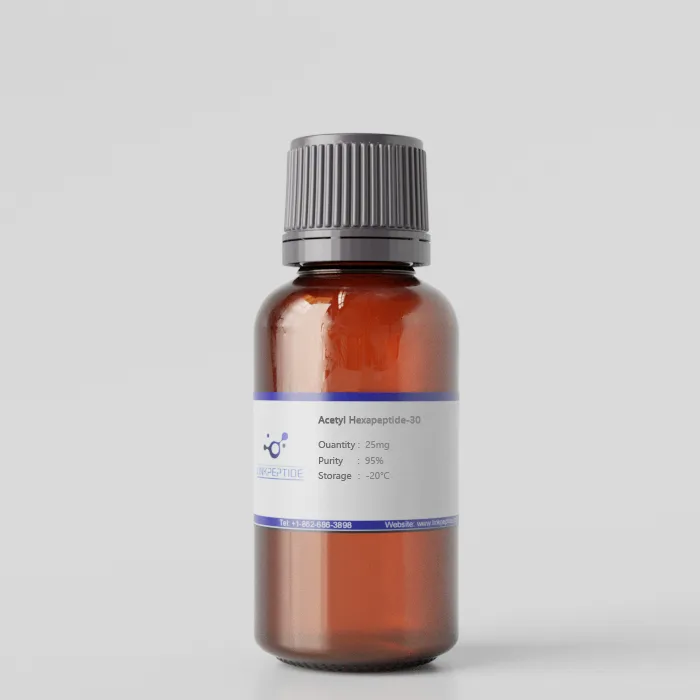
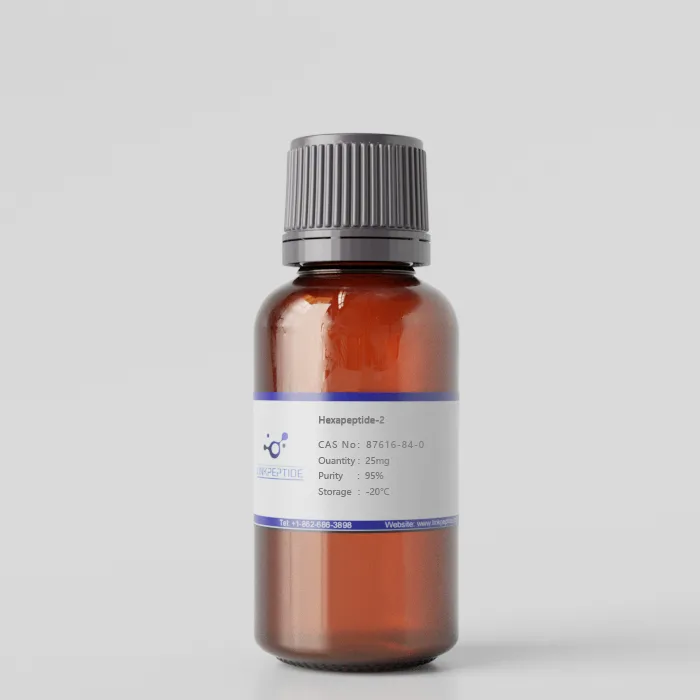
Product Name: Acetyl Hexapeptide-30
Purity: 95%
Storage: Keep in dark and cool dry place -5~8 degree Celsius
Application:
Acetyl Hexapeptide-30 is a precision-engineered biomimetic peptide developed to help visibly smooth expression lines and improve overall skin firmness. By modulating signals involved in facial muscle contraction, it supports cosmetic research aimed at reducing the appearance of dynamic wrinkles, particularly around the eyes and forehead. This hexapeptide is valued for promoting a more relaxed, refreshed look while enhancing skin suppleness. Its excellent water solubility and stability make it ideal for incorporation into serums, creams, and targeted anti-aging treatments designed to deliver a smoother, more youthful-looking complexion.
Current Research:
Acetyl Hexapeptide-30 is a synthetic hexapeptide designed as a SNARE-complex–modulating and neuro-signaling peptide for cosmetic anti-wrinkle applications. It belongs to the same general family as well-known expression-line peptides but has been engineered to interact with different protein targets upstream of vesicle fusion, with the aim of reducing dynamic wrinkle depth while improving tolerance and specificity.
Acetyl Hexapeptide-30 is described as a biomimetic fragment that influences proteins such as SV2, SNAP25 or closely related components involved in synaptic vesicle release at the neuromuscular junction. By modulating these targets, the peptide is proposed to limit neurotransmitter (acetylcholine) release from motor nerve endings into the neuromuscular synapse, in a reversible and non-paralytic cosmetic manner. This reduction in neurotransmitter availability translates into lower muscle contraction intensity in superficial facial muscles responsible for expression lines.
In in vitro neuromuscular models, hexapeptide-based SNAP25/SNARE modulators demonstrate decreased synaptic vesicle recycling and reduced frequency of stimulated neurotransmitter release, without fully blocking the fusion machinery. Acetyl Hexapeptide-30 follows this mechanistic concept, acting as a competitive or allosteric modulator that interferes with protein–protein interactions necessary for full SNARE complex formation. The result is a partial downregulation of exocytosis, which is sufficient at the cosmetic level to reduce repetitive mechanical strain on the overlying skin.
Keratino-cyte and fibroblast studies indicate that Acetyl Hexapeptide-30 does not significantly impair cell viability at cosmetic concentrations, supporting its use in leave-on formulations around the eye contour, forehead and nasolabial folds. Cellular assays also show minimal induction of inflammatory markers, consistent with a low-irritation profile compared with more aggressive actives. In reconstructed 3D skin models subjected to mechanical stress protocols, treatment with neuro-signaling peptides, including hexapeptide variants, leads to improved structural integrity of the epidermal–dermal junction and reduced microfold formation at the surface.
Clinical-style cosmetic evaluations on formulations containing Acetyl Hexapeptide-30 report visible reductions in wrinkle depth and roughness parameters when measured by profilometry or optical 3D imaging. These studies typically involve twice-daily application for several weeks on expression-prone areas. Results include decreased maximum wrinkle depth, reduced average roughness, and improved skin microrelief regularity. Subjective assessments often note a smoother appearance and softening of “expression marks” without the rigidity associated with pharmacological neuromodulators.
Research on neurocosmetic peptides also explores their influence on sensory neuromediators such as substance P, CGRP, and other neuropeptides released in the skin. By attenuating excessive neurogenic signaling, Acetyl Hexapeptide-30 may contribute indirectly to a more balanced neurosensory environment, which is relevant to perceived comfort and to limiting stress-induced micro-tension. This neurosensory aspect complements its primary action at neuromuscular junctions.
At the dermal level, some data suggest that hexapeptide-based neuromodulators can help preserve the architecture of collagen and elastin networks by reducing mechanical fatigue over time. Repeated facial expressions create folding lines that gradually become permanent as collagen bundles reorganize along stress axes. By lowering contraction intensity and frequency, Acetyl Hexapeptide-30 contributes to mechanobiological protection of the dermal matrix, slowing the transition from dynamic to static wrinkles.
From a physicochemical standpoint, Acetyl Hexapeptide-30 is a short, acetylated peptide with good water solubility and a molecular size suitable for topical delivery through the stratum corneum, especially when formulated in optimized vehicles such as liposomes, nanoemulsions, or penetration-enhancing gels. The N-terminal acetylation improves stability against exopeptidase degradation and can modulate overall peptide charge, supporting predictable behavior in complex formulations.
Stability studies in cosmetic-type emulsions typically monitor peptide integrity under conditions of elevated temperature and light exposure. Hexapeptide-30 shows acceptable stability profiles when formulated at appropriate pH ranges and protected with standard antioxidant and chelator systems. This allows its incorporation into serums, eye creams, and targeted wrinkle treatments intended for daily, long-term use.
Current research directions for Acetyl Hexapeptide-30 and related molecules focus on refining target specificity, comparing activity profiles across different facial muscle groups, and exploring combinations with other anti-aging strategies such as retinoids, signal peptides that stimulate collagen synthesis, and antioxidants that address oxidative components of skin aging. Multi-pathway formulations pairing neuromodulating peptides with matrix-support peptides and barrier-strengthening actives are of particular interest, as they integrate mechanical, biochemical, and structural aspects of wrinkle formation into a single system.
Overall, Acetyl Hexapeptide-30 is characterized in cosmetic research as a topical neuromuscular- and neurosensory-modulating hexapeptide that acts on SNARE-related and synaptic targets to reduce acetylcholine release, decrease expression-related muscle contractions, and mitigate mechanical stress on the skin, resulting in measurable reductions in dynamic wrinkle parameters in experimental and cosmetic-use studies.
Get a Quote
 LinkPeptide