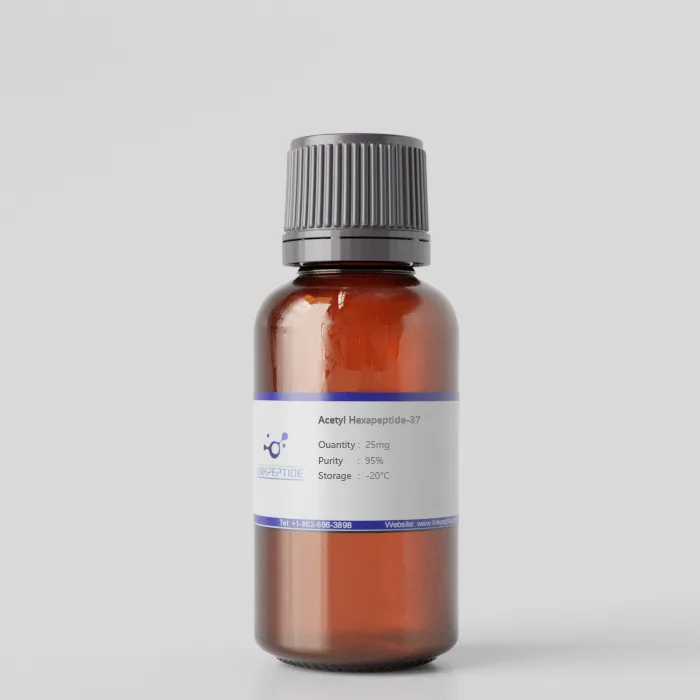
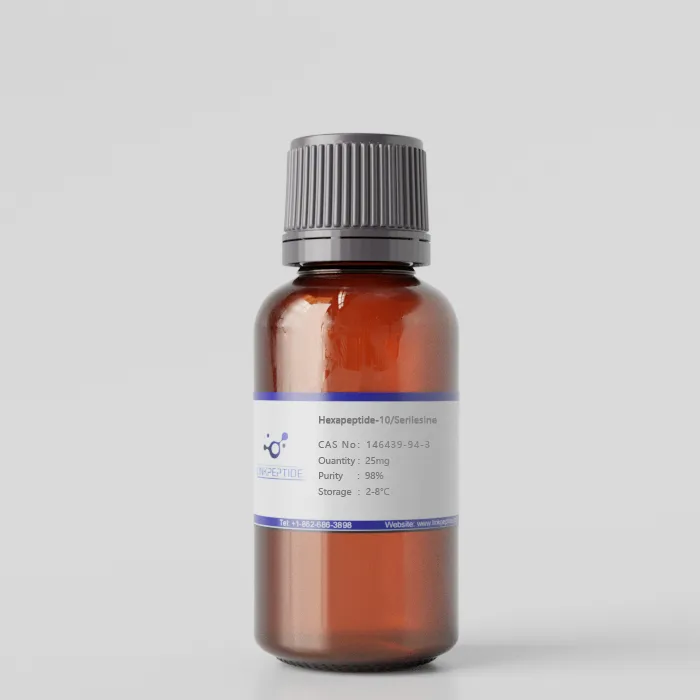
Product Name: Acetyl Hexapeptide-37
Purity: 95%
Storage: Keep in dark and cool dry place -5~8 degree Celsius
Sequence: Ac-Ser-Pro-Ala-Gly-Gly-Pro-NH2
Molar Mass: 525.6
Chemical Formula: C22H35N7O8
Synonyms: HY-P5221; CS-0857348
IUPAC Name: (2S)-1-[2-[[2-[[(2S)-2-[[(2S)-1-[(2S)-2-acetamido-3-hydroxypropanoyl]pyrrolidine-2-carbonyl]amino]propanoyl]amino]acetyl]amino]acetyl]pyrrolidine-2-carboxamide
SMILES: C[C@@H](C(=O)NCC(=O)NCC(=O)N1CCC[C@H]1C(=O)N)NC(=O)[C@@H]2CCCN2C(=O)[C@H](CO)NC(=O)C
InChIKey: WZUFKRTZHLMBTG-TUUVXOQKSA-N
InChI: InChI=1S/C22H35N7O8/c1-12(26-21(36)16-6-4-8-29(16)22(37)14(11-30)27-13(2)31)20(35)25-9-17(32)24-10-18(33)28-7-3-5-15(28)19(23)34/h12,14-16,30H,3-11H2,1-2H3,(H2,23,34)(H,24,32)(H,25,35)(H,26,36)(H,27,31)/t12-,14-,15-,16-/m0/s1
Application:
Acetyl Hexapeptide-37 is a biomimetic peptide celebrated for its ability to enhance skin hydration and improve overall smoothness. Acting on aquaporin pathways, it helps support optimal water balance, promoting a plumper, more refreshed appearance. In cosmetic research, this hexapeptide is used to explore improved skin suppleness, enhanced moisture distribution, and a more radiant complexion. Its gentle profile and excellent formulation compatibility make it ideal for hydrating serums, daily moisturizers, and advanced skincare treatments designed for dry or dehydrated skin. Acetyl Hexapeptide-37 offers a targeted approach to achieving softer, healthier-looking skin through boosted moisture dynamics.
Current Research:
Acetyl Hexapeptide-37: Research Overview
Acetyl Hexapeptide-37 is a synthetic hexapeptide developed through combinatorial peptide screening on human keratinocytes. It is classified as a bioactive cosmetic peptide with primary activity on epidermal water transport and barrier-related parameters. The peptide is N-terminally acetylated and C-terminally amidated, which improves chemical stability and resistance to enzymatic degradation in topical environments.
Structurally, Acetyl Hexapeptide-37 is a six–amino-acid sequence composed of small neutral residues arranged to favor interaction with epidermal cell membranes and receptors. The short chain length and terminal modifications support a molecular weight in the low-peptide range, compatible with diffusion through the upper layers of the stratum corneum when delivered in appropriate vehicles.
The main research focus for Acetyl Hexapeptide-37 is its effect on aquaporin-3 (AQP3), a membrane channel expressed in basal and suprabasal keratinocytes. AQP3 transports water and small solutes such as glycerol, and is known to contribute to epidermal hydration, elasticity, and barrier recovery.
In vitro studies on human keratinocytes show that treatment with Acetyl Hexapeptide-37 increases AQP3 expression at the mRNA and protein levels. Enhanced AQP3 expression is associated with greater transmembrane water and glycerol flux across keratinocyte monolayers and reconstructed epidermis models. These findings support the concept that the peptide acts as a functional modulator of epidermal water channels, contributing to improved distribution of water and humectant solutes between epidermal layers.
Because AQP3 activity influences epidermal hydration and lipid organization, Acetyl Hexapeptide-37 has been studied in the context of barrier integrity and transepidermal water loss (TEWL). Experimental data in reconstructed human epidermis and ex vivo skin indicate that peptide-treated samples show reduced TEWL compared with untreated controls, consistent with improved barrier function and better organization of the stratum corneum.
Elevated AQP3 expression is also linked to faster barrier recovery after experimental disruption in model systems. In this context, Acetyl Hexapeptide-37 is considered a tool to modulate water-channel biology and support barrier homeostasis through improved fluid distribution and solute transport in the viable epidermis.
In addition to its effects on AQP3, Acetyl Hexapeptide-37 has been evaluated for influence on cell proliferation and dermal extracellular matrix components. Keratinocyte assays report modest increases in proliferation and metabolic activity at cosmetic-use concentrations, suggesting a supportive role in epidermal renewal.
Fibroblast cultures exposed to the peptide show increased synthesis of type I collagen in some in vitro studies. Type I collagen is the predominant structural collagen in the dermis, critical for tensile strength and mechanical resilience. While these data are limited and largely supplier-generated, they point to a secondary activity of Acetyl Hexapeptide-37 on dermal matrix biology in addition to its primary effect on epidermal water handling.
Research on formulations containing Acetyl Hexapeptide-37 often includes biophysical measurements such as corneometry and TEWL, as well as imaging-based assessment of surface microrelief. In such studies, peptide-containing systems are associated with increased stratum corneum hydration, decreased TEWL, and more regular skin microrelief compared with vehicle controls after repeated application.
Microscopic analysis of reconstructed epidermis treated with the peptide shows more compact and homogeneous stratum corneum layering and a well-defined granular layer, consistent with improved barrier organization. These morphological changes correlate with the functional data on water transport and barrier function.
Acetyl Hexapeptide-37 is typically supplied as a white to off-white solid with high purity. It is hydrophilic and readily soluble in water and common polyols. The acetyl and amide termini contribute to stability in aqueous formulations and help maintain a defined charge profile over typical cosmetic pH ranges.
The peptide is generally added in the cool-down phase of emulsions or into aqueous serums and gels to limit thermal degradation. It is compatible with standard humectants, emollients, and other peptide actives and can be incorporated into systems designed to enhance epidermal penetration, such as liposomes or nanoemulsions, when deeper access to viable epidermis is desired.
Overall, current research characterizes Acetyl Hexapeptide-37 as:
A small, terminally modified hexapeptide active on keratinocyte AQP3 expression and function.
A modulator of epidermal hydration and barrier-related endpoints, including TEWL and water flux.
A peptide with additional observed activity on keratinocyte proliferation and type I collagen synthesis in in vitro models.
These properties place Acetyl Hexapeptide-37 within the group of cosmetic peptides that target water-channel regulation and barrier-support pathways as a strategy for maintaining epidermal homeostasis and structural quality.
Get a Quote
 LinkPeptide