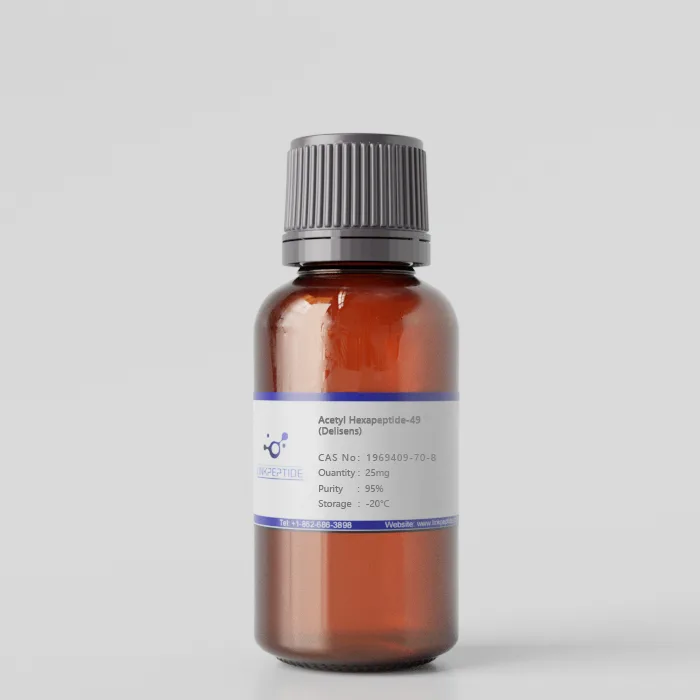
Product Name: Acetyl Hexapeptide-49 (Delisens)
Cas No: 1969409-70-8
Purity: 95%
Storage: Keep in dark and cool dry place -5~8 degree Celsius
Sequence: Ac-Phe-Phe-Trp-Phe-His-Val-OH
Molar Mass: 924.1
Chemical Formula: C51H57N9O8
IUPAC Name: (2S)-2-[[(2S)-2-[[(2S)-2-[[(2S)-2-[[(2S)-2-[[(2S)-2-acetamido-3-phenylpropanoyl]amino]-3-phenylpropanoyl]amino]-3-(1H-indol-3-yl)propanoyl]amino]-3-phenylpropanoyl]amino]-3-(1H-imidazol-5-yl)propanoyl]amino]-3-methylbutanoic acid
SMILES: CC(C)[C@@H](C(=O)O)NC(=O)[C@H](CC1=CN=CN1)NC(=O)[C@H](CC2=CC=CC=C2)NC(=O)[C@H](CC3=CNC4=CC=CC=C43)NC(=O)[C@H](CC5=CC=CC=C5)NC(=O)[C@H](CC6=CC=CC=C6)NC(=O)C
InChIKey: HZKWUUZWBZRTOO-RCWIFLETSA-N
InChI: InChI=1S/C51H57N9O8/c1-31(2)45(51(67)68)60-50(66)44(27-37-29-52-30-54-37)59-48(64)42(25-35-19-11-6-12-20-35)57-49(65)43(26-36-28-53-39-22-14-13-21-38(36)39)58-47(63)41(24-34-17-9-5-10-18-34)56-46(62)40(55-32(3)61)23-33-15-7-4-8-16-33/h4-22,28-31,40-45,53H,23-27H2,1-3H3,(H,52,54)(H,55,61)(H,56,62)(H,57,65)(H,58,63)(H,59,64)(H,60,66)(H,67,68)/t40-,41-,42-,43-,44-,45-/m0/s1
Application:
Acetyl Hexapeptide-49 (Delisens) is a soothing biomimetic peptide developed to help reduce discomfort, redness, and sensitivity while reinforcing the skin’s protective barrier. Designed to modulate neuro-sensory signaling, Delisens supports research focused on calming reactive skin and improving overall comfort. It aids in restoring hydration balance, smoothing texture, and reducing visible signs of irritation associated with environmental stressors. With excellent stability and compatibility in serums, moisturizers, and sensitive-skin formulations, Acetyl Hexapeptide-49 is ideal for treatments targeting increased tolerance, long-lasting comfort, and a healthier, more resilient-looking complexion.
Current Research:
Acetyl Hexapeptide-49, marketed as Delisens?, is a neuro-soothing cosmetic peptide developed specifically for sensitive, reactive, and itchy skin. It’s a six–amino acid sequence with an N-terminal acetyl group, optimized for skin penetration and stability in water-based systems. Current data position it as an ingredient that calms neurogenic inflammation, restores the skin barrier, and improves overall comfort and hydration.
Mechanism of Action: PAR-2, Neurogenic Inflammation, and Barrier Repair
Sensitive skin is strongly linked to overactive sensory nerves and cutaneous neuroinflammation—especially excess release of neuropeptides and cytokines such as CGRP, IL-6, and IL-8. Acetyl Hexapeptide-49 was designed to interrupt this process at an early step.
PAR-2 modulation
Delisens primarily targets protease-activated receptor-2 (PAR-2), a receptor expressed on keratinocytes and sensory nerve endings that is known to drive itch, burning, and inflammatory mediator release when over-activated. In vitro studies show that Acetyl Hexapeptide-49 reduces PAR-2 activity, which in turn lowers downstream neurogenic signals.
Reduced release of pro-inflammatory mediators
By dampening PAR-2–dependent signaling, Acetyl Hexapeptide-49 decreases the release of mediators such as CGRP, IL-6, and IL-8 from skin cells. These molecules contribute to vasodilation, redness, stinging, and chronic discomfort in sensitive skin. Lowering their levels helps calm irritation, stinging, and itching.
Barrier support and hydration
Technical data and raw-material descriptions report that Delisens enhances keratinocyte growth and viability, promotes barrier repair, and reduces transepidermal water loss (TEWL). As the barrier recovers, the skin becomes less reactive and holds more moisture, improving roughness, tightness, and flaking.
Altogether, Acetyl Hexapeptide-49 works on both nerve–signal modulation and structural repair, which is why it’s often described as a neuro-soothing + barrier-rebuilding peptide rather than a simple anti-inflammatory.
Place in Modern Cosmetic Peptide Science
Within the cosmetic peptide family, Acetyl Hexapeptide-49 belongs to:
Neurosensory / anti-itch peptides – focused on reducing stinging, burning, and pruritus in sensitive skin.
Anti-inflammatory, barrier-support actives – lowering cytokines and promoting barrier repair.
It is often mentioned alongside (but mechanistically distinct from) TRPV1-modulating peptides and classic “anti-redness” tetrapeptides. PAR-2, like TRPV1, is an important node in itch and pain signaling, and both are active targets in current dermatology and cosmetic research on chronic pruritus and sensitive skin.
Formulators typically position Delisens for:
Sensitive / reactive skin lines (stinging, burning, easily irritated).
Post-procedure and barrier-compromised skin (after peels, retinoids, masks, shaving, depilation).
Anti-itch and anti-tightness body and scalp care for dry, reactive skin types.
In Vitro and Application-Level Data
Most publicly available data come from supplier studies, peptide databases, and secondary technical articles, but they give a coherent picture:
Cell and biochemical models
Delisens reduces PAR-2 activation under experimental stimulation.
It lowers IL-6 and IL-8 secretion and other pro-inflammatory markers in skin cell cultures, indicating a real anti-inflammatory and neurogenic-calming effect.
Protects cell viability under irritant conditions, consistent with a protective role against external stressors.
Skin-benefit observations (from technical dossiers and brand tests)
Volunteers with self-perceived sensitive or reactive skin reported reduced stinging, burning, and itch after several weeks of using formulations containing Acetyl Hexapeptide-49.
Instrumental measurements showed lower TEWL and improved hydration, along with visible reduction in redness and roughness.
While these are relatively small, manufacturer-driven studies rather than large independent clinical trials, the mechanism is well aligned with the broader literature on PAR-2, neurogenic inflammation, and sensitive skin.
Safety and Formulation Considerations
Acetyl Hexapeptide-49 is supplied as a high-purity synthetic peptide or as part of a standardized aqueous/glycerin solution under the Delisens name. Key practical points:
Use levels are typically low in finished formulas, as is standard for potent cosmetic peptides.
It is water-soluble and compatible with emulsions, gels, essences, and masks, provided processing temperatures remain moderate to preserve peptide integrity.
Raw-material documentation describes a good irritation and sensitization profile at recommended concentrations, which is essential for products targeting sensitive skin.
It is intended strictly for topical cosmetic use, not as a drug for treating clinical allergy or dermatitis.
Get a Quote
 LinkPeptide