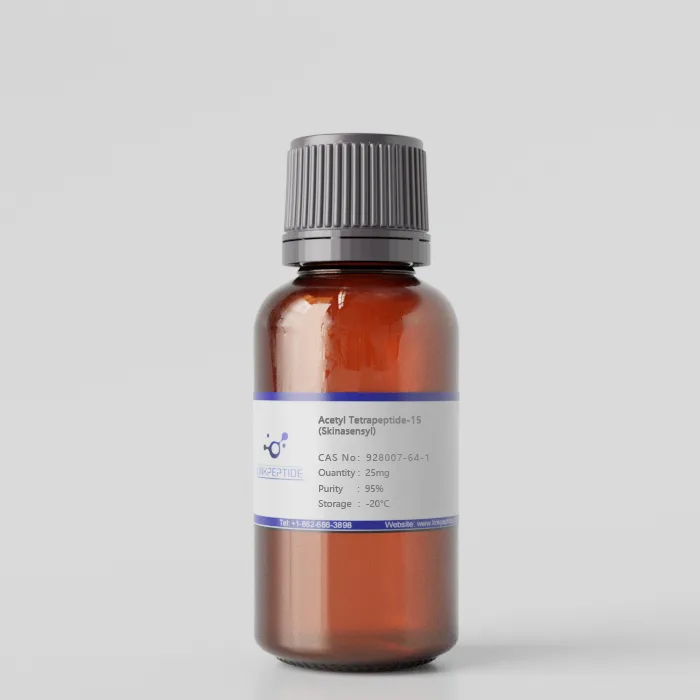
Product Name: Acetyl Tetrapeptide-15 (Skinasensyl)
Cas No: 928007-64-1
Purity: 95%
Storage: Keep in dark and cool dry place -5~8 degree Celsius
Sequence: Tyr-Pro-Phe-Phe
Molar Mass: 613.7
Chemical Formula: C34H39N5O6
IUPAC Name: (2S)-1-[(2S)-2-acetamido-3-(4-hydroxyphenyl)propanoyl]-N-[(2S)-1-[[(2S)-1-amino-1-oxo-3-phenylpropan-2-yl]amino]-1-oxo-3-phenylpropan-2-yl]pyrrolidine-2-carboxamide
SMILES: CC(=O)N[C@@H](CC1=CC=C(C=C1)O)C(=O)N2CCC[C@H]2C(=O)N[C@@H](CC3=CC=CC=C3)C(=O)N[C@@H](CC4=CC=CC=C4)C(=O)N
InChIKey: BSXFOBDOGHFWOC-KRCBVYEFSA-N
InChI: InChI=1S/C34H39N5O6/c1-22(40)36-29(21-25-14-16-26(41)17-15-25)34(45)39-18-8-13-30(39)33(44)38-28(20-24-11-6-3-7-12-24)32(43)37-27(31(35)42)19-23-9-4-2-5-10-23/h2-7,9-12,14-17,27-30,41H,8,13,18-21H2,1H3,(H2,35,42)(H,36,40)(H,37,43)(H,38,44)/t27-,28-,29-,30-/m0/s1
Application:
Acetyl Tetrapeptide-15 (Skinasensyl) is a calming biomimetic peptide designed to help reduce skin sensitivity and improve overall comfort. By modulating key neuro-sensory receptors, Skinasensyl supports research focused on lowering reactivity thresholds, diminishing irritation, and soothing stressed or delicate skin. It helps enhance tolerance, smooth texture, and promote a balanced, healthier-looking complexion. With excellent stability and compatibility in serums, moisturizers, and sensitive-skin care products, Acetyl Tetrapeptide-15 is ideal for formulations aimed at reducing discomfort, strengthening the skin??s protective barrier, and delivering long-lasting soothing benefits.
Current Research:
Acetyl Tetrapeptide-15 (Skinasensyl): Current Research Overview
Acetyl Tetrapeptide-15, trade name Skinasensyl?, is a neurocosmetic tetrapeptide designed specifically for neuro-sensitive and reactive skin. It is an acetylated short sequence derived from endomorphin-2, a natural human μ-opioid receptor agonist involved in pain modulation. By mimicking this endogenous pathway in a controlled cosmetic way, Acetyl Tetrapeptide-15 aims to raise the skin’s tolerance threshold and reduce discomfort sensations such as stinging, burning, and itching.
In modern formulations, it’s positioned as an anti-discomfort, anti-redness, and soothing peptide for face, body, scalp, and even intimate-care products.
Mechanism of Action: μ-Opioid Pathway + Neurogenic Soothing
The core mechanism of Acetyl Tetrapeptide-15 is neuromodulation rather than classic anti-inflammatory chemistry.
Because it is derived from endomorphin-2, Acetyl Tetrapeptide-15 can interact with the μ-opioid receptor system in cutaneous nerve endings. Technical data describe it as raising the excitatory threshold of neurons via an endorphin-like pathway: nerve fibers require stronger stimuli before firing.
Result:
Reduced hyperreactivity of sensory nerves,
Diminished perception of pain, burning, and itching,
Increased tolerance to cosmetic procedures and environmental stressors.
Another key aspect is its effect on neurogenic inflammation. Sensory nerves release neuropeptides such as CGRP (calcitonin gene–related peptide) when overstimulated; CGRP is a major driver of vasodilation, redness, and inflammatory discomfort in sensitive skin. Supplier and distributor data show that Skinasensyl inhibits CGRP release from sensory neurons, which reduces downstream redness and irritation and helps calm reactive skin.
In practice, these mechanisms translate into a measurable increase in the discomfort threshold:
In a single-blind clinical-style test, volunteers applied a low dose of the peptide twice daily for several days; subsequent capsaicin challenges on treated vs. control skin showed a higher capsaicin threshold (meaning it took stronger capsaicin to provoke discomfort).
This supports the core marketing message: skin becomes less reactive and more tolerant to everyday triggers.
Place in Modern Cosmetic Peptide Science
Within the peptide landscape, Acetyl Tetrapeptide-15 falls under:
Neurosensory / neuro-soothing peptides,
Sensitive-skin and anti-itch actives,
“Tolerance-boosting” cosmetic ingredients.
It complements, but is mechanistically distinct from, other sensitive-skin peptides like Acetyl Hexapeptide-49 (Delisens) or acetyl dipeptide-1 cetyl ester. While some focus on PAR-2 or TRPV1, Acetyl Tetrapeptide-15 offers a μ-opioid receptor / endorphin-mimetic angle, which is attractive for storytelling around comfort, well-being, and skin–brain connection.
It is often included in:
Sensitive / reactive skin moisturizers,
Post-procedure or after-peel serums and creams,
Scalp-soothing treatments,
Feminine-hygiene and intimate-care products,
Anti-redness and anti-itch body lotions.
In Vitro, Ex Vivo, and Clinical Evidence
Most data are from manufacturer and technical dossiers, but they are relatively consistent and aligned with broader neurosensory literature.
In vitro / mechanistic studies report that Acetyl Tetrapeptide-15:
Raises neuronal excitability threshold in μ-opioid–expressing neurons,
Reduces CGRP release under stimulatory conditions,
Decreases markers associated with inflammatory and neuropathic pain, suggesting benefit not only for acute irritation but also for chronic sensitivity.
Clinical-style tolerance studies (e.g., capsaicin and heat tests) show:
Significant increase in capsaicin discomfort threshold after several days of topical application,
Improved tolerance to thermal stimuli, with the largest soothing effect around 60 minutes post-application and sustained over time.
Consumer-oriented tests described in marketing literature also mention:
Reduced feelings of tightness, stinging, burning, and itch,
Visible improvements in redness and overall comfort, especially in people self-identifying as having sensitive skin.
These are typical cosmetic-scale studies (small samples, short duration), so claims should stay clearly in the appearance and comfort space.
Get a Quote
 LinkPeptide