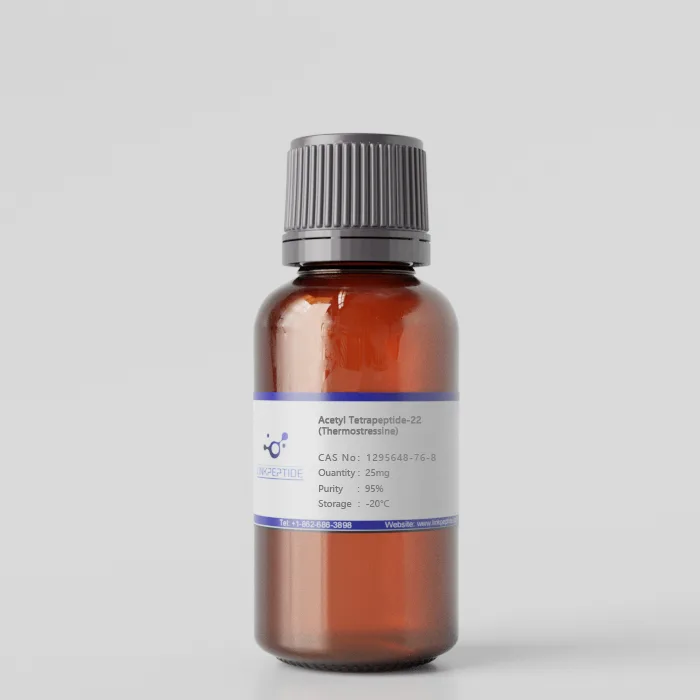
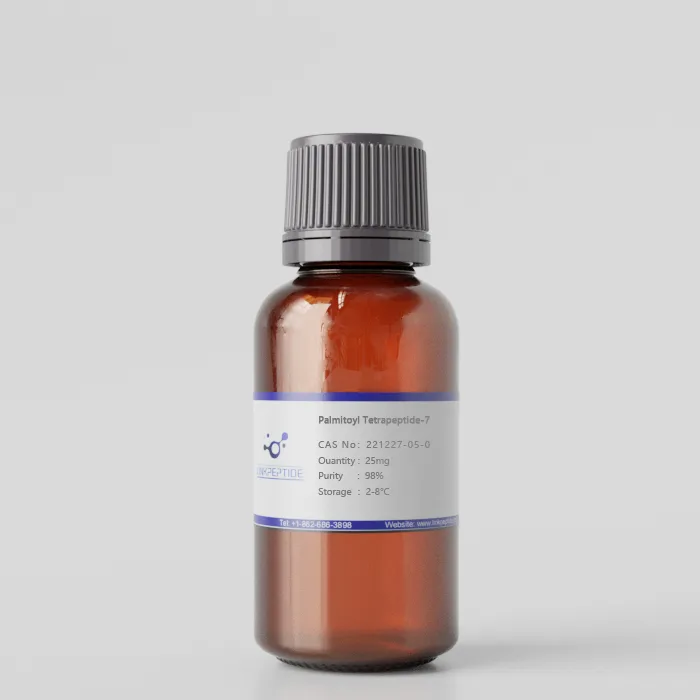
Product Name: Acetyl Tetrapeptide-22 (Thermostressine)
Cas No: 1295648-76-8
Purity: 95%
Storage: Keep in dark and cool dry place -5~8 degree Celsius
Sequence: Ac-His-Leu-Leu-Arg-OH
Molar Mass: 579.7
Chemical Formula: C26H45N9O6
IUPAC Name: (2S)-2-[[(2S)-2-[[(2S)-2-[[(2S)-2-acetamido-3-(1H-imidazol-5-yl)propanoyl]amino]-4-methylpentanoyl]amino]-4-methylpentanoyl]amino]-5-(diaminomethylideneamino)pentanoic acid
SMILES: CC(C)C[C@@H](C(=O)N[C@@H](CC(C)C)C(=O)N[C@@H](CCCN=C(N)N)C(=O)O)NC(=O)[C@H](CC1=CN=CN1)NC(=O)C
InChIKey: SXCZMIXJMNKJBF-TUFLPTIASA-N
InChI: InChI=1S/C26H45N9O6/c1-14(2)9-19(22(37)33-18(25(40)41)7-6-8-30-26(27)28)34-23(38)20(10-15(3)4)35-24(39)21(32-16(5)36)11-17-12-29-13-31-17/h12-15,18-21H,6-11H2,1-5H3,(H,29,31)(H,32,36)(H,33,37)(H,34,38)(H,35,39)(H,40,41)(H4,27,28,30)/t18-,19-,20-,21-/m0/s1
Application:
Acetyl Tetrapeptide-22 (Thermostressine) is an innovative biomimetic peptide designed to help the skin adapt to thermal stress and maintain optimal balance under fluctuating environmental conditions. Known for supporting heat-shock protein activity, it aids in reinforcing cellular defense mechanisms, promoting smoother texture, improved resilience, and a healthier-looking complexion. In cosmetic research, Thermostressine is valued for reducing signs of fatigue, enhancing hydration stability, and protecting against heat-induced dullness. With excellent formulation versatility, Acetyl Tetrapeptide-22 is ideal for serums, creams, and daily care treatments targeting environmental stress protection and long-lasting skin comfort.
Current Research:
Acetyl Tetrapeptide-22 (Thermostressine): Current Research Overview
Acetyl Tetrapeptide-22, marketed as Thermostressine?, is a synthetic tetrapeptide designed as a stress-protective and repair peptide for skin exposed to environmental and lifestyle stress. Chemically, it is an N-acetylated four–amino acid sequence (often abbreviated as Ac-HLLR), optimized for stability and skin penetration. It is classified as a signal peptide with a specific role in up-regulating heat shock protein 70 (HSP70) in skin cells.
HSP70 is a key molecular chaperone that helps cells cope with protein-damaging stress (heat, UV, pollution, oxidation). By boosting HSP70 levels, Acetyl Tetrapeptide-22 aims to increase skin’s stress tolerance, reduce damage, and support faster recovery.
Mechanism of Action: HSP70 Induction and Stress Tolerance
The core scientific story around Thermostressine is its ability to increase HSP70 expression in keratinocytes and other skin cells:
In vitro studies from the ingredient developer show that Acetyl Tetrapeptide-22 significantly elevates HSP70 levels after peptide treatment, versus untreated controls.
HSP70 acts as a molecular chaperone, refolding misfolded proteins and promoting the clearance of irreversibly damaged ones, thereby limiting proteotoxic stress and maintaining cellular homeostasis.
Because everyday skin stress rarely comes from heat alone, Thermostressine is positioned as a multi-stress shield. Supplier and technical sources emphasize protection against:
Temperature extremes (heat and cold)
UV radiation and free radicals
Pollution and heavy metals
Dehydration, jet lag, and lifestyle stress
By increasing HSP70, Acetyl Tetrapeptide-22 helps cells survive and adapt under these conditions, reducing visible signs of stress such as dullness, tightness, redness, and rough texture.
Role in Modern Cosmetic Peptide Science
Within the cosmetic peptide taxonomy, Acetyl Tetrapeptide-22 sits in the category of defense / stress-response signal peptides, rather than classic collagen-boosting or neurotransmitter-inhibiting peptides. Its key differentiator is the HSP70-centric, “thermo-stress” mechanism:
Upstream protection: instead of targeting one damage type (e.g., UV only), it reinforces a universal cellular defense system that responds to many stressors.
Proteostasis and longevity angle: HSP70 and related chaperones are widely studied in aging biology for their role in protein quality control, which is essential for long-term cell health.
This gives you a sophisticated narrative: Thermostressine is not just an antioxidant; it helps skin manage stress at the protein level.
Formulators often combine Acetyl Tetrapeptide-22 with:
Antioxidants (vitamin C/E, polyphenols)
Barrier lipids and humectants (ceramides, hyaluronic acid)
Soothing actives (panthenol, madecassoside)
to build “anti-stress,” “jet-lag,” or “urban defense” concepts for sensitive and stressed skin.
In Vitro, Ex Vivo, and Application Data
Most data available today are manufacturer studies and secondary technical reviews, but they are consistent:
In vitro
Keratinocyte models treated with Thermostressine show increased HSP70 expression and improved resistance to simulated stress (heat, oxidative, or environmental).
Cells exhibit less protein damage and better viability after stress exposure compared with untreated controls.
Ex vivo / early application
Skin explant tests indicate that Acetyl Tetrapeptide-22 can reduce markers of stress-induced damage and support tissue integrity, suggesting benefits for post-exposure recovery (e.g., after sun or harsh environmental exposure).
Cosmetic positioning
Widely used in formulas aimed at office workers, frequent flyers, and city dwellers, where chronic low-grade stress leads to skin that looks tired, dull, and fragile.
Large, independent clinical trials are still limited, so claims should stay within cosmetic boundaries, focusing on visible comfort, vitality, and resilience rather than medical treatment.
Get a Quote
 LinkPeptide