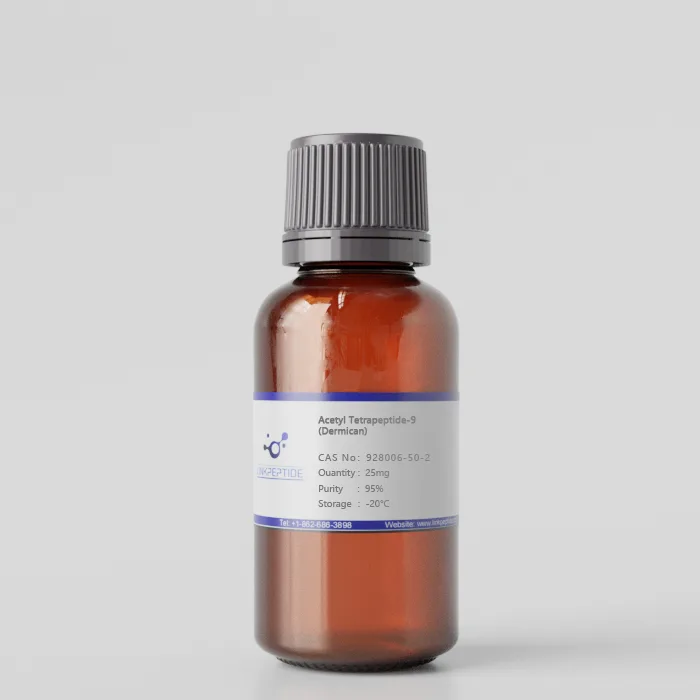
Product Name: Acetyl Tetrapeptide-9 (Dermican)
Cas No: 928006-50-2
Purity: 95%
Storage: Keep in dark and cool dry place -5~8 degree Celsius
Molar Mass: 539.5
Chemical Formula: C22H33N7O9
IUPAC Name: (3S)-3-[[(2S)-2-acetamido-5-amino-5-oxopentanoyl]amino]-4-[[(2S)-1-[[(1S)-1-carboxy-2-(1H-imidazol-5-yl)ethyl]amino]-3-methyl-1-oxobutan-2-yl]amino]-4-oxobutanoic acid
SMILES: CC(C)[C@@H](C(=O)N[C@@H](CC1=CN=CN1)C(=O)O)NC(=O)[C@H](CC(=O)O)NC(=O)[C@H](CCC(=O)N)NC(=O)C
InChIKey: QNZANUZIBYJBIN-XSWJXKHESA-N
InChI: InChI=1S/C22H33N7O9/c1-10(2)18(21(36)28-15(22(37)38)6-12-8-24-9-25-12)29-20(35)14(7-17(32)33)27-19(34)13(26-11(3)30)4-5-16(23)31/h8-10,13-15,18H,4-7H2,1-3H3,(H2,23,31)(H,24,25)(H,26,30)(H,27,34)(H,28,36)(H,29,35)(H,32,33)(H,37,38)/t13-,14-,15-,18-/m0/s1
Application:
Acetyl Tetrapeptide-9 (Dermican) is a biomimetic peptide engineered to support deeper skin firmness by enhancing key structural proteins within the dermal matrix. Known for stimulating lumican and collagen synthesis, Dermican helps improve skin density, refine texture, and reduce the appearance of wrinkles. In cosmetic research, it is widely used to explore enhanced dermal organization and long-term resilience, contributing to a firmer and more sculpted look. With excellent stability and solubility, Acetyl Tetrapeptide-9 integrates seamlessly into serums, creams, and advanced anti-aging treatments targeting improved skin architecture and a youthful, strengthened complexion.
Current Research:
Acetyl Tetrapeptide-9 (Dermican): Research Overview
Acetyl Tetrapeptide-9 is a synthetic signal tetrapeptide developed to target dermal extracellular matrix (ECM) architecture, especially collagen fibril organization and dermal density in the papillary dermis. It is N-terminally acetylated to improve stability and reduce susceptibility to exopeptidase degradation, and is supplied under the trade name Dermican as a cosmetic anti-aging active.
The conceptual model for Acetyl Tetrapeptide-9 is based on the role of lumican, a small leucine-rich proteoglycan that binds collagen fibrils and regulates:
Fibril diameter and uniformity
Lateral packing and spacing of collagen fibers
Overall dermal transparency and mechanical properties
With chronological and photo-induced aging, lumican and other dermal proteoglycans decline, leading to irregular collagen fibrils, disorganized bundles, and reduced dermal density. Acetyl Tetrapeptide-9 was designed via peptide screening to influence lumican expression and collagen-network quality in fibroblasts and skin models.
Key features of Acetyl Tetrapeptide-9:
Short linear tetrapeptide with N-terminal acetylation.
Hydrophilic low–molecular-weight peptide, suitable for topical delivery into viable epidermis and superficial dermis when formulated in appropriate vehicles.
Acts at signal-peptide concentrations, modulating cell pathways rather than contributing structurally to the ECM.
The exact amino acid sequence is not the primary focus in cosmetic dossiers; instead, emphasis is put on its functional profile as a lumican- and collagen-network–modulating peptide.
In fibroblast and skin-equivalent models, Acetyl Tetrapeptide-9 has been shown to:
Increase lumican expression, both at mRNA and protein levels.
Support more regular collagen fibril diameters and improved interfibrillar spacing in collagen gels and dermal equivalents.
Enhance overall dermal density, particularly in the papillary dermis.
By boosting lumican, the peptide is intended to re-establish more controlled collagen fibrillogenesis, resulting in finer, better-organized collagen networks rather than thick, irregular bundles typical of aged skin.
In vitro fibroblast studies with Acetyl Tetrapeptide-9 report:
Upregulation of lumican and related ECM genes.
Modest stimulation of collagen I and III synthesis.
Formation of collagen matrices with narrower fibril-diameter distribution compared with untreated controls.
Ex vivo human skin or reconstructed-skin models exposed to formulations containing the peptide show:
Increased papillary dermis density, as seen by histological staining.
More homogeneous and fine collagen network directly beneath the dermal–epidermal junction.
Improved definition of the interface between papillary and reticular dermis.
These observations support classification of Acetyl Tetrapeptide-9 as a matrix-structuring peptide, emphasizing quality of collagen organization as much as quantity.
Although its primary target is the dermal matrix, Acetyl Tetrapeptide-9 has indirect effects on the dermal–epidermal junction (DEJ) and surface appearance:
A denser, more uniform papillary dermis provides better mechanical support to the DEJ and basal epidermis.
Regular collagen scaffolding contributes to more even distribution of mechanical stresses, which is relevant to wrinkle formation and deepening.
Improved subsurface structure is associated in instrumental cosmetic studies with reduced surface roughness, diminished wrinkle depth, and more uniform microrelief.
Thus, the peptide is positioned as acting “from the dermis outward,” focusing on subsurface scaffolding that affects visible surface markers of aging.
Dermal aging involves:
Reduced collagen and proteoglycan synthesis
Increased matrix metalloproteinase activity
Loss of proteoglycans that regulate fibrillogenesis (decorin, lumican)
Acetyl Tetrapeptide-9 addresses mainly the regulatory layer of this process by:
Enhancing lumican levels to control fibril geometry
Supporting a denser, more finely organized collagen mesh
Complementing other actives that target synthesis (collagen-boosting peptides, retinoid-like compounds) or protection (anti-glycation, antioxidants)
In this framework, the peptide contributes to matrix quality control, making it suitable in combination protocols focused on comprehensive ECM management.
From a formulation point of view, Acetyl Tetrapeptide-9:
Is supplied as a water-soluble peptide, often pre-dispersed in a humectant-containing solution.
Is usually added in the cool-down phase of emulsions or directly into aqueous serums and gels.
Is compatible with other peptides, hyaluronic acid, antioxidants, and barrier-supporting lipids.
Is used at low dosage levels typical for signal peptides, relying on pathway modulation rather than bulk contribution.
Stability considerations include protection from prolonged high temperature and strong oxidants; under standard cosmetic pH and storage conditions, the peptide remains suitable for long-term use in finished products.
Summary
Acetyl Tetrapeptide-9 (Dermican) is a lumican-focused signal tetrapeptide characterized by its ability to modulate proteoglycan expression, refine collagen fibrillogenesis, and increase dermal density—particularly in the papillary dermis. Research describes it as a matrix-organizing peptide that improves collagen network quality and subsurface structure, with downstream effects on firmness, dermal support, and the visible appearance of fine lines and wrinkles in experimental and cosmetic-use models.
Get a Quote
 LinkPeptide