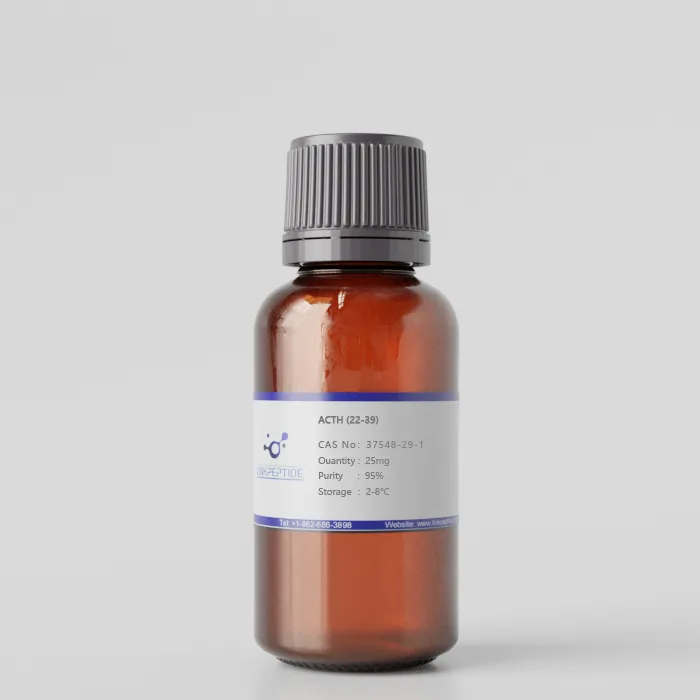
Product Name:ACTH (22-39)
Form:TFA salt
Purity:95%
Storage:2-8 degree Celsius
Cas No:37548-29-1
Molar Mass:1985.06
Chemical Formula:C90H125N19O32
IUPAC Name:4-[2-[[2-[[2-[[2-[[2-[2-[[2-[[4-amino-2-[[1-[2-[(2-amino-3-methylbutanoyl)amino]-3-(4-hydroxyphenyl)propanoyl]pyrrolidine-2-carbonyl]amino]-4-oxobutanoyl]amino]acetyl]amino]propanoylamino]-4-carboxybutanoyl]amino]-3-carboxypropanoyl]amino]-4-carboxybutanoyl]amino]-3-hydroxypropanoyl]amino]propanoylamino]-5-[[1-[[1-[2-[[1-[[4-carboxy-1-[(1-carboxy-2-phenylethyl)amino]-1-oxobutan-2-yl]amino]-4-methyl-1-oxopentan-2-yl]carbamoyl]pyrrolidin-1-yl]-1-oxo-3-phenylpropan-2-yl]amino]-1-oxopropan-2-yl]amino]-5-oxopentanoic acid
SMILES:CC(C)CC(C(=O)NC(CCC(=O)O)C(=O)NC(CC1=CC=CC=C1)C(=O)O)NC(=O)C2CCCN2C(=O)C(CC3=CC=CC=C3)NC(=O)C(C)NC(=O)C(CCC(=O)O)NC(=O)C(C)NC(=O)C(CO)NC(=O)C(CCC(=O)O)NC(=O)C(CC(=O)O)NC(=O)C(CCC(=O)O)NC(=O)C(C)NC(=O)CNC(=O)C(CC(=O)N)NC(=O)C4CCCN4C(=O)C(CC5=CC=C(C=C5)O)NC(=O)C(C(C)C)N
InChIKey:VNYTZTMGIJDKGF-UHFFFAOYSA-N
InChI:InChI=1S/C90H125N19O32/c1-44(2)36-57(82(132)99-55(28-32-70(118)119)80(130)106-62(90(140)141)39-50-18-12-9-13-19-50)102-85(135)64-20-14-34-108(64)88(138)60(37-49-16-10-8-11-17-49)104-76(126)48(7)95-78(128)53(26-30-68(114)115)97-75(125)47(6)96-84(134)63(43-110)107-81(131)56(29-33-71(120)121)100-83(133)59(41-72(122)123)101-79(129)54(27-31-69(116)117)98-74(124)46(5)94-67(113)42-93-77(127)58(40-66(91)112)103-86(136)65-21-15-35-109(65)89(139)61(105-87(137)73(92)45(3)4)38-51-22-24-52(111)25-23-51/h8-13,16-19,22-25,44-48,53-65,73,110-111H,14-15,20-21,26-43,92H2,1-7H3,(H2,91,112)(H,93,127)(H,94,113)(H,95,128)(H,96,134)(H,97,125)(H,98,124)(H,99,132)(H,100,133)(H,101,129)(H,102,135)(H,103,136)(H,104,126)(H,105,137)(H,106,130)(H,107,131)(H,114,115)(H,116,117)(H,118,119)(H,120,121)(H,122,123)(H,140,141)
Sequence:Val-Tyr-Pro-Asn-Gly-Ala-Glu-Asp-Glu-Ser-Ala-Glu-Ala-Phe-Pro-Leu-Glu-Phe
Application:ACTH (22-39) is a C-terminal fragment of adrenocorticotropic hormone (ACTH), consisting of the sequence Gly-Lys-Lys-Arg-Arg-Pro-Val-Lys-Val-Tyr-Pro-Asn-Gly-Val-Gly-Lys-Lys. Unlike the full-length ACTH (1-39), this truncated peptide does not stimulate adrenal corticosteroid release but has been studied for its potential neuromodulatory and immunoregulatory effects. ACTH (22-39) is used in research related to peptide-receptor interactions, neuropeptide signaling, and inflammatory regulation. Its potential role in neuroimmune function and melanocortin system modulation makes it a valuable tool in studies on cognition, neuroprotection, and immune responses. Researchers investigate its function across neurology, endocrinology, and immunology disciplines.
Current Research:Introduction ACTH (22-39) is a C-terminal ACTH fragment that lacks the N-terminal domain required for adrenal steroidogenesis. While its direct physiological effects remain under investigation, studies suggest that C-terminal ACTH fragments may have roles in neuropeptide signaling, peptide metabolism, and immune system regulation. This peptide is used in research exploring melanocortin receptor interactions, neuroimmune functions, and potential bioactive properties in neuroprotection and inflammation control. Neurobiological and Neuromodulatory Research While N-terminal ACTH fragments are primarily responsible for activating melanocortin receptors, C-terminal fragments like ACTH (22-39) have been studied for their possible neuromodulatory and peptide-processing roles. Research suggests: Potential involvement in neurotransmitter regulation, particularly in dopaminergic and serotonergic systems. Possible interaction with neuropeptides, affecting synaptic signaling and neuronal plasticity. Use in studies on peptide degradation, as C-terminal sequences influence ACTH stability and receptor binding properties. These properties make ACTH (22-39) useful for understanding peptide metabolism, receptor specificity, and neuropeptide interactions in the brain. Immunomodulatory and Anti-Inflammatory Effects Although direct immune-modulating activity of ACTH (22-39) has not been fully established, other ACTH fragments have demonstrated immunoregulatory properties. Research in this area explores: Potential interactions with immune cells, possibly influencing cytokine production and inflammatory responses. Anti-inflammatory properties, which could be relevant in autoimmune diseases, neuroinflammation, and metabolic inflammation. Comparative research across species to assess variations in immune regulation and peptide function. Further studies may determine whether ACTH (22-39) contributes to immune signaling pathways in diseases such as multiple sclerosis, rheumatoid arthritis, and inflammatory bowel disease. Peptide Stability and Metabolism Studies Since C-terminal fragments of ACTH play a role in peptide breakdown and receptor interactions, ACTH (22-39) is often included in: Investigations of ACTH enzymatic degradation and clearance. Studies on structural modifications to improve peptide-based therapies. Peptide-receptor binding assays, particularly in melanocortin receptor pharmacology. This research helps in the development of synthetic peptide analogs with enhanced stability and therapeutic potential. Potential Therapeutic and Research Applications Due to its structural significance and potential bioactivity, ACTH (22-39) is explored in: Neuroimmune studies, particularly in stress-related inflammation and neurodegenerative disorders. Peptide-receptor interaction research, focusing on melanocortin system modulation. Hormonal therapy development, examining the impact of C-terminal modifications on ACTH function. Conclusion ACTH (22-39), human, is a C-terminal ACTH fragment with applications in neurobiology, immune research, and peptide metabolism studies. While it does not stimulate adrenal steroidogenesis, its potential role in neuromodulation, immune signaling, and peptide stability makes it valuable in biochemical and pharmacological research. Ongoing studies continue to explore its biological significance and possible therapeutic applications in endocrinology, neurology, and immunology.
Get a Quote
 LinkPeptide