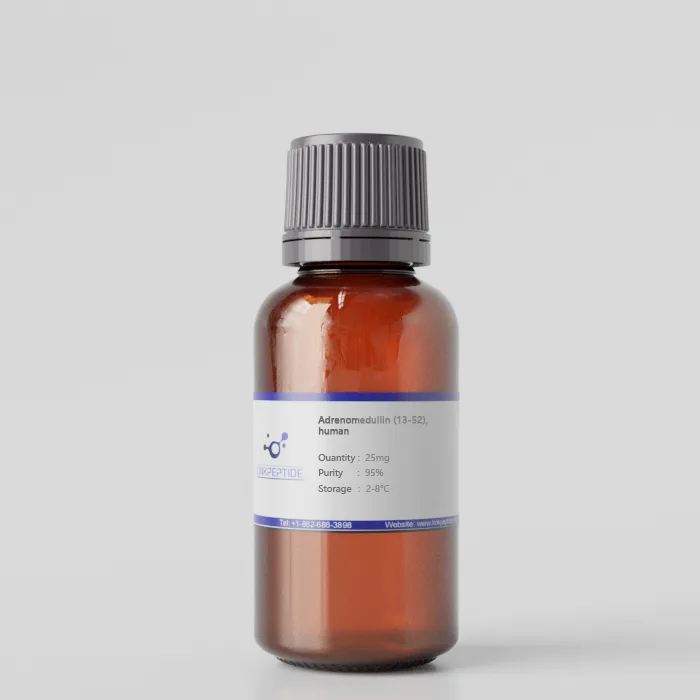
Product Name:Adrenomedullin (13-52), human
Form:free base
Purity:95%
Storage:2-8 degree Celsius
Molar Mass:4533.1
Chemical Formula:C200H308N58O59S2
Sequence:Ser-Phe-Gly-Cys-Arg-Phe-Gly-Thr-Cys-Thr-Val-Gln-Lys-Leu-Ala-His-Gln-Ile-Tyr-Gln-Phe-Thr-Asp-Lys-Asp-Lys-Asp-Asn-Val-Ala-Pro-Arg-Ser-Lys-Ile-Ser-Pro-Gln-Gly-Tyr-NH2
Application:Adrenomedullin (13-52), human is a bioactive peptide fragment derived from adrenomedullin (ADM), spanning amino acids 13-52. This fragment retains critical functional domains responsible for vasodilation, immune modulation, and metabolic regulation. Research indicates that ADM (13-52) plays a key role in cardiovascular homeostasis, endothelial function, and inflammatory response regulation. It is widely used in hypertension, heart failure, and sepsis research, with potential applications in vascular protection, immune system modulation, and metabolic disease models. Due to its ability to interact with ADM receptors, ADM (13-52) is a significant research tool for peptide-based therapeutics and biomarker development.
Current Research:
Introduction
Adrenomedullin (13-52), human, is a biologically active fragment of adrenomedullin (ADM), a peptide hormone involved in vascular regulation, immune response, and metabolic balance. The 13-52 sequence retains functional regions essential for binding to calcitonin receptor-like receptor (CLR) and receptor activity-modifying proteins (RAMPs), which mediate ADM’s effects. This fragment is extensively studied in cardiovascular, immunological, and metabolic research, particularly in hypertension, heart failure, and inflammation-related conditions.
Cardiovascular and Vasodilatory Research
ADM and its derivatives, including ADM (13-52), play a key role in blood pressure regulation and vascular function. Studies suggest that ADM (13-52):
Activates nitric oxide (NO) pathways, leading to vasodilation and improved endothelial function.
Regulates vascular permeability, helping to control capillary leakage and inflammation.
Protects against ischemic damage, reducing the risk of heart failure and stroke.
Given its vasoprotective properties, ADM (13-52) is a potential therapeutic target for hypertension, ischemia, and endothelial dysfunction research.
Immunomodulatory and Anti-Inflammatory Effects
ADM is a known immune modulator, and studies on ADM (13-52) suggest:
Inhibition of pro-inflammatory cytokines (e.g., TNF-α, IL-6, IL-1β), reducing inflammatory responses in sepsis and autoimmune diseases.
Regulation of macrophage and neutrophil activity, influencing infection response and wound healing.
Protection against endothelial inflammation, making it relevant in chronic inflammatory conditions such as atherosclerosis.
Due to these properties, ADM (13-52) is a promising candidate in sepsis, inflammatory disease, and immune response research.
Metabolic and Endocrine Research
ADM plays a role in glucose and lipid metabolism, and studies on ADM (13-52) indicate:
Potential regulation of insulin secretion, suggesting relevance in diabetes and metabolic disorder models.
Influence on stress hormone signaling, impacting adrenal function and energy balance.
Lipid metabolism modulation, making it a candidate for obesity and cardiovascular risk management research.
These findings highlight ADM (13-52) as a target for endocrine and metabolic disease therapies.
Potential Research and Therapeutic Applications
Due to its vasodilatory, immune-regulating, and metabolic-stabilizing effects, ADM (13-52), human, is being explored for:
Cardiovascular disease models, particularly in hypertension and endothelial dysfunction studies.
Sepsis and immune-related inflammatory studies, targeting cytokine dysregulation.
Metabolic disorder research, including insulin regulation, glucose homeostasis, and lipid metabolism.
Conclusion
Adrenomedullin (13-52), human, is a bioactive peptide fragment involved in vascular regulation, immune function, and metabolic stability. Its vasodilatory, anti-inflammatory, and metabolic properties make it a valuable tool in cardiovascular, immunology, and endocrine research. Ongoing studies continue to explore its therapeutic potential in blood pressure regulation, sepsis management, and metabolic disorders, with promising applications in biomarker discovery and peptide-based drug development.
Get a Quote
 LinkPeptide