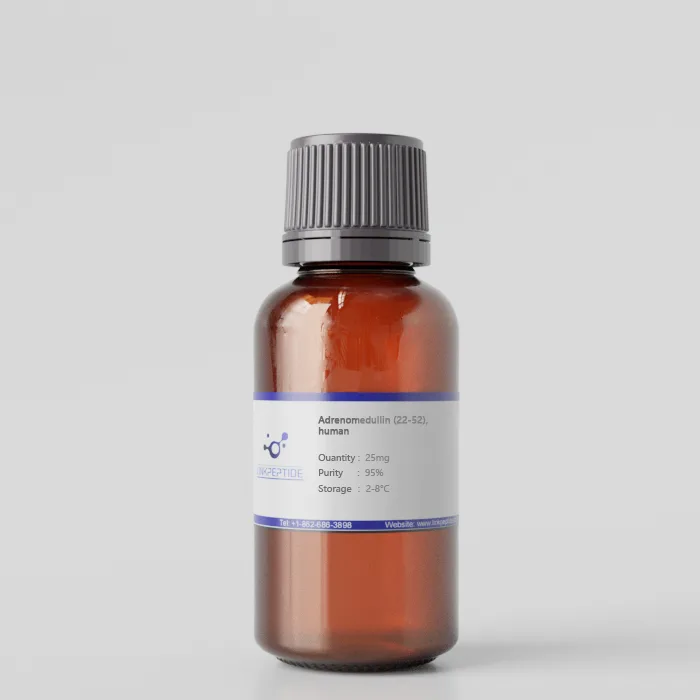
Product Name:Adrenomedullin (22-52), human
Form:TFA salt
Purity:95%
Storage:2-8 degree Celsius
Molar Mass:3718.1
Chemical Formula:C163H257F3N46O50
Sequence:Thr-Val-Gln-Lys-Leu-Ala-His-Gln-Ile-Tyr-Gln-Phe-Thr-Asp-Lys-Asp-Lys-Asp-Asn-Val-Ala-Pro-Arg-Ser-Lys-Ile-Ser-Pro-Gln-Gly-Tyr-NH2
Application:Adrenomedullin (22-52), human is a bioactive peptide fragment derived from adrenomedullin (ADM), comprising amino acids 22-52. This fragment is a functional antagonist of full-length adrenomedullin, modulating its vasodilatory, cardiovascular, and immune-regulating properties. Research suggests that ADM (22-52) competitively inhibits ADM receptors, affecting vascular tone, blood pressure regulation, and inflammatory responses. It is widely used in cardiovascular, renal, and immune studies, with potential applications in hypertension, sepsis, heart failure, and endothelial dysfunction models. Due to its ability to modulate ADM pathways, ADM (22-52) is a critical research tool for peptide-based therapeutic development.
Current Research:
Introduction
Adrenomedullin (22-52), human, is a truncated antagonist fragment of the vasodilatory peptide adrenomedullin (ADM). ADM plays a key role in cardiovascular homeostasis, immune modulation, and metabolic balance, and ADM (22-52) functions as a competitive inhibitor, blocking ADM’s ability to activate calcitonin receptor-like receptor (CLR) and receptor activity-modifying proteins (RAMPs). This peptide is a valuable tool for studying ADM receptor function, cardiovascular regulation, and inflammatory response modulation.
Cardiovascular and Vasodilatory Research
As an ADM antagonist, ADM (22-52) is widely studied for its effects on vascular tone and blood pressure regulation. Research findings indicate that it:
Inhibits ADM-induced vasodilation, leading to increased vascular resistance and blood pressure modulation.
Competes with full-length ADM for CLR/RAMP binding, making it useful in studies of hypertension and heart failure.
Modulates endothelial function, affecting vascular integrity and capillary permeability in conditions such as sepsis and ischemic injury.
By blocking ADM’s hypotensive effects, ADM (22-52) provides insights into ADM receptor-targeted therapies for cardiovascular diseases.
Renal and Fluid Balance Research
ADM is a key regulator of fluid balance and renal function, and ADM (22-52) is being investigated in kidney-related disorders. Research suggests that ADM (22-52):
Reduces ADM-mediated natriuresis and diuresis, affecting renal sodium handling and blood pressure regulation.
Alters renal vasodilation, which may influence chronic kidney disease (CKD) and acute kidney injury (AKI) models.
Modulates renin-angiotensin-aldosterone system (RAAS) activity, making it relevant in hypertension research.
These properties make ADM (22-52) an important research tool for renal function and hypertension studies.
Immunomodulatory and Anti-Inflammatory Effects
ADM plays a role in immune function and inflammation control, and ADM (22-52) has been studied as a modulator of immune response. Research highlights include:
Inhibition of ADM’s anti-inflammatory effects, leading to enhanced cytokine production (e.g., TNF-α, IL-6, IL-1β).
Potential exacerbation of immune responses, making it useful in sepsis and inflammatory disease models.
Influence on macrophage and neutrophil activity, impacting studies on immune-mediated disorders.
These findings suggest that ADM (22-52) is a key peptide in inflammation research, particularly for immune disorders and infection response studies.
Potential Research and Therapeutic Applications
Due to its antagonistic effects on ADM signaling, ADM (22-52), human, is being explored for:
Hypertension and cardiovascular disease models, particularly in ADM-receptor signaling regulation.
Renal function studies, including its role in fluid homeostasis and kidney disease.
Sepsis and immune research, targeting inflammation and ADM’s immunosuppressive effects.
Conclusion
Adrenomedullin (22-52), human, is a functional ADM antagonist that modulates vascular tone, immune response, and renal function. Its ability to inhibit ADM receptor activation makes it a valuable research tool in cardiovascular, immunological, and renal studies. Ongoing research continues to explore its therapeutic potential in hypertension, heart failure, inflammatory diseases, and kidney disorders, providing insights into ADM-based peptide therapeutics.
Get a Quote
 LinkPeptide

![[Pyr1]-Apelin-13](https://www.linkpeptide.com/wp-content/uploads/2024/10/Pyr1-Apelin-13-jpg-3.webp "[Pyr1]-Apelin-13")