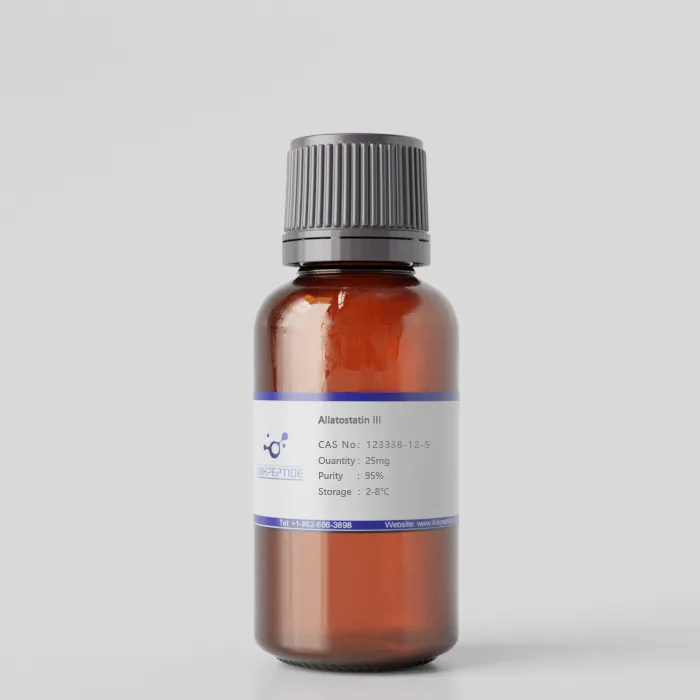
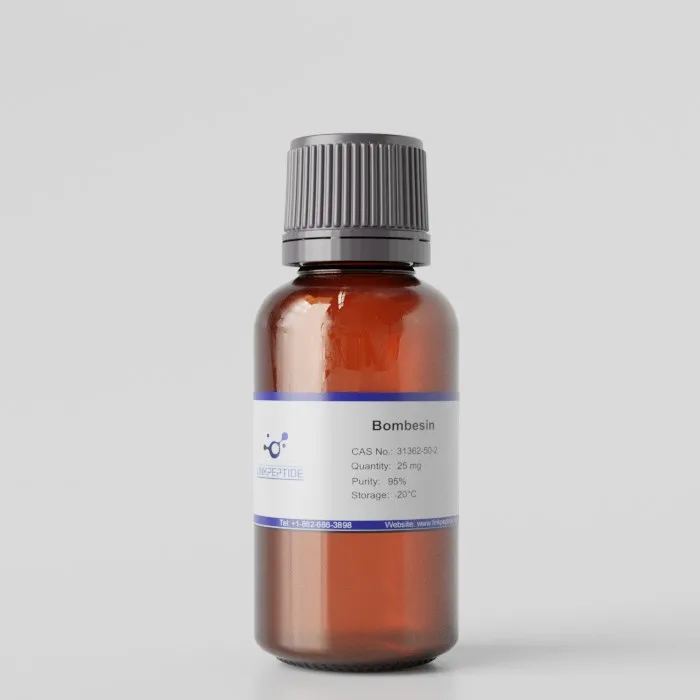
Product Name:Allatostatin III
Form:TFA salt
Purity:95%
Storage:2-8 degree Celsius
Cas No:123338-12-5
Molar Mass:899
Chemical Formula:C42H62N10O12
IUPAC Name:(2S)-2-[[2-[[(2S)-2-[[(2S)-2-[[(2S)-2-[[(2S)-2-[[(2S)-2-[[2-[(2-aminoacetyl)amino]acetyl]amino]-3-hydroxypropanoyl]amino]-4-methylpentanoyl]amino]-3-(4-hydroxyphenyl)propanoyl]amino]-3-hydroxypropanoyl]amino]-3-phenylpropanoyl]amino]acetyl]amino]-4-methylpentanamide
SMILES:CC(C)C[C@@H](C(=O)N)NC(=O)CNC(=O)[C@H](CC1=CC=CC=C1)NC(=O)[C@H](CO)NC(=O)[C@H](CC2=CC=C(C=C2)O)NC(=O)[C@H](CC(C)C)NC(=O)[C@H](CO)NC(=O)CNC(=O)CN
InChIKey:FQELVQXEBBNBAC-FSJACQRISA-N
InChI:InChI=1S/C42H62N10O12/c1-23(2)14-28(37(44)59)47-36(58)20-46-38(60)30(16-25-8-6-5-7-9-25)50-42(64)33(22-54)52-40(62)31(17-26-10-12-27(55)13-11-26)51-39(61)29(15-24(3)4)49-41(63)32(21-53)48-35(57)19-45-34(56)18-43/h5-13,23-24,28-33,53-55H,14-22,43H2,1-4H3,(H2,44,59)(H,45,56)(H,46,60)(H,47,58)(H,48,57)(H,49,63)(H,50,64)(H,51,61)(H,52,62)/t28-,29-,30-,31-,32-,33-/m0/s1
Sequence:Gly-Gly-Ser-Leu-Tyr-Ser-Phe-Gly-Leu-NH2
Application:Allatostatin III is a neuropeptide hormone found in insects, primarily involved in the inhibition of juvenile hormone (JH) synthesis, which regulates growth, metamorphosis, and reproduction. It belongs to the allatostatin (AST) family, which modulates neuroendocrine signaling, digestive activity, and muscle contractions. By suppressing JH production in the corpora allata, Allatostatin III plays a key role in insect development, molting, and reproductive processes. Research on Allatostatin III focuses on insect endocrinology, metabolic regulation, and pest control applications, making it a valuable tool for hormonal manipulation studies and environmentally friendly insect population control strategies.
Current Research:Allatostatin III is an essential neuropeptide involved in juvenile hormone (JH) regulation, feeding behavior, and digestive control in insects. As a member of the allatostatin family, it functions as a potent inhibitor of JH biosynthesis, influencing insect growth, development, and reproduction. Due to its role in hormonal regulation, Allatostatin III is extensively studied in insect endocrinology, pest control research, and metabolic signaling. 1. Role in Juvenile Hormone Regulation and Development Allatostatin III acts on the corpora allata, the endocrine gland responsible for juvenile hormone (JH) production, leading to: Suppression of JH synthesis, accelerating metamorphosis and reducing larval stages. Altered reproductive functions, as JH is critical for ovarian development in many insects. Disruptions in molting cycles, affecting normal insect growth and survival. Studies suggest that by manipulating Allatostatin III levels, researchers can modulate insect development, making it a target for hormonal pest control strategies. 2. Influence on Feeding and Digestive Processes Allatostatin III is also known to regulate gut motility and digestive enzyme activity, with effects including: Inhibition of peristalsis, slowing food movement through the gut. Modulation of digestive enzyme secretion, impacting nutrient absorption. Regulation of feeding behavior, linking neuropeptide signaling to metabolic control. These findings suggest that Allatostatin III plays a broader role in insect physiology beyond JH inhibition, affecting nutritional and energy homeostasis. 3. Applications in Pest Control and Insecticide Development Due to its ability to disrupt JH synthesis and feeding behaviors, Allatostatin III is being explored as a potential target for biological pest control. Synthetic allatostatin analogs are being tested to block insect reproduction and development. Genetic engineering approaches aim to disrupt allatostatin signaling in pest species. By selectively interfering with insect hormonal pathways, these strategies provide a sustainable, non-toxic alternative to chemical pesticides. 4. Comparative Neuroendocrinology and Evolutionary Research Allatostatins share similarities with vertebrate neuropeptides, such as somatostatin and galanin, leading to research on: Evolutionary conservation of neuropeptide signaling across species. Potential applications in metabolic and appetite regulation beyond insects. Conclusion Allatostatin III is a key neuropeptide regulating juvenile hormone synthesis, feeding behavior, and gut motility in insects. Its potential applications in pest control, endocrinology, and metabolic research continue to drive scientific interest, offering novel strategies for insect population management and comparative neuropeptide studies.
Get a Quote
 LinkPeptide