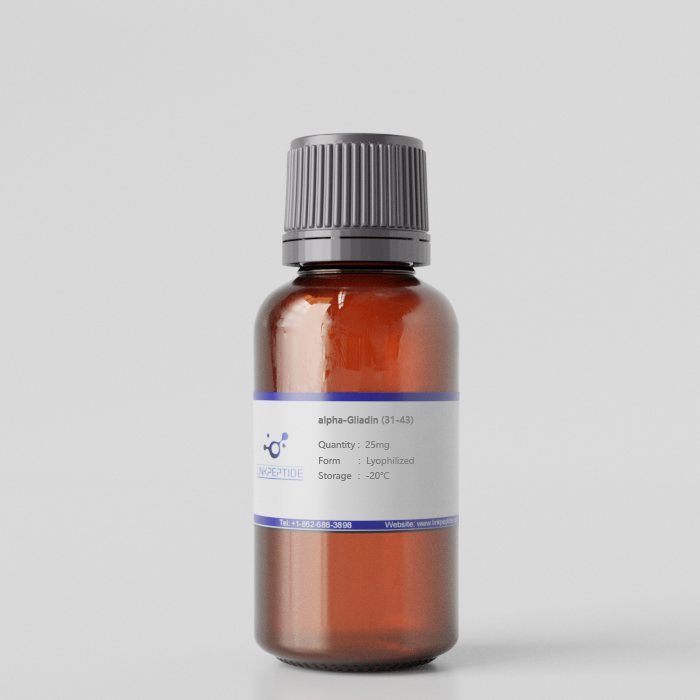
Product Name: alpha-Gliadin (31-43)
Sequence One Letter Code: LGQQQPFPPQQPY
Sequence Three Letter Code: H-Leu-Gly-Gln-Gln-Gln-Pro-Phe-Pro-Pro-Gln-Gln-Pro-Tyr-OH
Chemical Formula:C71H102N18O20
Molecular Weight: 1527.8
Purity: 95%
Form: Lyophilized
Storage Conditions: - 20 °C
Research Area: Inflammation and Immunology Research
Source / Species: wheat
Conjugation: Unconjugated
Code Nacres: NA.26
Application: Alpha-Gliadin (31–43) is a synthetic peptide corresponding to residues 31–43 of the wheat gliadin protein and is widely studied in the context of gluten-related immune responses. This peptide fragment is known to trigger innate immune activation by promoting the expression of inflammatory mediators such as interleukin-15 (IL-15) and cyclooxygenase-2 (COX-2). It can also stimulate CD25 expression on monocytes and macrophages, induce CD83 expression on dendritic cells, and activate the p38 MAP kinase signaling pathway. Exposure to alpha-Gliadin (31–43) has been shown to enhance the activity of immunodominant gliadin epitopes, leading to T-cell activation and enterocyte apoptosis. Because of these properties, this peptide is commonly used to investigate mechanisms of intestinal inflammation, gluten sensitivity, and immune dysregulation associated with celiac disease.
Current Research: Celiac disease and other gluten-related disorders are characterized by abnormal immune responses to dietary gluten proteins found in wheat, barley, and rye. Among these proteins, gliadins—a component of gluten—contain several peptide fragments capable of triggering inflammatory and immune signaling in the intestinal mucosa. Synthetic peptides derived from gliadin sequences are widely used in research to understand how gluten interacts with the immune system. Alpha-Gliadin (31–43) is a synthetic peptide corresponding to residues 31–43 of the wheat gliadin protein. This fragment has attracted significant attention because it can activate innate immune responses and influence intestinal epithelial signaling pathways associated with gluten sensitivity. As a result, it has become a widely used experimental tool in studies of intestinal inflammation, immune activation, and the molecular mechanisms underlying celiac disease. Gliadin and Gluten-Related Immune Responses Gluten is a complex mixture of storage proteins found in wheat, consisting mainly of gliadins and glutenins. Gliadins are particularly important in the context of celiac disease because they contain peptide sequences that resist gastrointestinal digestion and can interact with the immune system. In individuals with celiac disease, ingestion of gluten triggers a pathological immune response in the small intestine. This response leads to chronic inflammation, damage to the intestinal epithelium, and villous atrophy. The disease involves both adaptive immune responses, mediated by gluten-specific T cells, and innate immune activation, which contributes to early inflammatory signaling in intestinal tissues. Several gliadin-derived peptides have been identified as key drivers of these processes. Among them, alpha-Gliadin (31–43) is notable for its ability to stimulate innate immune pathways independent of classical antigen presentation mechanisms. Biological Activity of Alpha-Gliadin (31–43) The 31–43 region of alpha-gliadin has been shown to influence multiple cellular pathways associated with inflammation and immune regulation. Experimental studies demonstrate that exposure to this peptide can trigger the production of pro-inflammatory mediators within intestinal cells and immune populations. One of the key effects of this peptide is the upregulation of inflammatory signaling molecules, including: Interleukin-15 (IL-15), a cytokine that plays a major role in activating immune responses in the intestinal epithelium Cyclooxygenase-2 (COX-2), an enzyme involved in inflammatory prostaglandin production These molecules contribute to the inflammatory environment observed in celiac disease and other gluten-related conditions. The peptide can also stimulate CD25 expression on monocytes and macrophages, indicating activation of immune signaling pathways. In addition, it has been reported to induce CD83 expression on dendritic cells, suggesting involvement in antigen-presenting cell activation and immune regulation. Activation of Intracellular Signaling Pathways Beyond its influence on cytokine production, alpha-Gliadin (31–43) has been shown to activate intracellular signaling cascades that regulate inflammatory responses. One of the major pathways involved is the p38 MAP kinase signaling pathway, which plays a key role in cellular responses to stress and inflammatory stimuli. Activation of p38 MAPK can lead to changes in gene expression that promote immune activation and inflammatory mediator production. In intestinal epithelial cells, this signaling activity contributes to alterations in cellular behavior and may influence barrier integrity, immune signaling, and cell survival. Interaction with Adaptive Immune Responses Although alpha-Gliadin (31–43) primarily stimulates innate immune pathways, its activity can also influence the broader immune response to gluten. Studies suggest that exposure to this peptide can enhance the activity of immunodominant gliadin epitopes, increasing their capacity to stimulate gluten-specific T cells. These T cells play a central role in the adaptive immune component of celiac disease by producing cytokines that drive intestinal inflammation. In addition, the peptide has been associated with enterocyte apoptosis, a process that contributes to intestinal tissue damage and the loss of epithelial integrity observed in celiac disease. Through these combined effects, alpha-Gliadin (31–43) contributes to the inflammatory cascade that characterizes gluten-induced intestinal pathology. Applications in Celiac Disease and Immunology Research Because of its ability to activate multiple inflammatory pathways, Alpha-Gliadin (31–43) is widely used as a research tool in studies of gluten-related immune responses. Synthetic versions of this peptide allow investigators to analyze specific cellular and molecular mechanisms involved in intestinal inflammation. Common research applications include: Studies of innate immune activation Researchers use the peptide to investigate how gliadin fragments stimulate cytokine production and inflammatory signaling in intestinal epithelial cells and immune cells. Investigation of IL-15 signaling Because IL-15 plays a major role in celiac disease pathogenesis, the peptide is often used to examine regulatory pathways controlling this cytokine. Analysis of dendritic cell and macrophage activation The peptide can help characterize how antigen-presenting cells respond to gluten-derived signals. Research on epithelial stress and apoptosis Experimental models using the peptide allow scientists to examine how gluten-derived fragments influence epithelial cell survival and barrier function. Studies of gluten sensitivity and intestinal inflammation The peptide is frequently used in cellular and animal models designed to replicate aspects of gluten-induced intestinal immune responses. Advancing Research on Gluten-Related Disorders Understanding how specific gliadin peptides trigger immune activation is critical for uncovering the molecular basis of celiac disease and other gluten-associated conditions. Synthetic peptides provide a controlled experimental system for analyzing these mechanisms without the complexity of whole gluten proteins. The Alpha-Gliadin (31–43) peptide represents one of the most widely studied fragments involved in innate immune activation within the intestinal mucosa. Through its ability to stimulate inflammatory signaling pathways, activate immune cells, and influence epithelial responses, this peptide serves as an important model for investigating the early stages of gluten-induced intestinal inflammation. As research continues to explore the interplay between dietary proteins and immune regulation, tools such as alpha-Gliadin (31–43) remain essential for advancing our understanding of celiac disease pathogenesis, intestinal immune signaling, and gluten-related immune dysregulation.
Get a Quote
 LinkPeptide