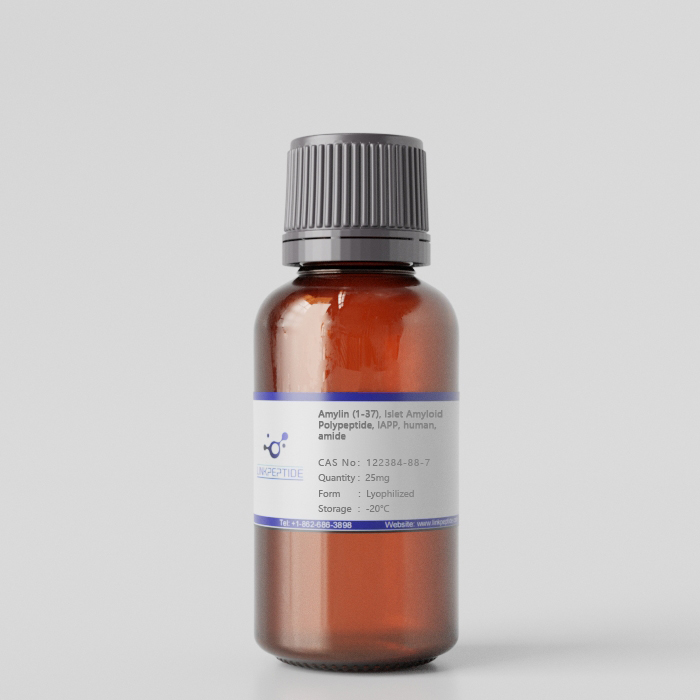
Product Name: Amylin (1-37), Islet Amyloid Polypeptide, IAPP, human, amide
Sequence One Letter Code: KCNTATCATQRLANFLVHSSNNFGAILSSTNVGSNTY-NH2 (Disulfide bridge: 2-7)
Sequence Three Letter Code: H-Lys-Cys-Asn-Thr-Ala-Thr-Cys-Ala-Thr-Gln-Arg-Leu-Ala-Asn-Phe-Leu-Val-His-Ser-Ser-Asn-Asn-Phe-Gly-Ala-Ile-Leu-Ser-Ser-Thr-Asn-Val-Gly-Ser-Asn-Thr-Tyr-NH2 (Disulfide bridge: 2-7)
Cas No: 122384-88-7
Chemical Formula:C165H261N51O55S2
Molecular Weight: 3903.5
Purity: 95%
Form: Lyophilized
Storage Conditions: - 20 °C
Research Area: Diabetes and Metabolic Syndrome
SMILES: CC[C@H](C)[C@@H](C(=O)N[C@@H](CC(C)C)C(=O)N[C@@H](CO)C(=O)N[C@@H](CO)C(=O)N[C@@H]([C@@H](C)O)C(=O)N[C@@H](CC(=O)N)C(=O)N[C@@H](C(C)C)C(=O)NCC(=O)N[C@@H](CO)C(=O)N[C@@H](CC(=O)N)C(=O)N[C@@H]([C@@H](C)O)C(=O)N[C@@H](CC1=CC=C(C=C1)O)C(=O)N)NC(=O)[C@H](C)NC(=O)CNC(=O)[C@H](CC2=CC=CC=C2)NC(=O)[C@H](CC(=O)N)NC(=O)[C@H](CC(=O)N)NC(=O)[C@H](CO)NC(=O)[C@H](CO)NC(=O)[C@H](CC3=CN=CN3)NC(=O)[C@H](C(C)C)NC(=O)[C@H](CC(C)C)NC(=O)[C@H](CC4=CC=CC=C4)NC(=O)[C@H](CC(=O)N)NC(=O)[C@H](C)NC(=O)[C@H](CC(C)C)NC(=O)[C@H](CCCNC(=N)N)NC(=O)[C@H](CCC(=O)N)NC(=O)[C@H]([C@@H](C)O)NC(=O)[C@H](C)NC(=O)[C@@H]5CSSC[C@@H](C(=O)N[C@H](C(=O)N[C@H](C(=O)N[C@H](C(=O)N[C@H](C(=O)N5)[C@@H](C)O)C)[C@@H](C)O)CC(=O)N)NC(=O)[C@H](CCCCN)N
IUPAC: (2S)-N-[(2S)-1-[[(2S)-1-[[(2S)-1-[[(2S)-4-amino-1-[[(2S)-1-[[(2S)-1-[[(2S)-1-[[(2S)-1-[[(2S)-1-[[(2S)-1-[[(2S)-4-amino-1-[[(2S)-4-amino-1-[[(2S)-1-[[2-[[(2S)-1-[[(2S,3S)-1-[[(2S)-1-[[(2S)-1-[[(2S)-1-[[(2S,3R)-1-[[(2S)-4-amino-1-[[(2S)-1-[[2-[[(2S)-1-[[(2S)-4-amino-1-[[(2S,3R)-1-[[(2S)-1-amino-3-(4-hydroxyphenyl)-1-oxopropan-2-yl]amino]-3-hydroxy-1-oxobutan-2-yl]amino]-1,4-dioxobutan-2-yl]amino]-3-hydroxy-1-oxopropan-2-yl]amino]-2-oxoethyl]amino]-3-methyl-1-oxobutan-2-yl]amino]-1,4-dioxobutan-2-yl]amino]-3-hydroxy-1-oxobutan-2-yl]amino]-3-hydroxy-1-oxopropan-2-yl]amino]-3-hydroxy-1-oxopropan-2-yl]amino]-4-methyl-1-oxopentan-2-yl]amino]-3-methyl-1-oxopentan-2-yl]amino]-1-oxopropan-2-yl]amino]-2-oxoethyl]amino]-1-oxo-3-phenylpropan-2-yl]amino]-1,4-dioxobutan-2-yl]amino]-1,4-dioxobutan-2-yl]amino]-3-hydroxy-1-oxopropan-2-yl]amino]-3-hydroxy-1-oxopropan-2-yl]amino]-3-(1H-imidazol-5-yl)-1-oxopropan-2-yl]amino]-3-methyl-1-oxobutan-2-yl]amino]-4-methyl-1-oxopentan-2-yl]amino]-1-oxo-3-phenylpropan-2-yl]amino]-1,4-dioxobutan-2-yl]amino]-1-oxopropan-2-yl]amino]-4-methyl-1-oxopentan-2-yl]amino]-5-carbamimidamido-1-oxopentan-2-yl]-2-[[(2S,3R)-2-[[(2S)-2-[[(4R,7S,10S,13S,16S,19R)-16-(2-amino-2-oxoethyl)-19-[[(2S)-2,6-diaminohexanoyl]amino]-7,13-bis[(1R)-1-hydroxyethyl]-10-methyl-6,9,12,15,18-pentaoxo-1,2-dithia-5,8,11,14,17-pentazacycloicosane-4-carbonyl]amino]propanoyl]amino]-3-hydroxybutanoyl]amino]pentanediamide
INCHIKEY: PLOPBXQQPZYQFA-AXPWDRQUSA-N
INCHI:
InChI=1S/C165H261N51O55S2/c1-22-75(12)124(159(266)200-95(47-71(4)5)140(247)203-108(64-219)153(260)206-110(66-221)154(261)216-129(84(21)226)163(270)202-105(58-119(174)234)147(254)209-122(73(8)9)157(264)181-61-121(236)187-106(62-217)150(257)198-103(56-117(172)232)148(255)215-128(83(20)225)162(269)190-93(130(175)237)49-87-38-40-89(227)41-39-87)211-132(239)76(13)183-120(235)60-180-136(243)97(50-85-32-25-23-26-33-85)194-144(251)101(54-115(170)230)196-145(252)102(55-116(171)231)197-151(258)107(63-218)205-152(259)109(65-220)204-142(249)99(52-88-59-178-69-182-88)201-158(265)123(74(10)11)210-146(253)96(48-72(6)7)193-141(248)98(51-86-34-27-24-28-35-86)195-143(250)100(53-114(169)229)191-131(238)77(14)184-139(246)94(46-70(2)3)192-137(244)91(37-31-45-179-165(176)177)188-138(245)92(42-43-113(168)228)189-161(268)126(81(18)223)212-133(240)78(15)185-155(262)111-67-272-273-68-112(207-135(242)90(167)36-29-30-44-166)156(263)199-104(57-118(173)233)149(256)214-125(80(17)222)160(267)186-79(16)134(241)213-127(82(19)224)164(271)208-111/h23-28,32-35,38-41,59,69-84,90-112,122-129,217-227H,22,29-31,36-37,42-58,60-68,166-167H2,1-21H3,(H2,168,228)(H2,169,229)(H2,170,230)(H2,171,231)(H2,172,232)(H2,173,233)(H2,174,234)(H2,175,237)(H,178,182)(H,180,243)(H,181,264)(H,183,235)(H,184,246)(H,185,262)(H,186,267)(H,187,236)(H,188,245)(H,189,268)(H,190,269)(H,191,238)(H,192,244)(H,193,248)(H,194,251)(H,195,250)(H,196,252)(H,197,258)(H,198,257)(H,199,263)(H,200,266)(H,201,265)(H,202,270)(H,203,247)(H,204,249)(H,205,259)(H,206,260)(H,207,242)(H,208,271)(H,209,254)(H,210,253)(H,211,239)(H,212,240)(H,213,241)(H,214,256)(H,215,255)(H,216,261)(H4,176,177,179)/t75-,76-,77-,78-,79-,80+,81+,82+,83+,84+,90-,91-,92-,93-,94-,95-,96-,97-,98-,99-,100-,101-,102-,103-,104-,105-,106-,107-,108-,109-,110-,111-,112-,122-,123-,124-,125-,126-,127-,128-,129-/m0/s1
Source / Species: human
Conjugation: Unconjugated
Code Nacres: NA.26
Application: Amylin (1–37), also known as islet amyloid polypeptide (IAPP), is a 37-amino acid peptide hormone co-secreted with insulin by pancreatic β cells. It plays a critical physiological role in postprandial glucose regulation by slowing gastric emptying, suppressing glucagon secretion, and promoting satiety. Through these coordinated actions, amylin complements insulin in maintaining glycemic control. In humans, however, amylin exhibits a strong tendency to aggregate, forming amyloid fibrils that accumulate within pancreatic islets in individuals with type 2 diabetes mellitus. These deposits are closely associated with β-cell dysfunction and progressive loss of insulin secretion. Amylin (1–37) is widely used in metabolic and endocrine research to investigate β-cell physiology, peptide aggregation mechanisms, and amyloid cytotoxicity. It also serves as a model system for studying structure–aggregation relationships and therapeutic strategies aimed at preventing islet amyloid formation and preserving pancreatic function in diabetes progression studies.
Current Research: Amylin (1–37), also referred to as islet amyloid polypeptide (IAPP), remains a central focus of contemporary metabolic and diabetes research due to its dual physiological and pathological significance. This 37-amino acid peptide hormone is co-secreted with insulin by pancreatic β cells in response to nutrient intake. Under normal conditions, amylin acts as a complementary regulator of postprandial glucose homeostasis. It slows gastric emptying, suppresses inappropriate glucagon release, and promotes satiety, thereby reducing the rate of glucose influx into circulation and preventing excessive glycemic excursions. Together with insulin, amylin forms a coordinated endocrine axis that fine-tunes metabolic balance following meals. In current research, amylin is increasingly recognized not only as a metabolic hormone but also as a key contributor to β-cell pathology in type 2 diabetes mellitus (T2DM). Human amylin has an intrinsic propensity to misfold and aggregate, forming oligomers and eventually amyloid fibrils. These aggregates accumulate within pancreatic islets and are considered a hallmark pathological feature of T2DM. Growing evidence suggests that soluble oligomeric intermediates, rather than mature fibrils alone, exert cytotoxic effects on β cells by disrupting membrane integrity, inducing oxidative stress, impairing mitochondrial function, and activating pro-apoptotic signaling pathways. Mechanistic studies of amylin aggregation remain an active area of investigation. Structural analyses have identified specific regions within the peptide—particularly residues 20–29—as critical determinants of amyloidogenicity. Subtle sequence variations between species strongly influence aggregation behavior, which explains why human amylin forms amyloid deposits while rodent amylin does not. This structure–aggregation relationship has made Amylin (1–37) a valuable model system for studying peptide misfolding disorders more broadly, including parallels with amyloid-β in Alzheimer’s disease and other protein aggregation pathologies. Advanced biophysical techniques such as circular dichroism spectroscopy, nuclear magnetic resonance, cryo-electron microscopy, and fluorescence-based aggregation assays are frequently employed to characterize conformational transitions of Amylin (1–37). Researchers monitor the conversion from random coil or α-helical intermediates to β-sheet–rich fibrillar structures, providing insight into nucleation kinetics and fibril elongation mechanisms. These studies inform the development of aggregation inhibitors and molecular chaperone strategies aimed at stabilizing non-toxic conformations. In parallel, cellular and in vitro models are widely used to evaluate the cytotoxic effects of amylin aggregates. Cultured β-cell lines and isolated islets exposed to aggregated Amylin (1–37) exhibit impaired insulin secretion, elevated endoplasmic reticulum stress markers, and activation of inflammatory pathways. Such systems enable detailed dissection of signaling cascades involved in β-cell dysfunction and allow screening of small molecules, peptides, or antibodies that mitigate amyloid-induced toxicity. Therapeutic development efforts have also drawn inspiration from amylin biology. The clinical use of pramlintide, a non-amyloidogenic amylin analog, demonstrates that preserving amylin’s physiological benefits while eliminating aggregation risk is feasible. Current research extends this concept by exploring sequence modifications, backbone stabilization strategies, and aggregation-resistant variants to better understand how structural alterations influence both receptor activity and fibril formation. Beyond pancreatic pathology, emerging studies are examining amylin’s systemic roles, including potential effects on central appetite regulation and interactions with other metabolic hormones. There is increasing interest in how chronic metabolic stress, hyperglycemia, and lipid overload may accelerate amylin aggregation, linking environmental and genetic risk factors to disease progression. Overall, Amylin (1–37) continues to serve as an indispensable research tool for investigating β-cell physiology, peptide aggregation mechanisms, and amyloid-associated cytotoxicity. Its well-defined sequence and reproducible aggregation behavior provide a robust platform for exploring structure–function relationships and evaluating therapeutic strategies aimed at preventing islet amyloid formation. As understanding of metabolic disease pathogenesis deepens, Amylin (1–37) remains central to efforts focused on preserving pancreatic function and improving outcomes in type 2 diabetes.
Get a Quote
 LinkPeptide