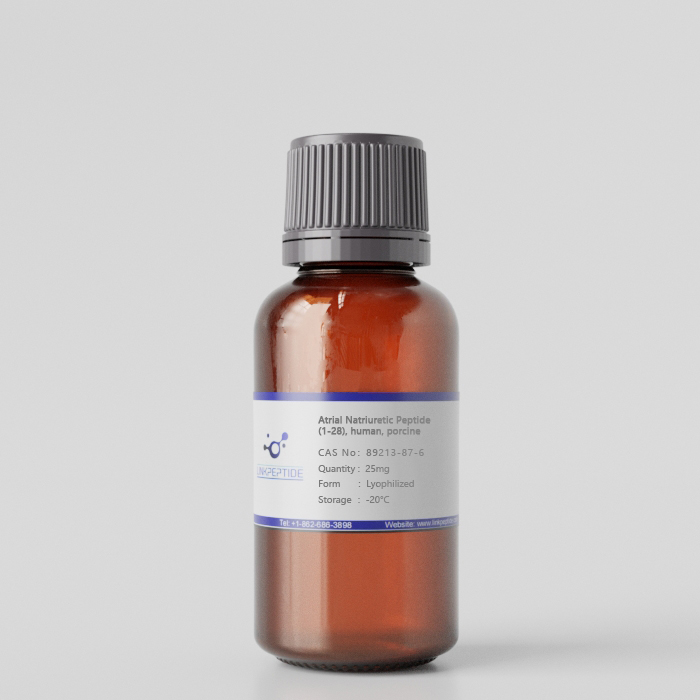
Product Name: Atrial Natriuretic Peptide (1-28), human, porcine
Sequence One Letter Code: SLRRSSCFGGRMDRIGAQSGLGCNSFRY (Disulfide bridge: 7-23)
Sequence Three Letter Code: H-Ser-Leu-Arg-Arg-Ser-Ser-Cys-Phe-Gly-Gly-Arg-Met-Asp-Arg-Ile-Gly-Ala-Gln-Ser-Gly-Leu-Gly-Cys-Asn-Ser-Phe-Arg-Tyr-OH (Disulfide bridge: 7-23)
Cas No: 89213-87-6
Chemical Formula:C127H203N45O39S3
Molecular Weight: 3080.6
Purity: 95%
Form: Lyophilized
Storage Conditions: - 20 °C
Research Area: Cardiovascular Disease Research
SMILES: CC[C@H](C)[C@H]1C(=O)NCC(=O)N[C@H](C(=O)N[C@H](C(=O)N[C@H](C(=O)NCC(=O)N[C@H](C(=O)NCC(=O)N[C@@H](CSSC[C@@H](C(=O)N[C@H](C(=O)NCC(=O)NCC(=O)N[C@H](C(=O)N[C@H](C(=O)N[C@H](C(=O)N[C@H](C(=O)N1)CCCNC(=N)N)CC(=O)O)CCSC)CCCNC(=N)N)CC2=CC=CC=C2)NC(=O)[C@H](CO)NC(=O)[C@H](CO)NC(=O)[C@H](CCCNC(=N)N)NC(=O)[C@H](CCCNC(=N)N)NC(=O)[C@H](CC(C)C)NC(=O)[C@H](CO)N)C(=O)N[C@@H](CC(=O)N)C(=O)N[C@@H](CO)C(=O)N[C@@H](CC3=CC=CC=C3)C(=O)N[C@@H](CCCNC(=N)N)C(=O)N[C@@H](CC4=CC=C(C=C4)O)C(=O)O)CC(C)C)CO)CCC(=O)N)C
IUPAC: (2S)-2-[[(2S)-2-[[(2S)-2-[[(2S)-2-[[(2S)-4-amino-2-[[(4R,10S,16S,19S,22S,28S,31S,34S,37S,40S,49S,52R)-52-[[(2S)-2-[[(2S)-2-[[(2S)-2-[[(2S)-2-[[(2S)-2-[[(2S)-2-amino-3-hydroxypropanoyl]amino]-4-methylpentanoyl]amino]-5-carbamimidamidopentanoyl]amino]-5-carbamimidamidopentanoyl]amino]-3-hydroxypropanoyl]amino]-3-hydroxypropanoyl]amino]-19-(3-amino-3-oxopropyl)-49-benzyl-28-[(2S)-butan-2-yl]-31,40-bis(3-carbamimidamidopropyl)-34-(carboxymethyl)-16-(hydroxymethyl)-22-methyl-10-(2-methylpropyl)-37-(2-methylsulfanylethyl)-6,9,12,15,18,21,24,27,30,33,36,39,42,45,48,51-hexadecaoxo-1,2-dithia-5,8,11,14,17,20,23,26,29,32,35,38,41,44,47,50-hexadecazacyclotripentacontane-4-carbonyl]amino]-4-oxobutanoyl]amino]-3-hydroxypropanoyl]amino]-3-phenylpropanoyl]amino]-5-carbamimidamidopentanoyl]amino]-3-(4-hydroxyphenyl)propanoic acid
INCHIKEY: NSQLIUXCMFBZME-MPVJKSABSA-N
INCHI:
InChI=1S/C127H203N45O39S3/c1-9-64(6)99-121(209)150-52-94(182)151-65(7)100(188)155-76(34-35-91(129)179)109(197)167-85(56-174)104(192)149-53-96(184)153-78(43-62(2)3)102(190)148-54-97(185)154-89(119(207)164-82(48-92(130)180)114(202)169-86(57-175)116(204)163-81(46-67-23-14-11-15-24-67)113(201)158-73(27-18-39-143-125(135)136)107(195)166-84(122(210)211)47-68-30-32-69(178)33-31-68)60-213-214-61-90(171-118(206)88(59-177)170-117(205)87(58-176)168-108(196)74(28-19-40-144-126(137)138)156-106(194)72(26-17-38-142-124(133)134)157-112(200)79(44-63(4)5)161-101(189)70(128)55-173)120(208)162-80(45-66-21-12-10-13-22-66)103(191)147-50-93(181)146-51-95(183)152-71(25-16-37-141-123(131)132)105(193)160-77(36-42-212-8)110(198)165-83(49-98(186)187)115(203)159-75(111(199)172-99)29-20-41-145-127(139)140/h10-15,21-24,30-33,62-65,70-90,99,173-178H,9,16-20,25-29,34-61,128H2,1-8H3,(H2,129,179)(H2,130,180)(H,146,181)(H,147,191)(H,148,190)(H,149,192)(H,150,209)(H,151,182)(H,152,183)(H,153,184)(H,154,185)(H,155,188)(H,156,194)(H,157,200)(H,158,201)(H,159,203)(H,160,193)(H,161,189)(H,162,208)(H,163,204)(H,164,207)(H,165,198)(H,166,195)(H,167,197)(H,168,196)(H,169,202)(H,170,205)(H,171,206)(H,172,199)(H,186,187)(H,210,211)(H4,131,132,141)(H4,133,134,142)(H4,135,136,143)(H4,137,138,144)(H4,139,140,145)/t64-,65-,70-,71-,72-,73-,74-,75-,76-,77-,78-,79-,80-,81-,82-,83-,84-,85-,86-,87-,88-,89-,90-,99-/m0/s1
Source / Species: Human, Porcine
Conjugation: Unconjugated
Code Nacres: NA.26
Application: Atrial Natriuretic Peptide (ANP) (1–28) is a biologically active 28-amino-acid peptide hormone derived from prepro-ANP through enzymatic processing and corin-mediated cleavage. It features a characteristic 17-amino-acid ring structure formed by a disulfide bond between Cys7 and Cys23, which is essential for its biological activity. Synthesized and secreted by cardiac myocytes, ANP plays a key role in cardiovascular homeostasis by promoting vasodilation, natriuresis, and diuresis. These effects contribute to the regulation of blood pressure and fluid balance via activation of the natriuretic peptide receptor A (NPR-A). ANP (1–28) is widely used in cardiovascular and renal research to study hormone signaling, vascular function, and fluid regulation mechanisms.
Current Research: Atrial Natriuretic Peptide (ANP) (1–28) is a biologically active 28-amino-acid peptide hormone derived from the precursor prepro-ANP through proteolytic processing and corin-mediated cleavage. It is primarily synthesized and secreted by cardiac atrial myocytes in response to increased blood volume or atrial stretch. ANP plays a central role in maintaining cardiovascular homeostasis, particularly in the regulation of blood pressure, sodium balance, and extracellular fluid volume. Structural Features and Biological Activity A defining feature of ANP (1–28) is its 17-amino-acid ring structure, formed by a disulfide bond between Cys7 and Cys23. This cyclic structure is essential for its biological activity, as it enables proper interaction with its receptor and maintains structural stability. The intact ring motif is critical for: High-affinity binding to natriuretic peptide receptors Activation of downstream signaling pathways Preservation of peptide conformation required for function Disruption of this disulfide bond significantly reduces or abolishes ANP activity, underscoring its importance in receptor recognition. Mechanism of Action via NPR-A ANP exerts its physiological effects primarily through binding to natriuretic peptide receptor A (NPR-A), a membrane-bound receptor with intrinsic guanylyl cyclase activity. Upon ligand binding, NPR-A catalyzes the conversion of GTP to cyclic GMP (cGMP), a second messenger that mediates downstream effects. This signaling cascade leads to: Relaxation of vascular smooth muscle (vasodilation) Increased renal sodium excretion (natriuresis) Enhanced urine production (diuresis) Inhibition of renin and aldosterone secretion Through these coordinated actions, ANP reduces blood volume and arterial pressure, counteracting systems such as the renin–angiotensin–aldosterone system (RAAS). Role in Cardiovascular and Renal Physiology ANP is a key hormone in the regulation of fluid and electrolyte balance. Its release is triggered by physiological conditions such as: Increased atrial pressure or stretch Volume overload Elevated blood pressure Once released, ANP acts on multiple target organs: Kidneys: Promotes sodium and water excretion Blood vessels: Induces vasodilation Endocrine system: Suppresses RAAS activity These effects help maintain hemodynamic stability and prevent excessive fluid retention. Applications in Cardiovascular and Renal Research ANP (1–28) is widely used as a model peptide in studies of cardiovascular physiology, renal function, and hormone signaling. Its well-characterized activity and receptor specificity make it an essential tool in experimental research. Common applications include: Studies of vascular tone and endothelial function Investigation of renal sodium handling and diuretic mechanisms Analysis of cGMP-mediated signaling pathways Evaluation of interactions between ANP and RAAS components Pharmacological studies targeting natriuretic peptide pathways These applications contribute to a deeper understanding of how the body regulates blood pressure and fluid balance. Relevance to Cardiovascular Disease Dysregulation of ANP signaling is associated with various cardiovascular conditions, including: Hypertension Heart failure Fluid retention disorders In heart failure, elevated ANP levels often reflect a compensatory response to increased cardiac stress and volume overload. Studying ANP (1–28) helps elucidate the mechanisms underlying these conditions and supports the development of therapies targeting natriuretic peptide pathways. A Fundamental Tool for Studying Fluid and Pressure Regulation Atrial Natriuretic Peptide (ANP) (1–28) represents the active hormonal form responsible for mediating natriuretic peptide signaling. Its defined structure, receptor specificity, and physiological relevance make it a cornerstone reagent in studies of cardiovascular regulation, renal physiology, and endocrine signaling. By enabling detailed investigation of vasodilation, natriuresis, and fluid homeostasis, ANP (1–28) continues to support advances in understanding the molecular and physiological mechanisms that maintain cardiovascular balance and systemic homeostasis.
Get a Quote
 LinkPeptide