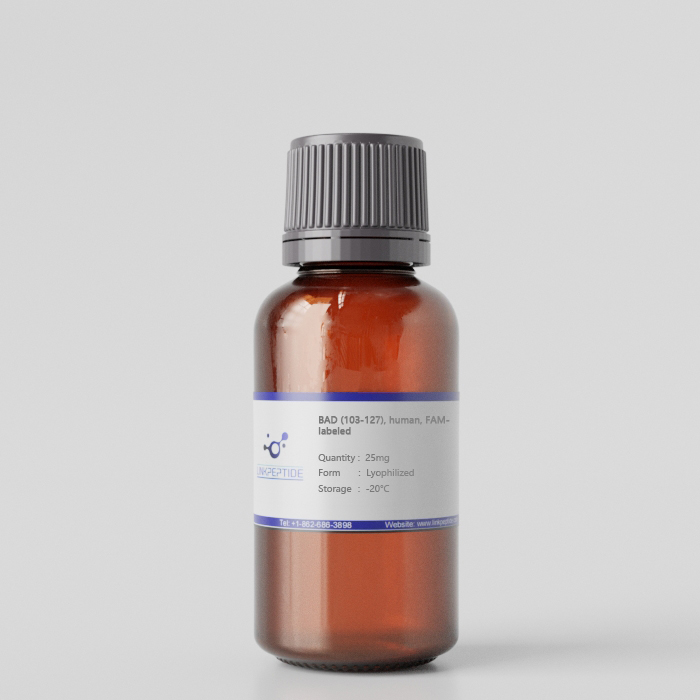
Product Name: BAD (103-127), human, FAM-labeled
Sequence One Letter Code: FAM-NLWAAQRYGRELRRMSDEFVDSFKK
Sequence Three Letter Code: FAM-Asn-Leu-Trp-Ala-Ala-Gln-Arg-Tyr-Gly-Arg-Glu-Leu-Arg-Arg-Met-Ser-Asp-Glu-Phe-Val-Asp-Ser-Phe-Lys-Lys-OH
Chemical Formula:C158H222N42O45S
Molecular Weight: 3462
Purity: 95%
Form: Lyophilized
Storage Conditions: - 20 °C Protected from light
Research Area: Cancer Disease Research
Source / Species: human
Conjugation: Conjugated
Conjugation Type: Fluorescent dyes
Code Nacres: NA.26
Application: BAD (103–127), human, FAM-labeled is a synthetic peptide corresponding to the BH3 domain of the pro-apoptotic protein BAD, a key regulator of mitochondrial apoptosis. This region mediates interactions with anti-apoptotic BCL-2 family members, thereby promoting apoptotic signaling through the intrinsic pathway. Conjugation with fluorescein (FAM; excitation/emission 494/521 nm) enables direct visualization and quantitative detection in biochemical and cell-based assays. The peptide is widely applied in apoptosis and oncology research to analyze BCL-2 family protein interactions, evaluate BH3 mimetic activity, and monitor mitochondrial apoptotic signaling.
Current Research: BAD (103–127), human, FAM-labeled is a synthetic peptide corresponding to the BH3 domain of the pro-apoptotic BCL-2 family protein BAD (BCL-2-associated death promoter). This sequence encompasses the functional interaction motif responsible for binding anti-apoptotic proteins such as BCL-2, BCL-xL, and BCL-w, thereby promoting activation of the intrinsic (mitochondrial) apoptotic pathway. Covalent conjugation with fluorescein (FAM) provides excitation/emission maxima of approximately 494/521 nm, enabling direct fluorescence-based detection in biochemical and cell-based assays. The labeled peptide serves as a versatile probe for analyzing BCL-2 family protein interactions and apoptotic signaling dynamics. Biological Context BAD is a BH3-only protein that functions as a sensitizer within the BCL-2 family network. Under pro-survival conditions, BAD is sequestered through phosphorylation-dependent interactions. Upon dephosphorylation, its BH3 domain engages anti-apoptotic BCL-2 proteins, displacing pro-apoptotic effectors such as BAX and BAK. This displacement promotes mitochondrial outer membrane permeabilization (MOMP), cytochrome c release, caspase activation, and apoptotic execution. The 103–127 region contains the core BH3 α-helical motif, which is both necessary and sufficient for high-affinity interaction with anti-apoptotic BCL-2 members. Synthetic peptides derived from this region are widely used to dissect molecular determinants of mitochondrial apoptosis. Functional Applications 1. Fluorescence Polarization (FP) and Binding Assays FAM labeling allows BAD (103–127) to function as a tracer peptide in fluorescence polarization assays, where binding to recombinant BCL-2 or BCL-xL increases polarization signal. This format is commonly used to: Quantify binding affinities Screen BH3 mimetic compounds Characterize competitive displacement kinetics 2. BH3 Profiling and Mitochondrial Sensitivity Testing BH3 domain peptides are employed in mitochondrial priming assays to assess apoptotic sensitivity. BAD BH3 peptides selectively target anti-apoptotic proteins such as BCL-2 and BCL-xL, enabling functional evaluation of mitochondrial dependence in cancer cells. 3. Drug Discovery and BH3 Mimetic Evaluation In oncology research, BAD-derived peptides provide a reference tool for evaluating small-molecule inhibitors targeting anti-apoptotic BCL-2 family proteins. Competitive displacement of the FAM-labeled peptide indicates compound potency and target engagement. 4. Cell-Based Imaging and Uptake Studies The FAM conjugate facilitates visualization of peptide localization and uptake using fluorescence microscopy or flow cytometry. These studies can assess intracellular distribution, mitochondrial association, and real-time apoptotic responses. Advantages of FAM Labeling Direct fluorescence detection without secondary reagents Compatibility with standard FITC filter sets Quantitative application in plate-based assays Suitable for kinetic and high-throughput screening formats Experimental Considerations Fluorescent labeling may slightly alter binding kinetics compared with unlabeled peptides; appropriate controls are recommended when conducting affinity measurements. For fluorescence-based assays, buffer composition, ionic strength, and protein concentration should be optimized to ensure accurate signal detection and minimize background fluorescence.
Get a Quote
 LinkPeptide