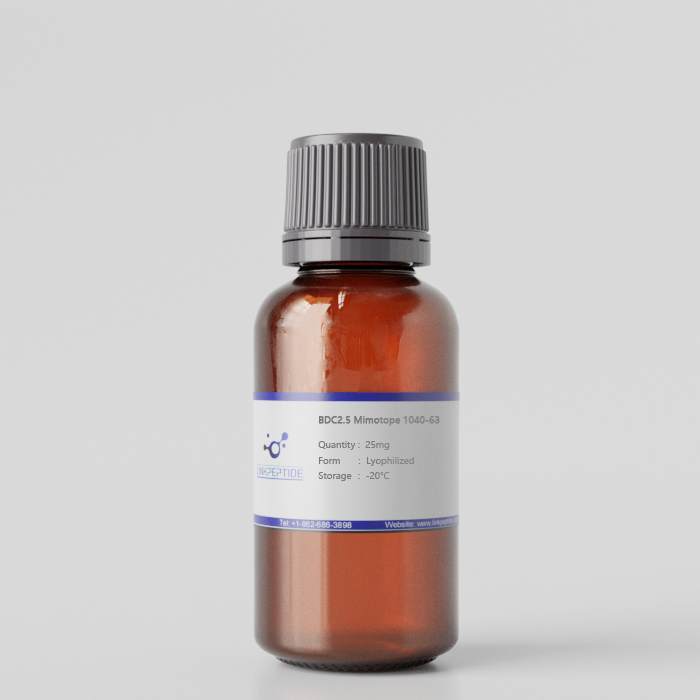
Product Name: BDC2.5 Mimotope 1040-63
Sequence One Letter Code: RTRPLWVRME
Sequence Three Letter Code: H-Arg-Thr-Arg-Pro-Leu-Trp-Val-Arg-Met-Glu-OH
Chemical Formula:C59H98N20O14S
Molecular Weight: 1343.7
Purity: 95%
Form: Lyophilized
Storage Conditions: - 20 °C
Research Area: Diabetes and Metabolic Syndrome
Source / Species: mouse
Conjugation: Unconjugated
Code Nacres: NA.26
Application: BDC2.5 Mimotope 1040-63 is a synthetic peptide used in the BDC2.5 T cell receptor transgenic model of type 1 diabetes. This model enables detailed study of autoreactive CD4⁺ T cell responses against pancreatic β cell antigens. The mimotope efficiently activates BDC2.5 T cells through antigen presentation, facilitating investigation of T cell proliferation, cytokine production, and immune tolerance mechanisms. It is widely applied in studies of autoimmune diabetes pathogenesis, antigen-specific T cell regulation, and therapeutic strategies aimed at restoring immune tolerance in type 1 diabetes.
Current Research: Type 1 diabetes (T1D) is an autoimmune disorder characterized by T cell–mediated destruction of insulin-producing pancreatic β cells. CD4⁺ T lymphocytes play a central role in orchestrating the inflammatory cascade that culminates in islet infiltration and β cell loss. The BDC2.5 T cell receptor (TCR) transgenic mouse model has become a cornerstone system for dissecting autoreactive CD4⁺ T cell responses in T1D. BDC2.5 T cells recognize a β cell–associated antigen presented by MHC class II molecules (I-A^g7), enabling antigen-specific investigation of autoimmune mechanisms. BDC2.5 Mimotope 1040-63 is a synthetic peptide ligand designed to efficiently stimulate BDC2.5 T cells, providing a reproducible and well-defined antigenic stimulus. The original BDC2.5 TCR was identified from a diabetogenic CD4⁺ T cell clone isolated from non-obese diabetic (NOD) mice. While the precise endogenous antigen was initially unclear, mimotope peptides were developed to reproduce high-affinity TCR engagement. Mimotope 1040-63 binds to I-A^g7 and effectively activates BDC2.5 T cells, eliciting robust proliferation and cytokine production. This defined peptide ligand overcomes variability associated with natural antigen processing and enables precise control of T cell activation in vitro and in vivo. In cellular assays, BDC2.5 Mimotope 1040-63 is commonly used to stimulate splenocytes, lymph node cells, or purified CD4⁺ T cells from transgenic mice. Antigen presentation by dendritic cells or other antigen-presenting cells (APCs) triggers TCR signaling, leading to clonal expansion and differentiation. Measurement of proliferation, typically via thymidine incorporation or flow cytometric tracking dyes, provides quantitative assessment of antigen responsiveness. Concurrent evaluation of cytokines such as IFN-γ, IL-2, IL-17, and IL-10 allows characterization of T helper subset polarization and functional phenotype. The peptide is particularly valuable for studying mechanisms of immune tolerance. In the BDC2.5 model, autoreactive T cells can be driven toward pathogenic effector states or regulatory phenotypes depending on the immunological context. Administration of Mimotope 1040-63 under tolerogenic conditions—such as low-dose exposure, mucosal delivery, or presentation by tolerogenic dendritic cells—facilitates investigation of peripheral tolerance induction. Researchers use this approach to examine anergy, deletion, and regulatory T cell (Treg) differentiation as strategies to restrain autoimmune progression. In vivo, adoptive transfer of BDC2.5 T cells into immunodeficient or NOD recipient mice, followed by peptide stimulation, enables controlled modeling of autoimmune diabetes onset. The mimotope allows temporal coordination of T cell activation, supporting studies of islet infiltration, β cell stress responses, and cytokine-driven inflammation. Because the antigenic stimulus is precisely defined, investigators can correlate TCR engagement strength with disease severity and immune regulation outcomes. BDC2.5 Mimotope 1040-63 is also instrumental in evaluating therapeutic interventions aimed at restoring immune tolerance in T1D. Approaches such as peptide-based immunotherapy, nanoparticle-coupled antigen delivery, and checkpoint modulation are frequently tested using this model. The defined antigen specificity permits direct monitoring of autoreactive T cell frequency, activation markers, and cytokine profiles following treatment. Such antigen-focused strategies provide mechanistic insight into how targeted immunomodulation may prevent or delay β cell destruction. Additionally, the peptide supports structural and biophysical studies of TCR–peptide–MHC interactions. Analysis of binding affinity and TCR signaling thresholds contributes to understanding how autoreactive T cells escape central tolerance and become pathogenic. In summary, BDC2.5 Mimotope 1040-63 is a synthetic peptide ligand that efficiently activates autoreactive CD4⁺ T cells in the BDC2.5 transgenic model of type 1 diabetes. By enabling controlled stimulation of antigen-specific T cells, it supports mechanistic investigation of autoimmune pathogenesis, immune regulation, and tolerance-based therapeutic strategies. Its continued application advances understanding of T cell–mediated β cell destruction and informs development of targeted interventions for autoimmune diabetes.
Get a Quote
 LinkPeptide